New order follows suspended program
Announced on October 29, the Direction Générale de l'Armement (DGA) contract covers RP30NG tugs for naval bases in mainland France and overseas territories. Piriou will build the four firm vessels at Concarneau in Brittany.
The order succeeds the RP30/RPC30 program launched in April 2020, which called for 20 harbor and coastal tugs. That program was suspended in early 2024 after cost increases associated with the COVID-19 pandemic and the war in Ukraine made its terms economically unviable. Piriou subsequently won the replacement tender.
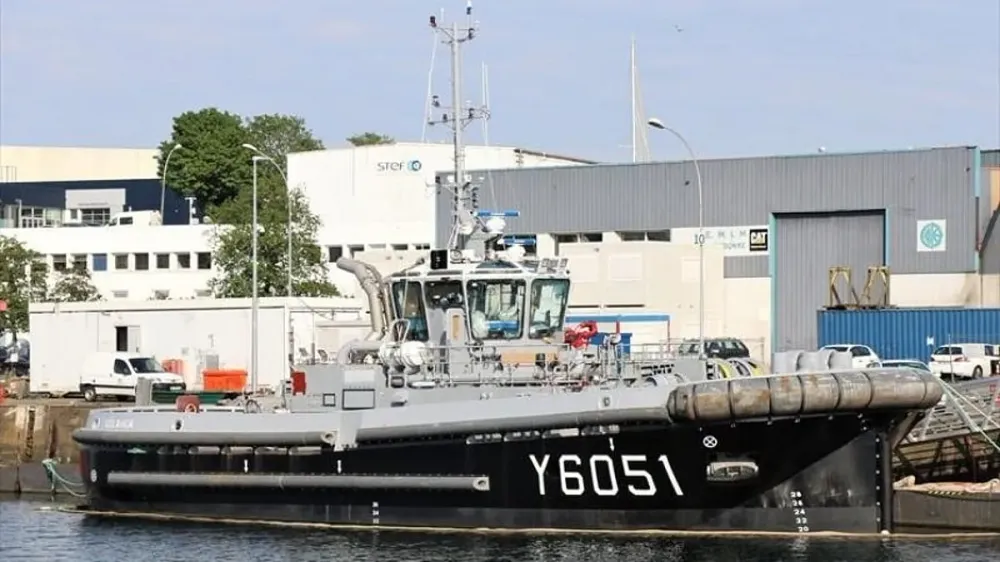
Only the original program's first firm batch of four vessels was completed. Céladon and Azur went to Toulon, while Brest received Zinzolin and Turquin; all four entered service in 2023.
Submarine handling and offshore duties
The DGA says the RP30NG design adapts a tug from Piriou's civilian range for maneuvering nuclear submarines. The agency credits that approach with enabling series production and shorter delivery times.
Alongside moving ballistic-missile submarines, attack submarines and first-rank surface warships, the vessels will undertake firefighting and pollution response. Their duties also extend to surveillance of exclusive economic zones and support for fisheries inspections.
Each vessel will measure 26 meters long and 9.2 meters wide, with a full-load displacement of 370 metric tons. A crew of six will be able to operate the tug for several days as far as 200 nautical miles offshore.
Propulsion will pair two engines rated at approximately 1,100 kW each with two stern-mounted azimuth thrusters. The specified bollard pull is 30 metric tons and maximum speed is 11 knots. Two generator sets, each rated at about 160 kWe, will supply electrical power.
Mer et Marine notes that the new design is wider and heavier than the earlier Céladon class, which has the same 26-meter length but an 8.4-meter beam. The older vessels displace 350 metric tons fully loaded and 285 metric tons light.
Although the Céladon class was also announced with a 30-metric-ton bollard pull, its actual figure is 35 metric tons, according to Mer et Marine. Those tugs use two 1,044 kW Baudouin diesel engines, two Schottel azimuth thrusters and a 350 kW bow thruster, and can reach 12.5 knots.
Fleet replacements at home and overseas
The RP30NG vessels are intended to succeed several generations of Navy tugs. Mer et Marine identifies the RCVS-type Buffle, Bison and Bélier, decommissioned between 2023 and 2024, as well as the 16 Fréhel-class RP12/RPC12 vessels commissioned between 1989 and 2003. Fourteen of the Fréhel-class tugs are scheduled to leave service between 2028 and 2031.
Overseas replacements include Maito (1984) at Fort-de-France and Maroa (1984) and Manini (1985) at Papeete. Mer et Marine expects two of the first four RP30NG vessels to go to the French Antilles and French Polynesia to address the urgent need to replace aging tugs there. It expects the other two to join mainland bases and continue the Fréhel-class replacement.
Those expectations are distinct from the basing plan for the earlier 20-vessel program, which allocated eight tugs to Toulon, seven to Brest, three to Cherbourg and one each to Fort-de-France and Papeete.
Shipyard workload and delivery outlook
Piriou president Vincent Faujour said: "Piriou is the last French builder of tugs with more than 30 tonnes of bollard pull." The company employs about 1,500 people across 11 locations in Europe, Africa and Asia. At Concarneau, it is also continuing work on the French Navy's offshore patrol vessel (PH) program.
The first RP30NG tugs are due at naval bases from 2028, but delivery dates for vessels after the first have not been specified. Mer et Marine estimates that Piriou could build four annually, matching the previous program's pace. Its analysis suggests the first four could therefore be completed in 2028 and, if the full order proceeds as envisaged, all 16 could potentially be delivered before 2032. These are potential timelines, not an announced delivery schedule.