Ancient roots and railway expansion
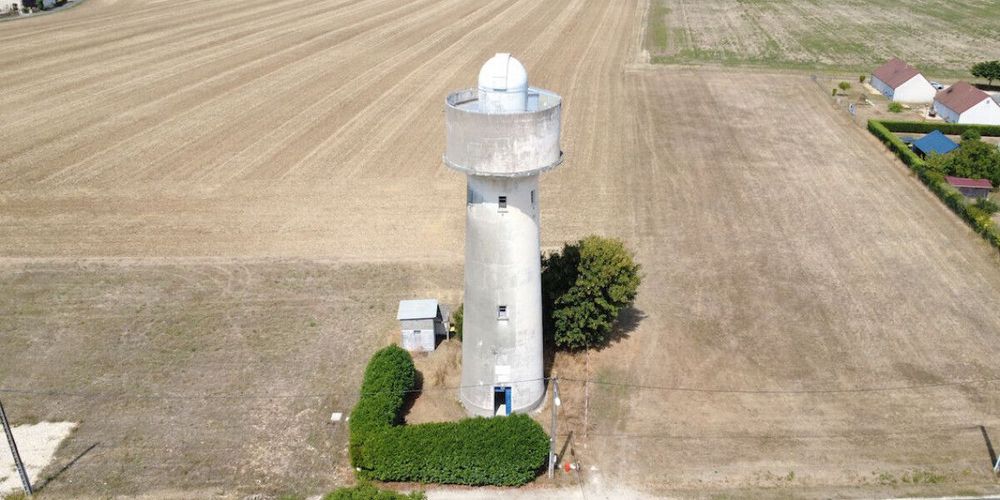
Across France, water towers are emerging from decades of invisibility. These imposing cylindrical structures, numbering approximately 16,000 nationwide, are being reconsidered not merely as obsolete infrastructure but as significant industrial heritage worthy of protection and preservation.
Eudes Ajot, president of Les Châteaux d'eau de France, an association dedicated to promoting water tower recognition, recalls his own awakening to their presence. In the mid-2000s, as an art student driving secondary roads between Chartres and Blois, he initially sought to purchase an antenna for conversion into a residence. When that proved impossible, his attention turned to water towers.
By 2008, Ajot had joined a newly formed association focused on documenting these structures. Today, the organization has catalogued 13,500 of France's estimated 16,000 water towers, working to shift public perception from viewing them as eyesores to recognizing their heritage value.
Ancient roots and railway expansion
The French term château d'eau derives from the Roman castellum divisorium, a distribution basin positioned at aqueduct terminals where water was channeled through lead or terracotta pipes to customers. France uniquely preserved this Latin root, distinguishing its terminology from other nations that opted for more literal translations.
Water towers proliferated dramatically during the 19th century, their expansion closely tied to railway development. Steam locomotives demanded substantial water supplies, prompting stations to construct dedicated towers. The rail network's mid-19th century advent revolutionized transport infrastructure, and water towers became essential components at stations across the country.
The 20th century brought new impetus for water tower construction, driven by hygienist movements influenced by scientific advances. Following Pasteur's breakthroughs in the late 19th century, water quality standards evolved, leading to the separation of drinking and non-drinking water networks. In 1930, only 23 percent of French communes had running water, and by 1945, 70 percent of rural communes still lacked mains supply. From the 1950s onwards, a massive infrastructure modernization program drove water tower construction nationwide.
By 1980, virtually every French commune had achieved running water provision at home, often memorialized in street names. The rue du Château-d'Eau in Paris's 10th arrondissement stands as the most famous example.
Regional character and architectural significance
Water towers reflect distinct regional influences and engineering traditions. Towers in Colmar and Metz display Germanic engineering characteristics, while southern French examples typically feature concrete construction covered with brick.
A little-known fact highlights their architectural significance: Le Corbusier's first work was a water tower in Podensac, completed in 1917 under his birth name Charles-Édouard Jeanneret. This structure was listed as a Monument Historique in 2006, with major restoration planned for completion in 2026 to open the building to the public.
Another notable early example, the Luçon water tower in Vendée, was commissioned by Prime Minister Georges Clemenceau in 1914 and received historic monument designation in 1992, recognized for its original architecture and pioneering use of reinforced concrete.
From the 1980s, buried reservoirs with pressure-boosting systems rendered traditional elevated towers obsolete. These discreet technical alternatives pushed older structures toward abandonment and demolition.
Heritage protection expands
Despite their industrial heritage status, many mayors have historically favored demolition. Recent examples include towers in La Ferté-Fresnel and La Bruffière. However, attitudes are gradually shifting.
The association advocates for formal heritage listings under three designation systems: Monument historique, Patrimoine remarquable du XXe siècle, and Patrimoine d'Intérêt régional d'Ile-de-France. Monument Historique classification, reserved for nationally significant structures by the French Ministry of Culture, represents the highest level of protection. Lesser monuments may receive regional inscription. France currently protects over 45,000 historic monuments, adding approximately 300 buildings and 1,500 movable objects to protection annually.
Currently, 46 water towers hold protected status on the association's website, with 25 designated as Monuments historiques.
Creative conversions breathe new life
Several mayors have embraced alternative uses for abandoned water towers. Toulouse-based architects Yannick Imberty and Séverine Frances transformed a tower abandoned since 1984 into a four-story, 300-square-meter home featuring a 360-degree rooftop terrace. The project required extensive deconstruction, removing the original interior including the protective concrete dome, before rebuilding with new floors, doors and windows within the 20-meter cylinder. A family purchased the completed residence for €143,000.
Other conversions have followed. Plasterer Michael Buton purchased the abandoned Daon water tower in 2017, investing €300,000 over two years to convert it into a gîte. Additional projects include a tourist office in Brive-la-Gaillarde, a panoramic restaurant in Palavas-les-Flots, and a crêperie in Ploudalmézeau.
Ajot emphasizes a pragmatic approach: while not opposing demolition when necessary, the association prioritizes offering viable second lives for these structures when possible.
Artists including Paule Adeline and Boris Voyret have embraced water towers as subjects. As the association notes, architects transformed these utilities from hidden infrastructure into bold skyline landmarks through technical advancement and design ambition.
Ajot himself achieved his long-sought scenic view six years ago by purchasing a water tower in Paimpol, where he currently oversees renovation work in preparation for retirement.