Northern cities surge ahead
Corsica remained the clear outlier in the national picture, with the northern half of the island recording an exceptional 18.3% price increase, nearly 10 percentage points above any other location. The strongest mainland growth occurred predominantly in northern and eastern cities.
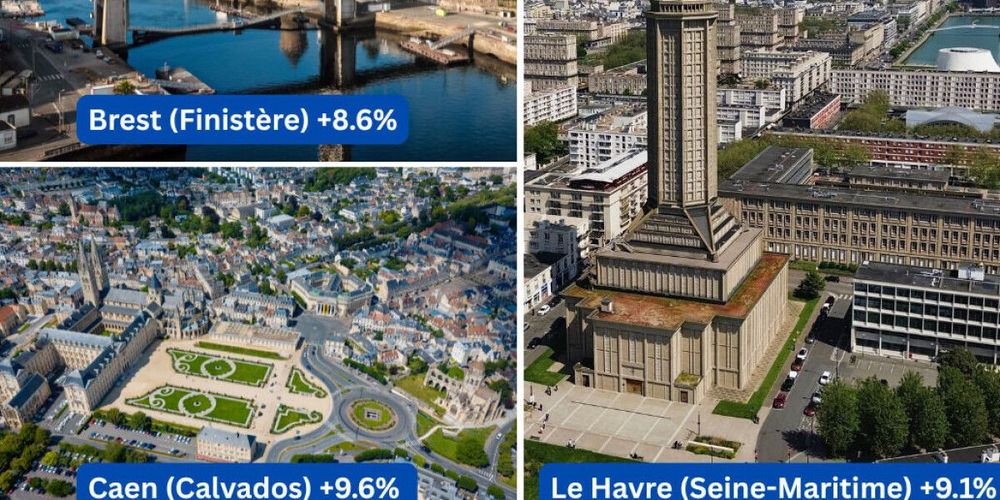
Caen in Calvados led mainland cities with a 9.6% increase, followed closely by Le Havre in Seine-Maritime at 9.1% and Brest in Finistère at 8.6%. Metz in Moselle saw prices rise 6.9%, while Reims in Marne recorded a 4.8% gain.
The price increases in northern cities occurred despite recent demographic headwinds, with census data showing population declines in cities like Reims (down 0.44% between 2017-2022) and Le Havre (down 0.34% in the same period). This counterintuitive trend suggests affordability relative to larger cities may be driving demand from buyers seeking value.
Major cities see modest declines
Only a handful of cities experienced price decreases during the period, though Dijon in Côte d'Or stood out with a sharp 5.6% drop. Other declines included Poitiers in Vienne (down 4.3%), Bordeaux in Gironde (down 2.4%), and Chartres in Eure-et-Loir (down 2.3%).
Most major metropolitan areas showed relative stability. Lyon in Rhône edged down 0.4%, while Nantes in Loire-Atlantique decreased 0.3%. Meanwhile, Marseille and Aix-en-Provence in Bouches-du-Rhône gained 1.9%, and Toulouse in Haute-Garonne rose 2.4%. Paris and the broader Île-de-France region recorded a marginal 0.4% decline.
Market recovery without overheating
The data, drawn from the DVF (Demande de Valeurs Foncières) — France's mandatory government register of every property transaction recorded by a notaire — covers year-on-year changes between the first quarters of 2025 and 2026, providing the most complete picture of the 2025 calendar year.
Transaction volumes tell an important part of the story. After dropping sharply in 2022 and reaching a low point in 2024, existing-home sales rebounded to approximately 925,000-945,000 units by the end of 2025, representing an 11% year-on-year increase. However, this remains about 25% below the 2021 peak, indicating recovery without market overheating.
Mortgage rates have also stabilized, settling into a 3.0-3.5% range for 20-year fixed terms by mid-2026, down from peaks above 4% in 2023-2024. As of July 2026, average rates stood at 3.15% for 10-year terms, 3.20% for 15 years, and 3.36% for 20 years. This stabilization in borrowing costs has supported market activity while preventing the speculative excesses of previous years.
Supply constraints support prices
A critical structural factor underpinning price stability is the severe shortage of new construction. Housing starts totaled just 23,854 units in February 2026, far below the historical average of 31,532 units and well short of estimated national demand of 400,000 units annually. This stagnation in new builds continues to funnel demand into the existing homes market, creating floor support for prices even amid buyer caution.
Energy performance is also playing an increasingly significant role in price differentiation. Properties with A or B energy ratings now command a 10-15% premium in most regions, while G-rated homes face substantial discounts, particularly among houses rather than flats.
Regional price hierarchy remains intact
Mediterranean cities retained their position as the most expensive locations for house purchases in mainland France. Toulon in Var topped the list at an average of €449,000, despite a modest 2.1% year-on-year decline. Montpellier in Hérault followed at €403,800 (up 3.9%), with Marseille and Aix-en-Provence at €390,200 (up 1.9%).
In Normandy, Caen recorded the highest average prices at €274,000, ahead of Le Havre at €210,600 and Rouen at €188,700 (up 3.6%). Along the Atlantic coast, Brest averaged €241,000, remaining more affordable than nearby Nantes at €310,000.
The least expensive markets remained remarkably consistent with previous periods. Châteauroux in Indre averaged €125,000, followed by Limoges in Haute-Vienne at €170,000, Amiens in Somme at €172,200, Troyes in Aube at €179,400, and Poitiers in Vienne at €180,000.
Other major city averages included Bordeaux at €323,000, Toulouse at €303,000, Lyon at €380,000, and Grenoble in Isère at €351,400.
Outlook remains cautious
While Notaires de France characterized the changes as
more like a normalisation of activity than a reversal of the market direction,the organization noted the market suffers
not so much from a lack of demand as from a lack of clarity regarding public policies and economic outlooks.
Industry forecasts for 2026 project 960,000-980,000 transactions with average price increases contained to 1-3% nationally, though the national real estate federation FNAIM has warned that sustained recovery depends heavily on political stability and clear housing policy direction.