Unions and authorities give different turnout estimates
The CGT union counted nearly 1.6 million participants at more than 200 demonstrations, including 350,000 in Paris. The Interior Ministry initially put national attendance at more than 600,000. AFP subsequently reported that the ministry had revised its estimate from 600,000 to 575,000, with 60,000 marchers in the capital.
Calling the turnout a new stage for the movement, the CGT pledged to "continue its fight for as long as necessary to force the government and employers to give in to its demands."
France's main unions warned of an approaching recession and a growing number of planned layoffs. Their joint statement said: "Fuel, food products, rent, gas, electricity ... everything's going up except wages and pensions."
Among those marching in Paris was Corinne Cucchini of the Private Healthcare Federal Union. She cited "staff shortages and a lack of equipment" at the private hospital where she works. "Our demands focus on raising wages and the working conditions," she said.
France is struggling with heavy debt and ranks among Europe's weakest economic performers, alongside Italy and Belgium. AFP reported that the marches came about six months before elections to replace President Emmanuel Macron, with the far right ahead in opinion polls.
School protests broaden into a national movement
The movement started on September 17, 2026, with a teachers' strike over staffing shortages at Antoine de Saint-Exupéry high school in Créteil, southeast of Paris, according to the Council on Foreign Relations. Students and parents joined the teachers in blocking the entrance. As videos circulated on social media, protests spread to high schools around the country.
An October 7 poll found support for the student-led movement among 55 percent of French respondents, the Council on Foreign Relations reported. France 24 placed the French demonstrations within a wider wave of so-called "Gen Z" protests in Germany, Italy, Belgium and Albania, fueled by concerns about living costs, poor school conditions and perceived corruption.
In Paris on Thursday, young demonstrators carried signs declaring "Inequalities seriously jeopardize our future" and "We can't spend our whole lives just trying to make a living."
"We need to give every single child here in this country a proper future," said Garance Blaise, a 21-year-old university student at the march.
"It's all about the way we don't know whether we'll get a job or not. And our parents, they know that and they agree with us and they also have things to ask for," Blaise said. "So I think the movement is already global, it is already all over Europe, and it's not just students. It's the whole population."
Classes, transit and landmarks disrupted
Roughly a third of French high schools were closed or could not operate, with student blockades and teacher strikes both contributing to the disruption. Transportation services were also interrupted in some areas. AFP reported that Paris's Eiffel Tower and Arc de Triomphe remained closed for the day.
Separate counts described different aspects of the school disruption: the government recorded blockades at 81 of France's 3,700 high schools, while a student association said classes had been suspended at 1,000 secondary schools. The education ministry put teacher participation in the strike at about 16 percent nationwide.
Paris march peaceful as clashes occur elsewhere
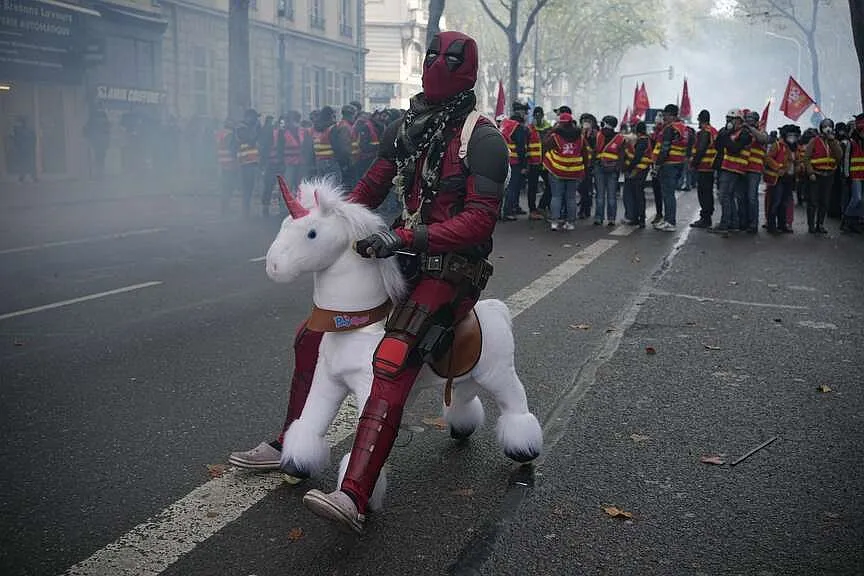
The march in Paris remained peaceful, but authorities reported tensions, scuffles and other incidents in Lyon, Nantes, Pau, Orléans, Rennes and Toulouse.
In Brittany, officials said masked people attempted to block roads in Rennes. They accused young people, frequently accompanied by adults, of "serious acts of violence," including hurling steel balls at police.
Interior Minister Laurent Nuñez said the security deployment involved 70,000 officers, with support from armored vehicles, drones and helicopters. Police tactics have drawn criticism over injuries to demonstrators. The Interior Ministry reported at least 448 arrests; its tally as of 6 p.m. (1700 GMT) on November 5 recorded 448 arrests and 53 officers injured in clashes with protesters.
Violence has repeatedly accompanied large protests in recent weeks. Authorities have attributed it to masked far-left radicals seeking to provoke an insurrection, as well as people seeking to loot.
The October 17 demonstrations drew an estimated 550,000 to 800,000 people nationwide, including 110,000 in Paris, according to the Council on Foreign Relations. Those protests turned into riots in which about 3,000 shops were looted and 2,700 people were arrested.
Students reject government proposals
Before Thursday's strike, the government had held talks with unions in an effort to contain a movement that has brought France its most violent civil unrest in years.
Education Minister Edouard Geffray offered a class-size limit of 28, €4 billion for school renovations, 15,000 additional higher-education places and a new admissions system by 2028, France 24 reported. High school student representatives rejected the proposals as insufficient and said they would continue protesting.