Officers intervened as suspect took out a lighter
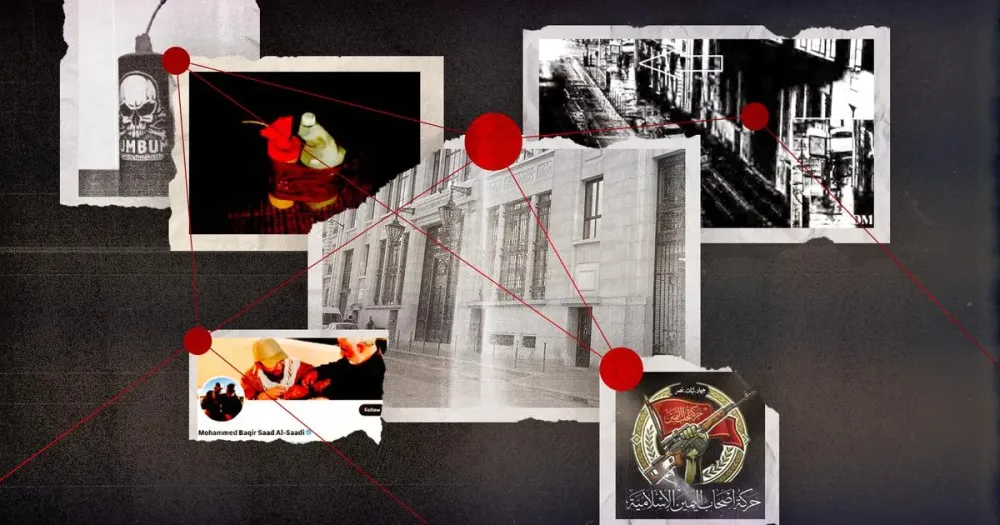
The attempt unfolded at about 3:20 a.m. on Rue La Boétie in the 8th arrondissement. Anti-crime brigade (BAC) officers waiting in an unmarked car saw two people in black clothing approach the bank through heavy rain. The pair put a large shopping bag outside the entrance and removed a compact object.
When one crossed the street holding a phone, apparently to record the other, the suspect remaining at the entrance took out a lighter. Officers moved in and subdued him after a struggle. He was 17. His companion, also 17, escaped but was caught the following day.
Le Figaro describes the device as powerful despite its homemade construction: a gas can taped to an "unusually sized" firework. The pair intended to detonate it that night, the newspaper reported.
The six suspects, who include minors and young adults, are being investigated for "criminal terrorist conspiracy" or "attempted destruction in connection with a terrorist enterprise."
Recruitment through a drug-delivery Snapchat group
Le Figaro's account traces the plot to an offer of a paid "job" made to teenagers on Snapchat. The promised reward was a few hundred euros, with petty criminals recruited to carry out the attack.
One of the arrested 17-year-olds told police that the offer came through a Snapchat group he ordinarily used to find paid drug-delivery assignments. That account comes from a police statement obtained by Le Monde and reported by The Irish Times.
The recruitment method fits a broader pattern described to The Irish Times by investigators, security officials and analysts. They say Iranian intelligence services and Revolutionary Guards operatives use criminal intermediaries to enlist teenagers for low-level "hybrid warfare" attacks in Europe. Small payments motivate these "disposable" recruits, who often understand little about their targets and do not know who ultimately pays them.
Suspected group and links to Iran
The pro-Iranian group suspected in the Paris case is Harakat Ashab al-Yamin al-Islamia (HAYI), also known as the Islamic Movement of the Companions of the Right Hand. Since March 2026, it has claimed attacks across Europe against Jewish schools, synagogues and charities, along with American, Israeli and Iranian opposition targets.
After the attempted bombing, French Interior Minister Laurent Nuñez made a "direct link" to Iran. He said Iranian intelligence services typically act through proxies and layers of subcontractors, often ordinary criminals, when targeting US interests, Jewish communities or Iranian opposition figures.
Investigators and analysts cited by The Irish Times placed the Paris plot within a wave of at least 17 attacks or attempted attacks recorded across Europe since early March 2026. The first wave began about 10 days after US and Israeli strikes on Iran and targeted US banks and Jewish community sites in Belgium and the Netherlands.
US charges and government responses
US court documents and the Justice Department subsequently linked the HAYI campaign to Mohammad Baqer Saad Dawood al-Saadi, an Iraqi national and commander of the Iran-backed militia Kata'ib Hezbollah. According to the court documents, he coordinated the campaign from Baghdad.
The Justice Department charged al-Saadi on May 15, 2026, linking him to 18 attacks in Europe, two in Canada and plans to attack synagogues in the United States.
In June, Western and allied states jointly condemned Iran's use of international and local criminal networks to conduct attacks in North America, Australia and Europe. The British government designated HAYI under the National Security (State Threats) Act 2026 in July.