New capital and a trillion-dollar valuation
The Claude developer reported $131.8 billion in cash and short-term investments before the offering. Its prospectus estimated that cash and investments would reach $232.4 billion after the IPO and concurrent private placement, excluding the over-allotment option.
Including the full over-allotment, Anthropic's own share sale brought in about $91.6 billion before fees, according to Ainvest's account of the prospectus. The private placement contributed another $26.0 billion. Reuters separately put the total IPO proceeds at $93.5 billion after underwriters exercised their additional-share option, exceeding SpaceX's $85.7 billion listing to set a record.
The shares ended their Nov. 19 debut at $97.17, then fell 8.5% to $88.91 on Friday, according to Ainvest data. At that price, Anthropic's market capitalization was approximately $1.18 trillion, equivalent to 33 times its $35.3 billion in trailing 12-month revenue.
Trading drew heavy retail participation. Reuters reported that individual investors traded roughly $772 million of Anthropic shares on opening day, the highest IPO-debut figure in Vanda Research's records dating to 2012. London-based index analytics firm Intropic estimates that index-tracking funds could purchase up to 30% of the shares by year-end. Meanwhile, Morgan Stanley closed the position it had used to stabilize trading after the debut, Reuters reported, removing a potential source of support.
What the spending schedule contains
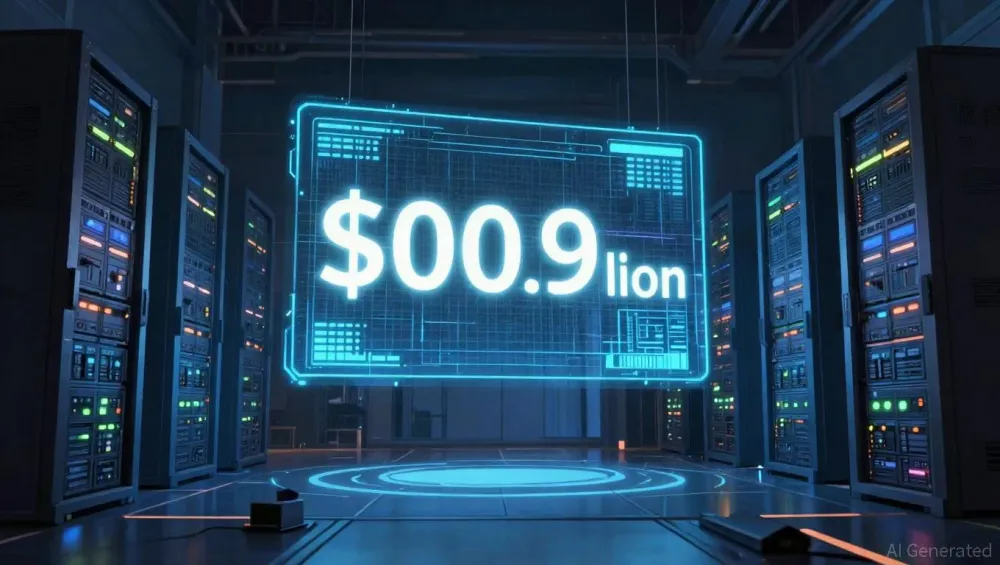
The $900.9 billion commitment total covers disclosures as of Sept. 30 and agreements reached afterward. It is largely separate from the $146.7 billion in reported balance-sheet liabilities, most of which consists of convertible notes expected to become equity.
The Sept. 30 contractual-obligations table accounts for $320.0 billion, primarily purchase commitments and $6.2 billion in leases. Another $451.2 billion consists of signed leases that had not started. The remaining categories are $105.7 billion in commitments entered after Sept. 30, $17.4 billion in short-term commitments omitted from the table, and $6.6 billion in subsequent short-term agreements.
That total does not include an estimated $150 billion to $175 billion in additional payments under compute arrangements without fixed dollar commitments. Of the disclosed payment schedule, about $70.7 billion is due within 12 months of Sept. 30, roughly $451.6 billion is expected before 2031, and the remaining payments extend through 2045.
CNBC reported that the build-out includes access to as much as 5 gigawatts of current and future Amazon Trainium capacity. Anthropic's infrastructure commitments to Amazon and Google each exceed $100 billion and extend into the 2030s. Potential spending with SpaceX for AI computing access could also exceed $100 billion.
Some agreements offer flexibility: $186.2 billion is subject to termination rights or conditions. But the Google contract requires at least $121.3 billion through July 2033 regardless of usage, including a true-up payment if spending falls below the minimum.
Revenue must catch up with capacity
Anthropic generally orders computing capacity 12 to 18 months before it becomes available. Its filing describes the resulting expense as "generally fixed in the near term," while revenue is "primarily consumption-based" and much of it lacks long-term contractual commitments.
The cost ratio has improved sharply. Third-quarter compute and infrastructure expense totaled $9.9 billion against revenue of $17.0 billion, or 58 cents for each revenue dollar. The ratio was 57 cents over the first nine months, compared with 251% in the first quarter of 2025. Third-quarter revenue increased 1,127%, while compute expense rose 382%.
Longer contracts can also secure lower prices. Anthropic said the $6.5 billion of compute purchased through short-term deals in the first nine months cost significantly more than comparable capacity under multiyear agreements.
Ainvest illustrated the growth requirement by keeping the nine-month compute-cost ratio at 57 cents per revenue dollar. Under that assumption, covering $451.6 billion of payments before 2031 would imply approximately $792 billion in cumulative revenue. From the third quarter's $68 billion annualized revenue base, its calculation requires roughly 48% annual growth over four years. This is a scenario, not a forecast.
Investor Chamath Palihapitiya presented a skeptical assessment in a Nov. 20 X article promoting Social Capital research. He described Anthropic's growth curve as having "bent," citing quarterly sales growth that slowed from 144% to about 47% alongside a 77% increase in compute spending. Those figures are his; FourWeekMBA, which reported the argument, did not independently check them against the prospectus.
Supplier financing and management's response
Not every supplier arrangement is fully secured. In a November filing, Anthropic disclosed that Lambda had missed a deadline to obtain a facility lease tied to a $34.9 billion agreement. Nscale said it had not secured binding financing commitments for Anthropic contracts valued at up to about $44 billion. Analysts cited by CNBC said the financing exposure in both cases rests with those neocloud providers and their lenders, rather than Anthropic.
CEO Dario Amodei defended the scale of the commitments during a CNBC appearance on IPO day. In relation to Anthropic's cash and annual revenue, he said, "those commitments don't seem so large." He also said the company hopes to obtain an investment-grade credit rating.
The prospectus lists an undrawn $15.0 billion senior secured revolving credit facility as of Sept. 30, 2026, with maturity in 2031. Obtaining an investment-grade rating would allow the facility's guarantees and security interests to be released.
Ainvest estimates that the post-offering cash reserve represents about three years of payments at the disclosed $70.7 billion annual pace, without counting further revenue. That comparison describes coverage at the current payment rate, not funding for the entire contractual schedule.
The accounting loss and the cost of equity
The reported net loss does not represent an equivalent cash outflow. Revaluations of convertible notes, derivatives and SAFEs contributed $94.3 billion of the $104.0 billion nine-month loss. Over the same period, operating activities produced $6.6 billion in cash.
As Anthropic's valuation rises, the conversion rights held by early note investors become more valuable. Fair-value accounting records that increase as an expense without requiring a cash payment. The effect therefore concerns the investors' eventual equity claims rather than an immediate drain on liquidity.
Employees also stand to gain from the listing. CNBC, citing SEC filings and investors, reported that the average employee could be worth more than $40 million after the IPO, with over 400 employees likely to exceed $100 million.
For the income statement, the prospectus identifies $24.1 billion in unrecognized compensation tied to restricted stock units whose service conditions were unmet at Sept. 30. Recognition over approximately two years implies roughly $3 billion in quarterly expense, more than the $2.5 billion in adjusted operating income reported for the third quarter.
Anthropic had 13.2 billion shares before the over-allotment, with additional shares expected from RSUs and convertible notes. Economic ownership also differs from voting control: the founders' Class F shares hold 50.1% of voting power but carry no economic rights.
The next reporting test
Ainvest identifies three measures to follow in Anthropic's first public-quarter report: changes to the $70.7 billion due over 12 months, compute and infrastructure expense relative to revenue, and revenue growth compared with its illustrative 48% annual path. Together, those figures will show how the payment schedule is developing alongside customer spending; the largely noncash headline loss does not answer that question.