
Putin's invitation draws a conditional response
The French presidential office said Europe must have a full role in negotiations to end the war before a Moscow visit could go ahead. An aide to President Emmanuel Macron said Russia needed to understand that Europe would participate actively and fully in the next meeting with the United States and Ukraine.
Russian President Vladimir Putin extended the invitation on November 19 on the sidelines of the Asia-Pacific Economic Cooperation summit in Shenzhen, China. Deputy Foreign Minister Sergei Ryabkov said Moscow was waiting for responses from British, French and German delegations, while cautioning that a visit would not by itself secure European participation in the U.S.-Russia-Ukraine negotiating format.
German Defense Minister Boris Pistorius urged acceptance of the invitation during a November 20 visit to Poland. Refusing could send the wrong signal, he said. But while dialogue could eventually produce results, he said meaningful talks required Russia to show that it was willing to negotiate a ceasefire.
According to POLITICO, Putin's November 19 press conference followed his first three-way summit with U.S. President Donald Trump and Chinese President Xi Jinping. Kyiv Mayor Vitali Klitschko said Russian drones struck central Kyiv as the leaders met, injuring three people and sending debris into residential and office buildings.
Europe presses for a four-party format
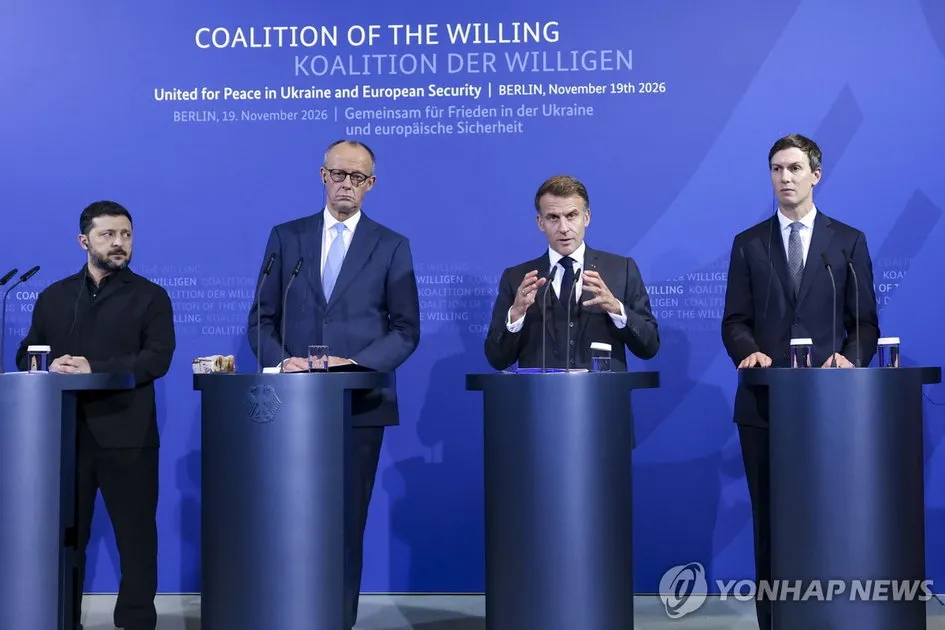
Ukraine announced that Europe had decided to join negotiations with Russia after the Coalition of the Willing met in Berlin on November 19. The Ukrainian presidential office said more than 40 participants attended in person or online. It was the coalition's 17th meeting since it first convened in February 2025.
The European delegation comprises representatives from France, Germany, the United Kingdom, Italy, Poland, the European Union and NATO. Kyiv called for negotiations among four parties: Ukraine, Europe, the United States and Russia.
Contrasting the Berlin gathering with the Shenzhen trilateral summit, German Chancellor Friedrich Merz said, "A Yalta format will not bring peace." He was referring to the 1945 conference at which great powers divided Europe. Merz said he expected another round of Ukraine peace talks soon, with Europe taking part alongside the United States, Russia and Ukraine.
The November 19 joint statement supported direct Ukrainian-Russian dialogue involving both the United States and Europe. It also reserved decisions on negotiating terms affecting the EU and NATO for their respective member states and allies.
Macron's aide said the United States, Europe and Ukraine needed to establish whether their positions aligned before negotiations. Discussing policy shifts under the Trump administration, the aide said past experience showed that Europe had not always been as firm as expected.
Competing positions on Ukraine's security
Russia also rejected NATO membership for Ukraine and security guarantees modeled on the alliance. Ryabkov said neither was acceptable, disputing the position previously described by U.S. envoys Jared Kushner and Steve Witkoff. The envoys had said they had secured Russian acceptance of the idea that Ukraine's guarantees would draw on Article 5, NATO's collective defense clause.
The French presidential aide argued that Article 5-style guarantees would, in practical terms, amount to Ukrainian membership in NATO.
The Berlin statement did not confirm NATO membership. Instead, it outlined possible arrangements after a ceasefire: ongoing military, financial and technical assistance; a ceasefire monitoring and verification system led by the United States; a multinational force led by Europe; and binding legal commitments to restore peace and security should Russia use force again.
Ukrainian President Volodymyr Zelenskyy has made security assurances and mechanisms to prevent another Russian invasion conditions for discussing territorial issues.
Winter and Black Sea ceasefire proposals
The November 19 statement by the leaders of Germany, France, the United Kingdom and Ukraine also sought narrower ceasefires. According to The Kyiv Independent, they called for a winter halt to attacks on energy facilities as an initial step toward ending hostilities, as well as a Black Sea ceasefire to allow food exports to pass safely in support of global food security.
Putin said on November 19 that Moscow was no longer prepared even to discuss a truce covering energy facilities or the Black Sea because of Ukraine's successful strike on the Crimean Bridge, The Kyiv Independent reported.
The leaders also pledged additional military and financial assistance, including air defense systems and 90 billion euros, or about $98.7 billion, through the EU's Ukraine Support Loan.
The latest proposals followed talks among Russian, Ukrainian and U.S. officials in Abu Dhabi during the week before November 19. Reuters reported that the meeting, the first such trilateral session in nine months, yielded agreement on a major prisoner exchange between Moscow and Kyiv but few other concrete breakthroughs.






