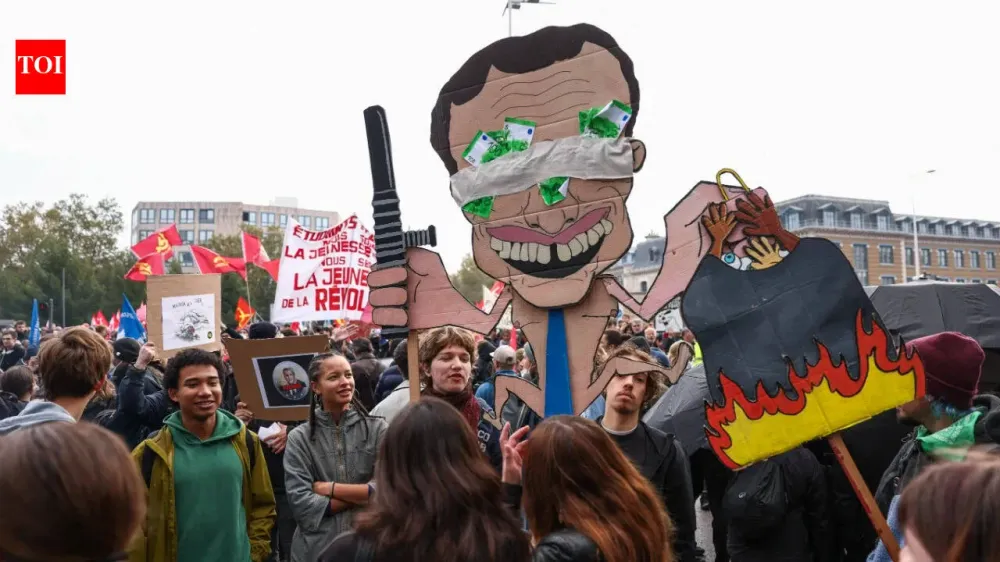
Two separate gatherings planned in Paris
The union and student march in central Paris will focus on living costs and support for young people. Yellow Vests activists have declined to participate, instead urging supporters to gather at Place de la Concorde, close to the lower house of parliament and the presidential palace, despite the authorities' prohibition.
"We are calling for mass disobedience," said Benjamin Ball, a member of the Yellow Vests coordinating committee. The movement protested planned fuel-tax increases under President Emmanuel Macron's government eight years ago.
Nunez warned that security forces were prepared to respond to violence. "If there are any rioters or looters... we'll be ready and waiting for them," he said.
From school grievances to nationwide demands
The movement began on September 17, 2026, at Lycée Saint-Exupéry in Créteil, a working-class suburb southeast of Paris, according to Northeastern Global News. High school students protested staff shortages, crowded classrooms and the condition of school buildings. Social media helped spread the campaign to university students and labor unions, expanding it into a national movement.
Workers and students now share demands concerning living costs, public services and education. Unions want higher pay across the board, tax reforms and improved learning conditions for young people, as well as an increase in the minimum wage, which has received no discretionary boost since 2012.
BBC News put the hourly minimum wage, known as the Smic, at €12.31. CFDT leader Marylise Léon said the unions' wage demands extend beyond raising that floor: "We are asking for a net increase of €100 a month."
An inter-union coalition said Friday that ending the protests would require a response to demands raised over several weeks by workers, civil servants, young people and pensioners.
The government has already released 10 million barrels of diesel from strategic reserves to lower fuel costs and ease anger over prices, BBC News reported. Ministers have also pledged to overhaul the unpopular Parcoursup university admissions platform and eventually replace it by 2028.
Thursday's strike draws hundreds of thousands
Saturday's demonstrations follow a nationwide strike on Thursday that drew hundreds of thousands of workers. Reuters reported sharply different turnout estimates: 575,000 from the Interior Ministry and 1.6 million from the CGT union, one of the organizers.
The ministry described the day as having "generally gone well," while reporting 642 arrests. It also separately reported 448 arrests during the demonstrations and injuries to 53 police officers.
Clashes occurred in several cities. In Paris, police used tear gas after confrontations at the head of the march, and demonstrators and officers clashed again as the protest ended. In Lyon, riot police charged a group of protesters and fired tear gas.
Some energy workers and teachers joined the one-day strike. According to the Education Ministry, slightly more than 15% of teaching staff participated.
Violence and scrutiny of police tactics
Most demonstrations in recent weeks have been peaceful, although some have been accompanied by vandalism and clashes with police. The broader unrest has resulted in thousands of arrests: Northeastern Global News cited Justice Ministry data as of October 9 showing more than 6,877 arrests, 86% involving minors.
On October 17, France experienced what authorities described as its worst rioting in years. RFI reported estimated damage of €1 billion to shops and public buildings. According to BBC News, more than 2,000 stores were looted and historic buildings were set on fire. Authorities responded with curfews, bans on large gatherings and restrictions on protest routes.
In a televised address, Macron blamed "insurrectionists from far-left groups, joined by numerous criminals" for the violence. He also said students had legitimate grievances that were being exploited politically.
Police conduct has come under scrutiny, with dozens of internal investigations into alleged brutality against demonstrators. The government has defended officers' actions while promising to investigate allegations of abuse.
RFI reported that a security crackdown and serious injuries to some protesters prompted the movement to add stronger protections for civil liberties and the right to protest to its demands. The French human rights league, Ligue des droits de l'Homme, accused the government of an "authoritarian shift" aimed at stifling "any dissenting voice".
Lecornu faces wage talks and budget constraints
The unrest is putting pressure on Prime Minister Sebastien Lecornu less than six months before the presidential election. Macron cannot run for another term. The far right leads opinion polls, with far-right, anti-immigration candidate Marine Le Pen polling strongly ahead of the election scheduled for spring 2027.
France, the European Union's second-largest economy, is also trying to contain its public debt. The Irish Examiner, citing The Guardian, reported that debt is approaching 120% of economic output. BBC News reported that the government aims to reduce the budget deficit to 5% of GDP and acknowledges that it has little fiscal room to meet protesters' demands.
Lecornu is scheduled to meet representatives of trade unions and employers' organizations on Monday to discuss wages and purchasing power.