
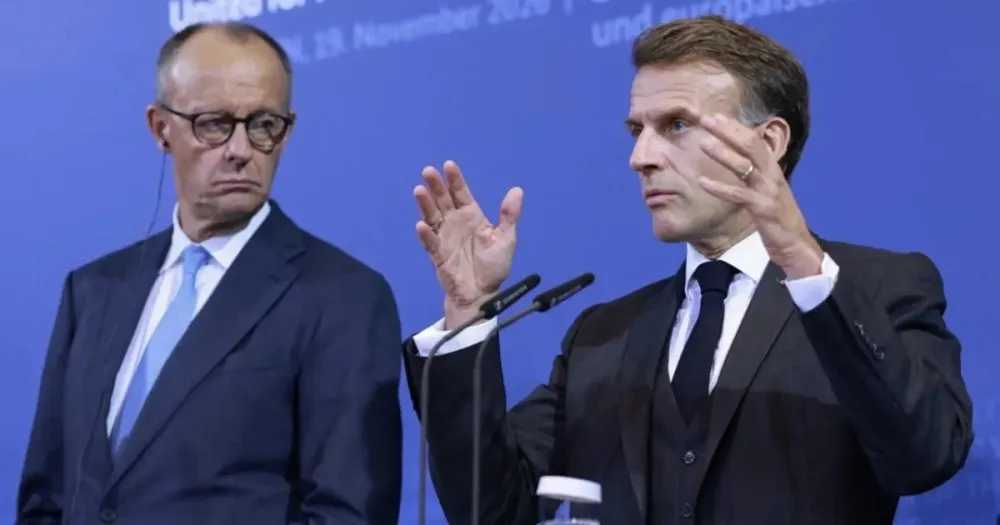
France seeks a place alongside Ukraine and the US
An adviser to French President Emmanuel Macron said opening or formalizing dialogue with Moscow must make clear that Russia accepts an active European role in the next peace talks alongside Ukraine and the United States, Dan Tri reported.
Macron's aides welcomed Russia's formal proposal for a dialogue channel, while stressing the need to confirm a shared position with Kyiv and Washington. "We need to verify this because, drawing on experience, we know that this consensus is not always as solid as we would like," the adviser told reporters.
Putin announced the invitation on November 19 after the APEC summit in Shenzhen, China. He said Russia had approached several European representatives through diplomatic channels to hear their proposals on regional security and ending the conflict in Ukraine.
"Discussing European security without Europe is also strange. Russia doesn't object, but we need to understand what Europe can bring to these negotiations. Then we will decide what form to take to continue dialogue with Ukraine," Putin said.
Conflicting statements on participation
The invitation has not resolved whether Europe will attend the next round of trilateral negotiations. Russian presidential aide Yury Ushakov said Moscow would consider European participation only after receiving clear indications of Europe's aims and substantive, constructive proposals for resolving the conflict.
German Chancellor Friedrich Merz said on November 20 that European involvement had "now been agreed," according to The Irish Times. He favored holding the talks somewhere "neutral," such as the Emirates, rather than Moscow.
US special envoy Steve Witkoff also said Europeans would attend the next meeting after he met Putin at the Kremlin. He described their inclusion as "a very important moment," Reuters reported through the Tri-City Herald. Those statements contrasted with Russia's insistence that it had not yet given its agreement.
A delegation chosen, but no Moscow trip confirmed
Ukraine and European governments have pressed for Europe to be represented in discussions about both the war and the region's security arrangements. After debating the choice of a representative for weeks, European leaders opted for a multinational team rather than a single special envoy.
European Council President Antonio Costa announced the arrangement on November 13. At an informal EU summit in Dublin that day, leaders agreed on a seven-member team comprising national security advisers from France, Germany, the United Kingdom, Italy and Poland, plus representatives of the European Commission and European Council, according to EUalive and European Pravda. NATO is also expected to be represented, Reuters reported through Chronicle.lu.
German Defense Minister Boris Pistorius urged Europeans to accept the Moscow invitation, saying a refusal would send "completely the wrong signal." He also said any negotiations must include a ceasefire.
Radio Liberty's Ukrainian service reported, citing its sources, that national security advisers from France, Germany and the United Kingdom could go to Moscow as early as November 2026. No final decision had been made.
Estonian Foreign Minister Margus Tsahkna questioned the usefulness of such a visit. He warned that no amount of "Kremlin tourism" would solve the problem and said Putin should instead say when Russia would stop bombing Ukraine.
Support for Kyiv and differences over security
European leaders had declared their willingness to negotiate an end to the war at the November 19 "Coalition of the Willing" summit in Berlin. The group comprises 36 countries and is led by the United Kingdom, France and Germany; about 30 heads of state and government attended, according to The Irish Times and EUalive.
The Berlin meeting also brought pledges of support for Ukraine. The EU was preparing to commit €45 billion toward the country's funding needs in 2027, while the United Kingdom pledged £10 billion, or about €12 billion, The Irish Times reported.
Security arrangements remain another point of disagreement. US presidential envoy Jared Kushner said Moscow was now "comfortable" with Ukraine receiving guarantees based on the principle enshrined in NATO's Article Five, according to Reuters.
Putin, however, warned that a European proposal to deploy Western troops in Ukraine after a peace agreement would restart the war because Russia would regard the deployment as a threat to its security. He also said full normalization of relations with Europe would be impossible until "the political elite changes in certain countries," The Irish Times reported.






