
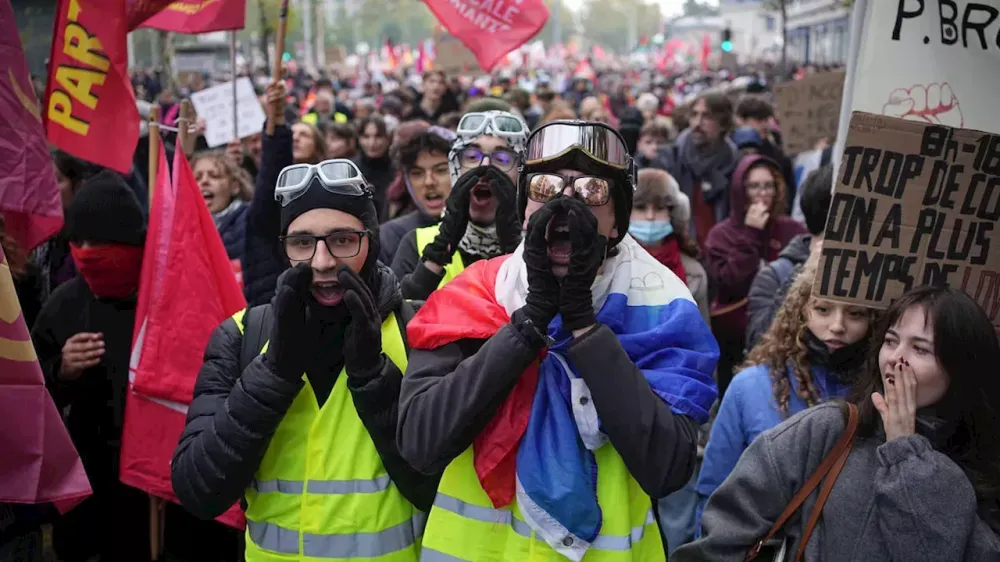
Services disrupted as protesters march
Hospital employees, air traffic controllers, postal workers, teachers and rail staff joined Thursday's action, with marches in cities including Lyon and Nice. Primary and secondary schools closed, leaving children without classes, while rail services were disrupted. The yellow vest movement also mobilized.
Strikes at energy plants caused shortages and prompted France to seek supplies abroad. Nuclear generation dropped by 2.4 gigawatts, and the country imported electricity for several hours, according to the World Socialist Web Site.
Authorities put nationwide participation at around 600,000, with the Interior Ministry's evening count reported as 575,000. The CGT union gave a much higher estimate: nearly 1.6 million participants, including about 350,000 in Paris.
Ahead of the strike, Interior Minister Laurent Nuñez announced plans to deploy more than 70,000 police and gendarmes nationwide. He warned that trouble would meet a "firm response".
Wages and spending cuts at the center of the dispute
The protests targeted rising living costs and roughly €54 billion, or about US$60 billion, in spending cuts proposed in Lecornu's austerity budget. Demonstrations against reductions in government departments' budgets have been taking place since September.
France's four rail unions warned in a joint statement that the cuts would "worsen poverty, slash social security, freeze state workers' salaries and dry up investment needed for environmental measures".
Sophie Binet of the CGT, France's second-largest union, said: "We want two things: wage increases everywhere ... and a revision of the government's draft budget which, as it stands, is catastrophic for the country." The CGT wants the minimum wage, known as the Smic, raised by 10%, according to The Rio Times. The CFDT union federation is also seeking an increase.
The strike followed a parliamentary defeat for the government. On November 4, the National Assembly voted 458 to 0 against the revenue portion of the 2027 state budget, leaving the government's original text to go to the Senate. The Rio Times described the result as evidence of the minority government's difficulty in assembling a majority.
Separately, the government aims to narrow the Social Security deficit from €21.8 billion, about US$24 billion, to €12.7 billion, about US$14 billion. Eurostat figures published on October 21, 2026, showed that France's public debt reached 115.7% of GDP in 2025, while its budget deficit stood at 5.1%.
The confrontation comes in President Emmanuel Macron's final months in office before his departure in spring 2027. With less than six months until the April presidential election, Euronews reported that Marine Le Pen, leader of the far-right National Rally, led the polls. Jean-Luc Mélenchon, who leads the hard-left France Unbowed, was second.
Government concessions and talks
Education Minister Edouard Geffray said some planned school job cuts would be abandoned. Macron had also sought to ease tensions on Monday by announcing a fuel-duty cut.
In a social media post, Macron described other efforts to lower fuel costs: releasing 10 million barrels from France's strategic reserves in October, securing supplies from Middle Eastern partners and working with distributors. He said those measures had delivered "more than ten cents off per liter of diesel" without changing taxes.
After the strike, Lecornu invited unions and employers to a "social conference" at his official residence on Monday, November 9, to discuss purchasing power and wages.






