
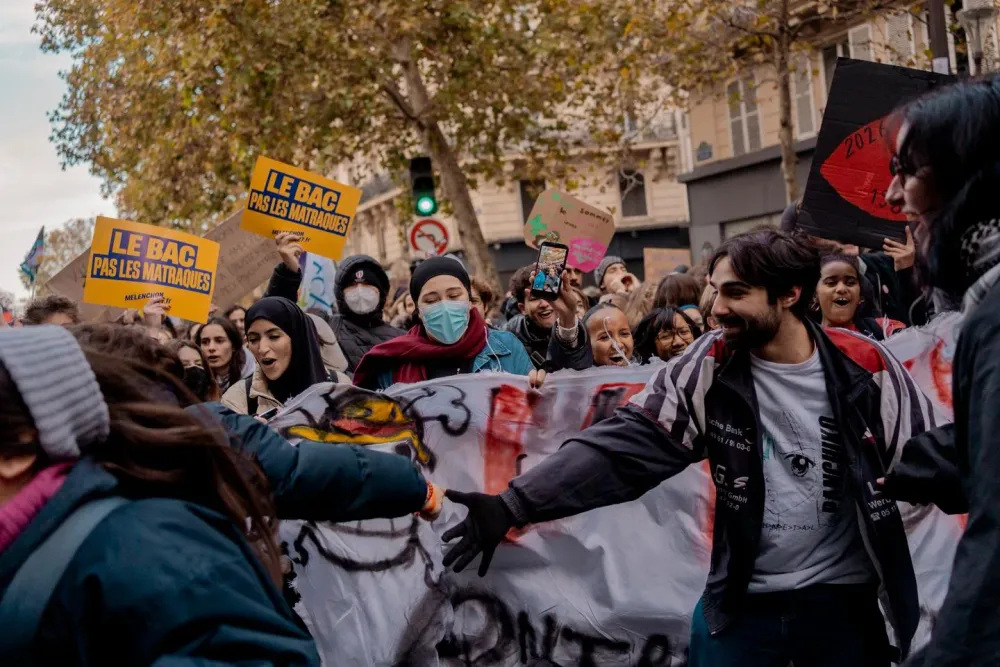
A broader turnout
High school and university students, Yellow Vest protesters and farmers joined the union-led demonstrations on Thursday. The Interior Ministry counted 55,000 participants in Paris, while Le Monde reported that attendance in numerous cities reached new highs for the movement.
The CFDT, CGT, FO, UNSA and FSU had maintained a call to demonstrate issued a month earlier, under different circumstances and with modest attendance initially expected. The weekday mobilization became a test of whether unions could sustain the protest wave that erupted on October 17 amid violence and looting.
According to BFMTV, the ministry's provisional estimate of nearly 600,000 participants surpassed its previous counts: 550,000 on October 17, 410,000 on October 24 and 320,000 on October 31.
From a school strike to nationwide action
The movement's roots predate the October street protests. According to the Council on Foreign Relations, teachers at Antoine de Saint-Exupéry High School in Créteil, a southeastern Paris suburb, struck over staff shortages on September 17. Students and parents joined them in blocking the entrance, and the action spread to high schools across France.
Education remained part of the November 5 mobilization. The Education Ministry estimated that nearly 16% of teachers were on strike, with participation among all school staff at about 13%. Separately, the SNES-FSU union estimated that 52% of middle- and high-school staff took part.
The Higher Education Ministry reported disruptions at 60 of the country's 184 higher-education institutions.
Heavy policing and localized clashes
On November 4, Interior Minister Laurent Nuñez announced plans to deploy more than 70,000 law enforcement officers. Authorities also required the Paris march to follow an alternative route. Unions and rights groups criticized what they described as excessive policing and "authoritarian" restrictions on protest.
Police began the day on high alert for attacks by aggressive ultra-left groups and roving looters. Near the Bastille in Paris, about 50 British union representatives from health care, public service and education encountered a line of CRS riot police that surrounded them at a corner of Boulevard Richard Lenoir. They had traveled from London by bus to "officially show their solidarity with the French trade union movement," Le Monde reported.
The Interior Ministry later characterized the marches as largely peaceful, while reporting localized clashes involving "radical and far-left activists" in Rennes, Nantes, Lyon and Marseille. It said at least 448 people had been detained nationwide, a small share of its estimated 575,000 participants.
The October 17 protests had involved extensive destruction. According to the Council on Foreign Relations, rioters broke into Marseille city hall and set fire to Limoges town hall. Roughly 3,000 shops were looted and more than 1,000 police officers were injured. Authorities arrested 2,700 people, and more than 200 were jailed.
Budget dispute and fuel pressures
The demonstrations followed a cross-party vote on November 4 in which French lawmakers rejected the first part of the 2027 budget bill. The government's original proposal then went to the Senate, where a vote was scheduled for December 9. A parliamentary committee would subsequently seek a compromise before the text returned to the National Assembly.
The unrest also coincided with a global fuel-supply shock caused by the Middle East conflict and the closure of the Strait of Hormuz. On November 1, France began releasing 10 million barrels of diesel from its strategic reserves.
Economy Minister Roland Lescure said diesel prices had dropped by an average of 15 cents per liter. The decrease reached 20 cents per liter at more than 3,000 of France's roughly 10,000 gas stations.
Wage talks scheduled at Matignon
Prime Minister Sébastien Lecornu's office announced on November 5 that he would convene a social conference at Matignon, his Paris office, on Monday, November 9. The formal talks would bring together trade unions and employer organizations, with the stated aim of providing answers on purchasing power and wages.






