
What the bill would change
The right-leaning Senate voted 205-110 in favor on November 20. The National Assembly had approved the bill at first reading on July 7, 2026, by 313 votes to 199, with five abstentions, according to Index on Censorship.
The legislation gives officers a presumption of legitimate self-defense when using firearms. Its wording says that "when they use their weapons", officers "are presumed to have acted" within the law.
The Senate's explanation limits that presumption to uses of weapons already authorized by Article L. 435-1 of the Internal Security Code, subject to absolute necessity and strict proportionality. Those cases include an armed attack or threat against an officer's or another person's life or physical integrity. Contrary evidence can overturn the presumption at any time.
Les Républicains lawmaker Éric Pauget, who represents the Alpes-Maritimes, introduced the bill in December 2024. According to Index on Censorship, a government amendment in January 2026 replaced its original presumption of self-defense with a presumption of lawful weapons use under Article L. 435-1. That article was created by the February 28, 2017, legislation known as the Cazeneuve law.
Protection for officers or an obstacle to investigations?
The measure fulfills a long-standing far-right demand. Supporters, including the government and the party of far-right presidential candidate Marine Le Pen, argue that officers should not automatically face suspicion of using disproportionate force.
Interior Minister Laurent Nuñez said Thursday that the bill would "put an end to the automatic practice of taking into custody a police officer or gendarme who has used their weapon". He also said it would "correct this reflex of systematically calling into question the daily, highly demanding work of our security forces".
Opponents say the presumption would obstruct investigations and further limit accountability in France, where allegations of police brutality seldom result in cases reaching criminal court. The Human Rights League warned that it would "block the opening of an investigation in the event of a police shooting following a failure to comply" with a traffic stop, or during protest policing.
Concerns also came from human rights institutions. In a July 2, 2026, opinion, France's Defender of Rights warned that the text would infringe the right to life, access to a court and the right to an effective remedy, according to Index on Censorship. Civic Space Watch reported that the UN Special Rapporteur on extrajudicial, summary or arbitrary executions urged France to reject the proposal, warning of possible impunity and weaker compliance with international human rights obligations.
Opposition in petitions and on the streets
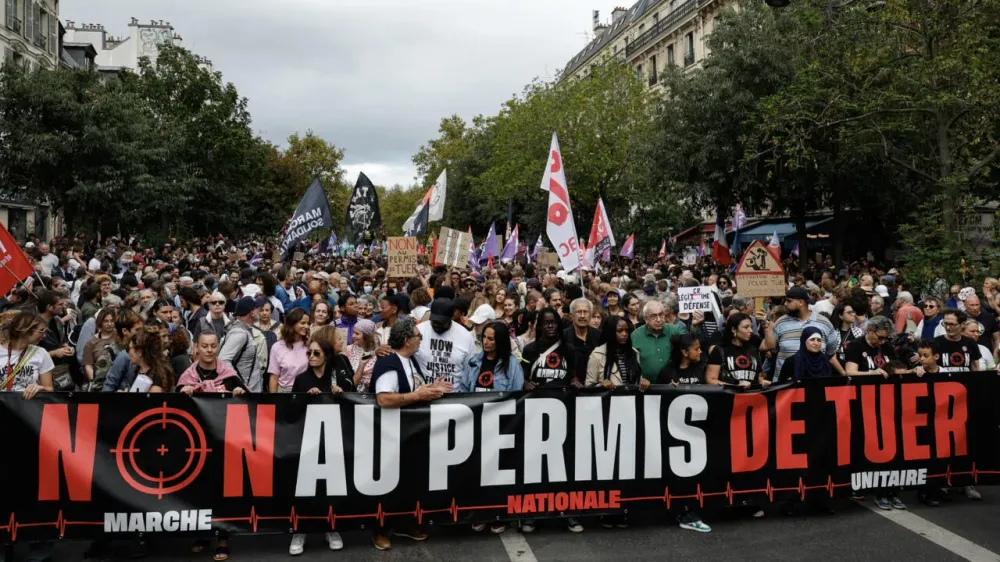
The final vote followed weeks of student-led protests that renewed scrutiny of alleged police brutality. Earlier demonstrations against the bill drew more than 30,000 people in Paris, Marseille and other French cities on September 20, 2026, according to Civic Space Watch.
A petition launched by Issam and Samia El Khalfaoui collected more than 330,000 signatures against the measure in one week, Index on Censorship reported.
Police stops have also drawn scrutiny. A report issued last year by France's rights chief found that young men "perceived as Arab, Black or from North Africa" were four times more likely than the rest of the population to be stopped.
Constitutional review sought
Left-wing lawmakers intend to ask the Constitutional Council, France's highest constitutional authority, to prevent the bill from becoming law. A referral requires 60 members of the National Assembly or 60 senators.
Under the procedure described by the Senate, the president should promulgate the law within a maximum of 15 days unless it is referred to the Council.






