
Both official and organizer counts fall
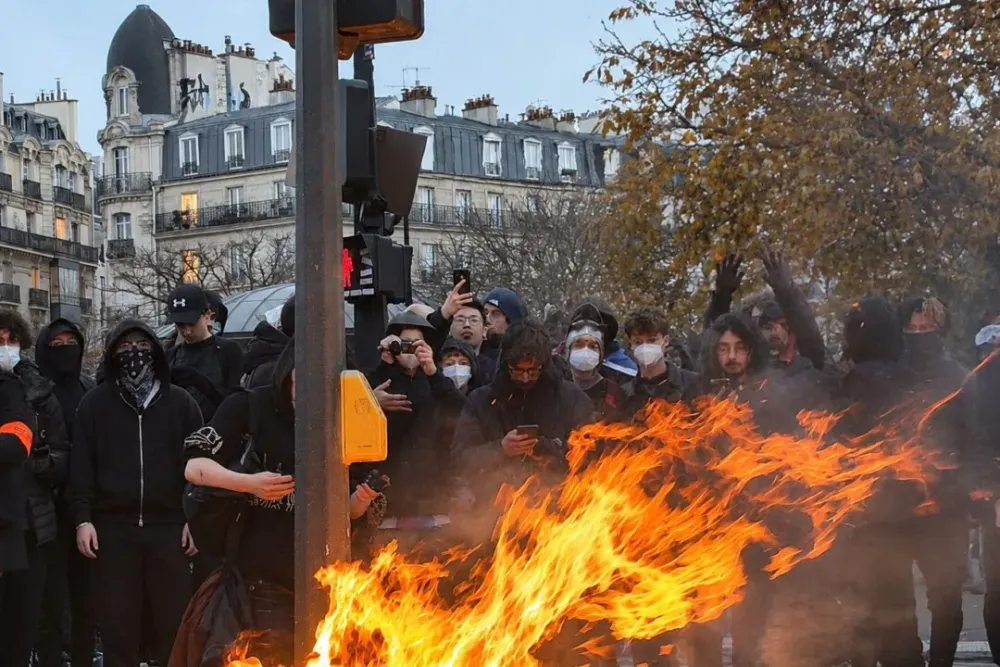
The Interior Ministry described attendance as having "significantly declined." Its nationwide tally was down from 106,000 a week earlier and 146,000 on Nov. 7. In Paris, officials recorded 21,500 demonstrators, compared with 24,000 the previous Saturday.
Organizers' estimates also pointed to smaller crowds, although their totals remained higher than the government's. They put national attendance at 150,000, down from 200,000 the week before and 800,000 on Oct. 17, the start of the weekly marches.
Thomas, an IT worker attending the Paris march, told The Epoch Times: "I'm sure the support is still there, but protesting takes time and sometimes money, so it inevitably wears people down after a while."
The Nov. 21 demonstrations were the sixth consecutive weekend of protests, RFI reported, citing AFP. The broader movement began in mid-September, when high school students demanded better learning conditions. The latest marches also fell on the eighth anniversary of the Yellow Vest movement.
Arrests and scrutiny of police powers
The Interior Ministry's arrest count had reached 144 by 6 p.m. on Nov. 21, according to RFI. Some demonstrations were accompanied by clashes involving attempts to gather in prohibited areas and the burning of vehicles and trash bins. Police used tear gas.
An AFP tally puts the number of people seriously injured by security forces since the French protests began at at least 31. The count draws on direct testimony, information from victims' lawyers and NGO records. Authorities have issued no official injury toll.
A day before the marches, on Friday, Nov. 20, France's parliament passed a law giving greater protection to law enforcement officers who use their weapons. The left denounced the measure as a "licence to kill." After its adoption, Interior Minister Laurent Nunez warned regional authorities to be "particularly vigilant regarding the groups most hostile to law enforcement."
Courthouse News Service reported that the protests are widely viewed as bolstering both political extremes in France. Demonstrators have been drawn toward hard-left leader Jean-Luc Mélenchon, while far-right leader Marine Le Pen has rallied supporters with calls to restore order and security.
Housing demands connect the European protests
The Nov. 20-22 coordinated demonstrations involved unions and activist groups in France, the United Kingdom, Belgium, Spain, Italy, Portugal and Greece. Many participants marched under the slogan "Fight for our future, not their wars." The cross-border initiative began earlier in November.
Organizers made a guaranteed right to housing and controls on rental prices central demands. They also called for money earmarked for rearmament to be redirected to education, youth policies and housing.
Eurostat, the European Union's statistics office, says EU home prices have increased by almost 70 percent since 2015, while rents have risen 25 percent. Both increases have far exceeded income growth.
Housing rights also drove outrage in Spain after the October 2026 eviction and subsequent death of Maricarmen Abascal, 87, in Madrid. According to Courthouse News Service, mass protests pressured Spain's parliament to pass new legislation before an early general election scheduled for Nov. 29.
The mobilization extended beyond the seven-country coordination effort. A coalition comprising more than 50 youth- and student-led groups said it expected young people in more than 25 countries to participate. Italy's CGIL union called a 24-hour strike that brought demonstrations to more than 100 cities. In Germany, the collective GenZ Regelt said it expected 15,000 participants at protests in Berlin.






