
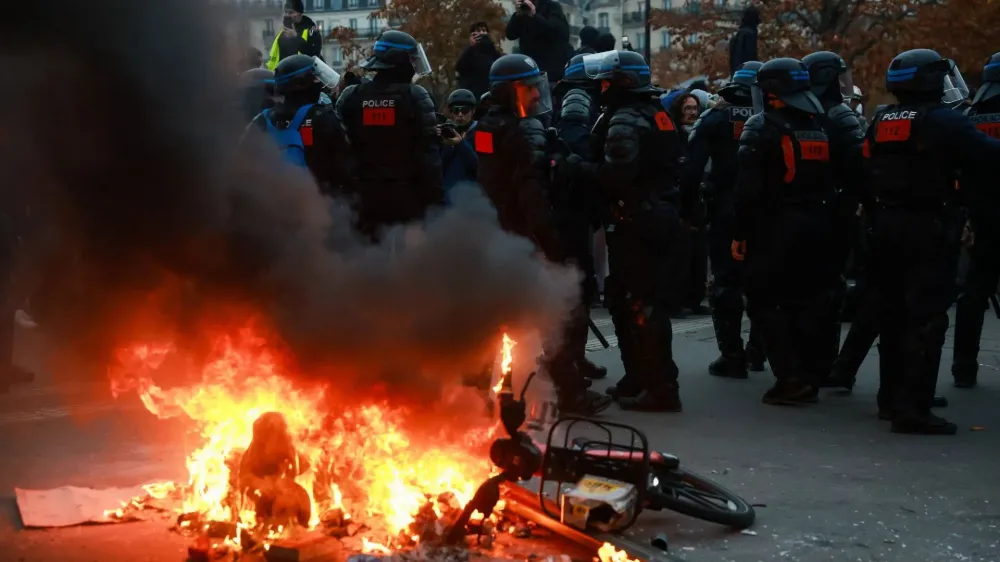
Clashes in Lyon and arrests in Paris
Interior Minister Laurent Nunez deployed 70,000 police officers for the demonstrations, known as "Act IV." About 45,000 people marched in Paris, where barricades lined boulevards, while bicycles and wheeled trash bins were set on fire during the unrest, The Sun reported.
Lyon experienced the most serious violence. Following the burning of a tourist office there the previous week, demonstrators again defied protest bans. Officers used tear gas against several hundred people blocking a road at an unauthorized gathering.
In Paris, police had prohibited demonstrations along certain routes, but Yellow Vest members gathered near the National Assembly. About 20 were arrested, among them Benjamin Ball, one of the movement's leaders, and spokeswoman Azelma Sigaux. Yellow Vest protesters who assembled at Place de la Concorde in defiance of the ban received fines of 135 euros each.
An earlier nationwide count from Nunez's aides recorded 18 arrests by 2 p.m., compared with 27 at the same point a week before. Police also conducted more than 15,600 preventive checks.
Lower turnout after weeks of disruption
Saturday's crowds were smaller than those at both the previous weekend demonstrations and Thursday's nationwide mobilization. Interior Ministry figures put attendance at 550,000 on October 17, 410,000 on October 24 and 320,000 on October 31. Arrest totals for those dates were 2,628, 1,435 and more than 500, respectively.
More than 600,000 people took to the streets on Thursday, November 5, in a day dubbed "black Thursday," according to The Sun. The Eiffel Tower went into lockdown, and roughly one-third of French high schools closed or could not operate amid student blockades and a teachers' strike.
At Françoise high school in Tournefeuille, masked and hooded attackers set off fireworks before setting the school on fire. A teacher told La Dépêche that those responsible had come to destroy property and terrorize people, rather than take part in a student protest.
Over the past month, more than 4,000 people have been arrested, hundreds have been wounded and about 3,000 shops have been broken into and looted, The Sun reported. A teenager lost an eye after being struck by a police rubber pellet, and another demonstrator lost a hand to a stun grenade.
Authorities have imposed curfews and demonstration bans in several major cities. Nunez promised "an extremely firm response" to "acts of violence" and announced an attempted murder investigation into petrol bombs thrown at police on Halloween night.
School grievances meet cost-of-living anger
The movement began with students in September 2026 protesting crowded classrooms, teacher shortages and deteriorating school buildings. It broadened on October 17, when a revived Yellow Vest coordination organized a national cost-of-living protest under the banner "vie chère," drawing students, union members and climate campaigners.
The demonstrations come amid rising household costs. INSEE, France's statistics office, recorded annual consumer-price inflation of 3.1% in September 2026, the highest rate since January 2024. Energy prices rose 21.3%, and diesel averaged €2.37 per liter on October 21.
Legislation and an approaching election
The Senate approved a proposed "rioters pay" law, known as casseurs-payeurs, overnight into October 28 by a vote of 229 to 105. It would allow the state to collect damages from people participating in violent gatherings by seizing welfare payments, including housing aid and the RSA basic income. Damages would be capped at €10,000 per person. The bill next goes to the National Assembly, which has not set a date to consider it.
The government also faces a budget dispute. On November 4, the National Assembly voted 458 to 0 against the revenue portion of the 2027 state budget. The government's original version now goes to the Senate. Prime Minister Sébastien Lecornu could still invoke Article 49.3 to pass a bill without a vote, though doing so exposes the government to a no-confidence motion.
A November Elabe survey found that 13% of respondents trusted President Emmanuel Macron, the lowest level the poll has recorded. That was below both François Hollande's 14% in November 2016 and Macron's own 14% in October 2025. Trust in Lecornu dropped to a personal low of 17%.
The unrest is unfolding about five months before the 2027 presidential election, whose first round is scheduled for April 18 and runoff for May 2. Macron is barred from running again by the constitutional limit of two consecutive presidential terms. The far right sees the election as its best opportunity yet to win power.
Wage talks scheduled for Monday
Following the November 5 nationwide strike, Lecornu's office called unions and employers to Matignon, his Paris office, for a formal "conférence sociale" on Monday, November 9. The talks will address wages and purchasing power.
The CGT union is seeking a 10% increase in France's minimum wage, known as the Smic. The CFDT also wants the minimum wage raised.






