
Smaller crowds across France
Both organizers and the Interior Ministry reported a drop in participation. Organizers estimated a nationwide turnout of 150,000, down from 200,000 a week earlier and 800,000 on October 17, the first major protest. The ministry counted 82,500 on Saturday, compared with 106,000 the previous weekend. Its estimate for October 17 was about 565,000, Reuters reported.
The two sides also differed over turnout in Paris: the ministry counted 21,500 people, while organizers reported 45,000, according to Reuters. About 70,000 security personnel were deployed nationwide.
Demonstrators took to the streets in Lille, Marseille, Lyon and other cities. In Paris, the gathering at Place de la Republique featured music, food trucks, costumes and handmade signs before the crowd headed east. Students marched alongside trade unionists, left-wing parties and members of the Yellow Vest movement, marking eight years since that movement shook President Emmanuel Macron's government.
Mock gravestones represented the loss of public services, including social security and education. Another protester's placard read: "I want to live, not survive."
School demands grow into a wider campaign
The movement took shape in mid-September around high school students' demands for better learning conditions, then broadened to encompass living costs, inadequate public services and police brutality. The Council on Foreign Relations traces its origins to a September 17 teachers' strike over staff shortages at Antoine de Saint-Exupéry High School in Créteil, southeast of Paris. Students and parents joined the action and blocked the entrance; social media helped spread it to high schools across France.
Students sought repairs to deteriorating school buildings, more teachers and university reforms, according to the council. They also demanded changes to Parcoursup, the university-admissions platform they described as excessively complicated and opaque.
The government's response included 3,000 additional substitute teachers, the withdrawal of proposed tuition fees for certain technical programs and preparatory classes, and an online platform for young people to raise concerns, the council said. On October 26, the government proposed modifying Parcoursup by 2027 and replacing it entirely by 2028.
The wider campaign has extended beyond France. On November 20, students and young workers demonstrated in more than 20 European countries and roughly 400 cities over living costs, education conditions and increasing military spending, O Globo reported. Climate concerns also featured in Friday's rallies, whose participants accused political leaders of disregarding young people's needs.
"In a number of countries, young people are going through the same thing, namely precarity. You have to choose between having a roof over your head, getting medical care, and being able to eat your fill," said Manon Moret, general secretary of the student union Unef.
New police protections draw opposition
Saturday's demonstrations also targeted the police-protection law approved by parliament on Friday. One Paris sign read: "No to the licence to kill".
O Globo reported that the Senate approved the measure by 205 votes to 110 on the night of November 20-21. It reverses the burden of proof by presuming that officers who use their weapons acted lawfully, although contrary evidence can overturn that presumption at any time.
The government, much of the political center and the far-right National Rally supported the law. The left strongly opposed it and announced an appeal to the Constitutional Court. A petition opposing the measure attracted more than 700,000 signatures, according to O Globo.
After its adoption, Interior Minister Laurent Nunez instructed regional authorities to be "particularly vigilant regarding the groups most hostile to law enforcement".
Arrests and scrutiny of police conduct
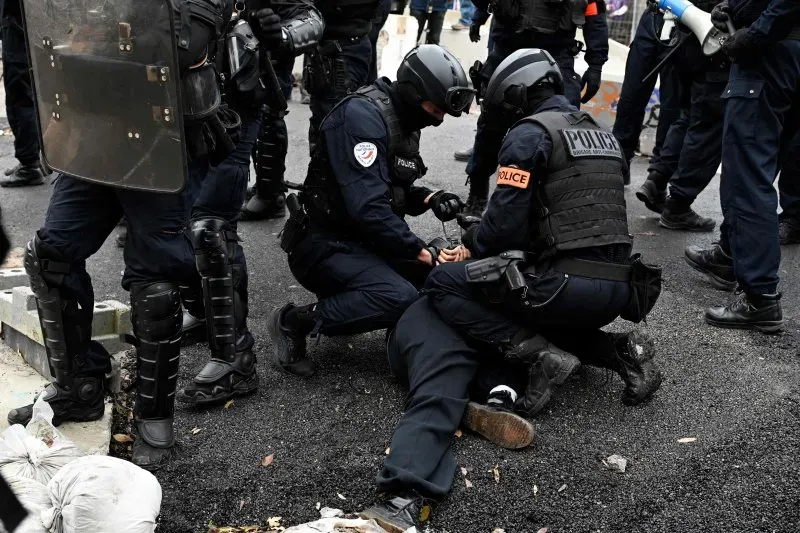
Most protests have been peaceful, though some have involved violence and allegations of police brutality. On Saturday, clashes occurred around several demonstrations as people attempted to gather in prohibited areas and burned vehicles and trash bins. Police used tear gas. The Interior Ministry reported 144 arrests as of 6 p.m. (1700 GMT).
The unrest followed much larger rallies last month that descended into France's worst rioting in years. Hundreds of shops were looted, and buildings were attacked and set on fire.
AFP has documented at least 31 people seriously injured by security forces since the protests began, drawing on firsthand accounts, victims' lawyers and nongovernmental organizations' records. Authorities have not released an official injury count.
On November 21, prosecutors opened an investigation into allegations that police officers used violence against two young people detained during an October 31 demonstration in Paris, O Globo reported. In one case, investigators are also examining an allegation of sexual assault by a person abusing the authority of their office.
Election backdrop and further demonstrations
The protests come ahead of France's April 2027 presidential election. The Council on Foreign Relations said the far right's law-and-order position could help bring it to power for the first time in modern French history. Polling after the October 17 escalation showed Marine Le Pen still leading with more than 30% support, the council said.
Lower turnout did not deter Avril Bas, 27, who joined the Paris march with her knitting group to support high school students seeking better learning conditions. "We'll be there next week and the next week and as long as we're needed," she told AFP.
Unions and activists are planning further demonstrations in the coming weeks. The CFDT, CGT and UNSA unions have called for a day of strikes and mobilization on December 1, according to O Globo.






