
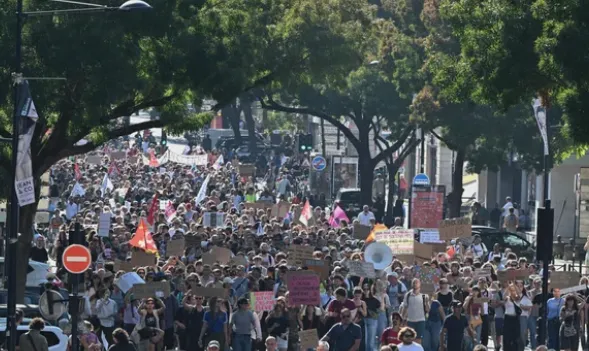
Lower turnout and limited strike participation
Tuesday's action was the third nationwide public sector strike since September, with private sector employees and students also joining the protests. More than 200 demonstrations were organized, according to AnewZ, including a Paris march from Place de la Nation to Place d'Italie.
Authorities and unions gave widely differing crowd estimates. The Interior Ministry counted 146,000 demonstrators across France and 28,000 in Paris; unions estimated approximately 550,000 nationally and 175,000 in the capital. On November 5, the previous unified protest day, the ministry had recorded 575,000 nationwide, including 65,000 in Paris.
Work stoppages were limited. The education ministry reported strike rates of 3.14% across national education staff, 3.76% among teachers and 9.28% among school support staff. A partial estimate from the Ministry of Action and Public Accounts put participation in the state public administration below 3%, compared with about 10% on November 5. JIJI Press reported that this was the lowest participation in that sector since the movement began.
Pay freeze at the center of the dispute
Talks with Prime Minister Sébastien Lecornu on Friday ended without agreement. The government has ruled out an across-the-board raise for public employees for a fourth straight year, while unions say public servants' purchasing power has fallen 16% since 2017. They link declining wages and poorer working conditions to problems in essential services such as education and health care.
The salary calculation for France's 5.8 million public employees relies on an "index point" that has not increased in three years, according to France 24 and AnewZ. No increase is planned in the 2027 budget. Some employees in lower-paid positions consequently have base salaries, before bonuses, below the national minimum wage of about €1,470 net a month.
The government has announced targeted measures in response to union demands: eight additional index points for the lowest-paid public workers and an earlier minimum-wage increase, brought forward to December 1, 2026. Government spokesperson Mathieu Lefèvre cited raises reaching €650 gross for more than 1.3 million civil servants, along with a guarantee that no civil servant earns less than the minimum wage.
Public services and election concerns
In Paris, nurse Aurelane Thos identified staffing shortages and deteriorating conditions in hospitals and schools as reasons workers were protesting. Students raised concerns about education, access to universities and France's economic prospects.
University professor Nicolas Prevot urged the protection of public services and human rights. He also warned about the prospect of the far right taking power in the presidential election next year.
Separately on Tuesday, far-right leader Marine Le Pen promised to reverse President Emmanuel Macron's pension reform if elected in spring 2027 and reduce the retirement age to between 60 and 62. Her proposals also included a €900 billion fund intended to support pension financing over the long term.
Clashes in Nantes
Most rallies passed peacefully. Authorities nevertheless deployed security forces and imposed a temporary ban on firecracker sales because of concerns about violence. In Nantes, in western France, riot police used tear gas and water cannon in confrontations with protesters.
Some demonstrations during the previous month had also led to clashes with riot police. RFI, citing AFP, reported more than 2,000 arrests during that period, as well as looting of shops and attacks on public buildings, some of which were set on fire.
Student protests beyond France
Several thousand demonstrators, most of them school pupils, gathered in Brussels on November 17 over worsening school conditions, budget cuts and increased university tuition fees. The movement was inspired in part by the French protests.
Youth organizations have called for a strike across more than 25 European countries on Friday.






