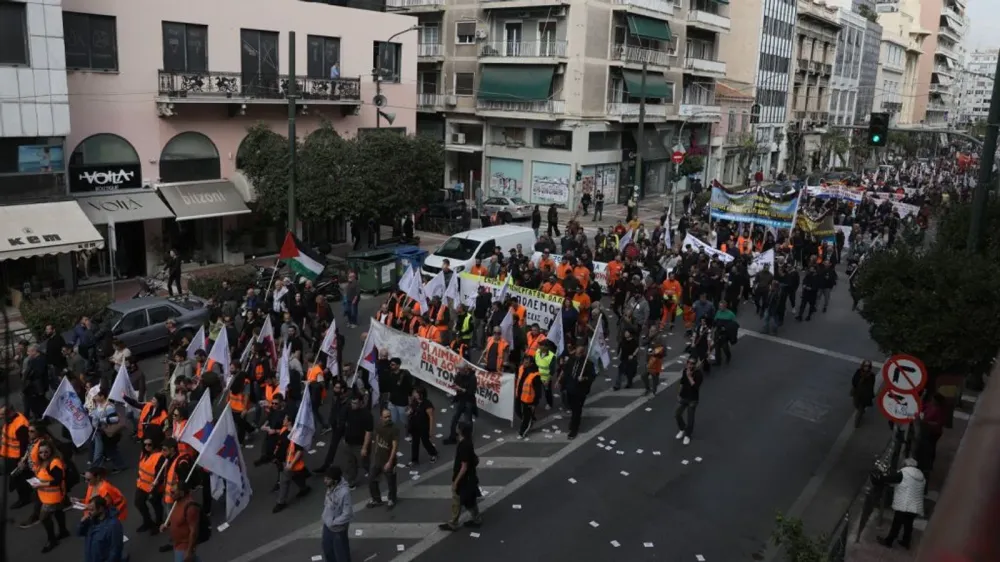
French strike turnout and the unions' strategy
Participants joined from Europe, North and Latin America, Australia and Asia to hear Lantier's report and take part in a 90-minute discussion led by Chris Marsden, the UK party's national secretary.
France was central to Lantier's argument. He described its political crisis as the deepest since May 1968, citing two months of student and worker protests, nearly 13,000 arrests, curfews, bans on demonstrations and the deployment of soldiers.
The number marching on French strike days fell from 575,000 on November 5 to 146,000 on November 19. Lantier rejected the interpretation that public anger was subsiding. He instead blamed union leaders for scheduling isolated, one-day actions weeks apart on dates agreed with the government. "The problem is not the absence of a will to fight," he said, arguing that workers lacked organizations and a revolutionary perspective through which to act.
He accused union officials and organizations he characterized as pseudo-left, including Jean-Luc Mélenchon's France Unbowed (LFI), of demobilizing workers while the state used repression. Union leaders had discussed policing the protests with Prime Minister Lecornu, he said. He also criticized CGT leader Sophie Binet for promising workplace general assemblies that were not organized. At Gare du Nord, which has about 10,000 workers, he reported attendance of roughly 100 at a meeting where no strike motion was introduced.
Lantier linked President Emmanuel Macron's refusal to offer concessions to what he called the bankruptcy of the French state, citing its €3.5 trillion debt. He argued that European governments were borrowing to expand the war against Russia amid rising interest rates while cutting social spending. "War abroad and class war at home are two sides of the same crisis of world capitalism," he said.
Spain's housing strike
Among the other mobilizations Lantier cited was Spain's first nationwide general strike in 14 years. The November 11, 2026, walkout focused on the housing crisis and was called by the General Union of Workers (UGT), the Workers' Commissions (CCOO), tenants' associations and other unions, according to TIME.
Participation was disputed. The unions put it at about 4 million workers, or roughly 17% of the country's 23-million-strong workforce, and described the strike as a success. Employers' confederation CEOE estimated participation below 5% and called it a "failure." Support was strongest along the coast, at ports and in the automotive industry. Police reported at least 75 arrests and at least 1,044 strike-related incidents.
The action preceded Spain's November 29 snap general election. Prime Minister Pedro Sánchez called the election after the September eviction and subsequent death of 87-year-old tenant Maricarmen Abascal triggered days of mass protests.
Housing costs provide the backdrop to the dispute. El País reported an 87% increase in rents from 2015 to 2025, compared with wage growth of about 30%. According to the Youth Council of Spain, average monthly rent of €1,176 amounted to nearly 99% of the average monthly salary for workers ages 16 to 29. The Bank of Spain estimated that the country lacked around 750,000 homes and that the shortfall could exceed one million by 2028.
Port actions and opposition to conscription
Lantier also pointed to international dockworker action and German youth protests as evidence of opposition to war and militarization. According to gCaptain, the October 30, 2026, campaign under the banner "Dockworkers Don't Work for War" brought together more than 25 unions at 113 ports in 22 countries across five continents.
The campaign combined full-day strikes, shorter stoppages and demonstrations. Its demands covered an end to arms and military-equipment shipments through civilian ports, improved pay and working conditions, and medical personnel aboard ships operating in war zones. The International Transport Workers' Federation supported the campaign. About 3,000 workers joined the walkout at Piraeus in Greece, while Italy also held a general strike.
In Germany, more than 120,000 young people demonstrated against conscription in more than 34 cities on October 31, 2026, according to Revolutionary Marxism. The organizing group, Gen Z regelt, or Gen Z takes charge, had formed only three weeks before that first nationwide action.
The same outlet reported that, in preparation for reinstating conscription, the German state sent questionnaires to 300,000 people coming of age in 2026; only 0.18% joined the army. It recorded 16,869 conscientious objectors in the year's first ten months, more than four times the total of under 4,000 for all of 2025. Lantier also noted further strikes planned for November in Italy, Belgium and Greece.
Mélenchon and the far right
Lantier's criticism of the French left centered on its relationship with Mélenchon's 2027 presidential campaign. He described Révolution Permanente and similar groups as "orbiting around Mélenchon" and steering the protest movement toward that election.
He also criticized Mélenchon for dining with Bernard Arnault and TotalEnergies CEO Patrick Pouyanné on the day of the strike. According to Lantier's account, Mélenchon told the business leaders they were "condemned to live together" and said there were some "really good ones" among them. Lantier's assessment was blunt: "That is the voice of a bourgeois politician aspiring to run the affairs of French imperialism."
During the discussion, Marsden asked why Marine Le Pen was leading presidential polls despite widespread opposition to a far-right presidency. An Ifop-Fiducial survey conducted November 13-16, 2026, placed Le Pen at 32% to 36% and Mélenchon at 17% to 19.5% in first-round voting intentions, with both advancing in every scenario tested, according to The Rio Times. An Elabe poll published November 14 put them at 31% to 33% and about 17% to 18.5%, respectively. The election's first round is scheduled for April 18, 2027, followed by a May 2 runoff.
Lantier attributed the National Rally's gains to what he described as a decade of betrayals by social-democratic, Stalinist and pseudo-left organizations. He cited the 2023 pension cuts, which Macron imposed by decree despite opposition from up to 90% of the population. Once the law was promulgated, union leaders ended strike action, while Mélenchon pursued a letter-writing campaign to Macron. Mélenchon, Lantier said, "never called any of his 8 million voters to take strike action."
He cautioned against dismissing National Rally voters as "hopeless fascists." While stressing opposition to racism, he argued that the far-right threat had to be understood "above all in class terms" and that uniting workers in struggle was the basis for opposing it.
Committees, cross-border action and party building
As an alternative to the unions' strategy and an electoral focus, Lantier advocated committees elected by participants in workplaces, schools, universities and neighborhoods, independent of unions and bourgeois parties. The International Workers Alliance of Rank-and-File Committees could connect those bodies internationally, he said.
He defended the International Committee of the Fourth International's call for a European general strike, saying it "is no abstract slogan." Such a strike would raise the question of state power, he argued. In his view, a progressive resolution required expropriating the financial oligarchy and replacing the European Union with the United Socialist States of Europe.
Marsden linked that program to building the ICFI and its national sections. He said the success of workers' resistance "depends upon the development of a revolutionary movement in the working class" and urged participants to join the Socialist Equality Party.
Asked whether UK student walkouts could develop into sustained rank-and-file mobilization, Lantier said the outcome depended above all on the organizers' own political activity and on young people's understanding of the issues. He urged efforts to direct radicalized youth toward workers in factories, ports and railway stations.