Polls point to a far-right, far-left contest
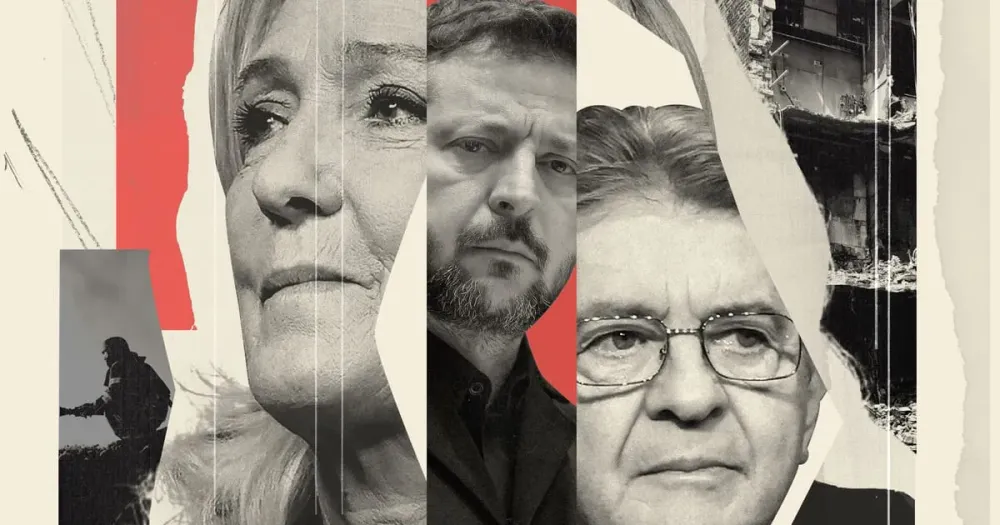
An Ifop-Fiducial survey conducted Nov. 13-16, 2026, puts far-right leader Le Pen at 32% to 36% and far-left candidate Mélenchon at 17% to 19.5% in the first round. According to The Rio Times, both advance in every scenario tested. France votes on April 18, 2027, with the runoff scheduled for May 2.
Both politicians criticize NATO, and opponents accuse them of repeating Kremlin arguments about the war. Their positions differ from Macron's on several fronts, including financial assistance, Ukrainian military operations and France's participation in security arrangements for Kyiv.
Le Pen argues that France's strained public finances cannot sustain financial aid to Ukraine. Mélenchon opposes Ukrainian attacks deep inside Russia and drew criticism for supporting a referendum on whether Donbas residents want to belong to Russia or Ukraine. Much of the territory is under Russian occupation, preventing a free and fair vote.
Marko Mihkelson, who chairs the Estonian parliament's foreign affairs committee, warned that the French result could have far-reaching consequences for European security and the alliance. His concern is shared in Baltic and Nordic capitals. Of eight lawmakers and diplomats interviewed by POLITICO in Europe and Ukraine, roughly half feared either candidate would weaken Europe's resolve toward Russia; the others expected them to accept the European consensus once elected.
Le Pen sets out aid cuts
Le Pen has pledged to suspend French financial assistance to Ukraine within six months of taking office if she wins in 2027, Il Foglio reported. Her deputy campaign director, Renaud Labaye, told Le Monde that the cuts would extend to funding routed through the European Union. The National Rally verbally communicated that position to Ukrainian Ambassador Vadym Omelchenko in mid-November.
That pledge reaches beyond bilateral aid: France accounts for 18% of European funding plans for Ukraine, according to Il Foglio. Citing the Kiel Institute, the newspaper reported that France has allocated €7.9 billion in bilateral assistance since Russia's 2022 invasion, with military aid making up 78%. Another €19.45 billion through European mechanisms brings its contribution above €27 billion, placing it second to Germany among major European contributors.
Le Pen nevertheless has sought to reassure Kyiv, including through a private meeting with Omelchenko earlier this week. She has also tried to distance her party from its pro-Russia reputation, rooted partly in a 2014 loan from a Russia-linked bank and her 2017 meeting with Vladimir Putin.
Mélenchon says he is defending Ukrainians' interests. But his earlier statements, including attributing part of the blame for Russia's 2014 annexation of Crimea to NATO's eastward expansion, have fueled doubts about his commitment to Kyiv.
France's military and political role
The concerns extend beyond money. Three European diplomats told POLITICO that Macron's principal contribution is political leadership, which they fear could disappear under either prospective successor. France trails countries such as Germany and Sweden in military aid, but it is the EU's only nuclear-armed member and helps lead European security efforts for Ukraine.
A Ukrainian official identified France's commitments to security guarantees, future EU funding and the Coalition of the Willing as the main vulnerabilities. In that official's assessment, France does not rank among the top 10 for financial support; the greater danger would be its ability to break European consensus. A NATO diplomat separately warned that a change in Paris could make a common European position in peace negotiations harder to achieve.
The Coalition of the Willing began in March 2025 as a British-French initiative and now includes 35 nations, according to the U.K. Ministry of Defence. Its military arm, the Multinational Force-Ukraine, was formally created through a Declaration of Intent signed by Britain, France and Ukraine in January 2026. Britain and France share command through a Paris headquarters scheduled to rotate to the U.K. before the end of 2026.
The force has military commitments from 24 countries. It is neither a peacekeeping force nor connected to NATO, the ministry says. Its first major exercise, Koalicja, spans Nov. 9-22 in Poland and rehearses logistics for a future deployment. Ukrinform reported participation by about 2,800 personnel from 11 countries, including roughly 1,100 French troops, alongside about 30 aircraft and 500 vehicles. A senior official on Macron's military staff said the exercise demonstrated an ability to deploy at short notice.
A National Rally official rejected the coalition approach, telling POLITICO: "The coalition of the willing, that's not our thing." The official said the party instead wanted France to reclaim an independent voice internationally.
The candidates' differences with the government also surfaced after Radio France Internationale confirmed this week that French military personnel were conducting training missions in Ukraine. Russian Foreign Minister Sergey Lavrov called their presence "direct participation" in the war, an accusation rejected by French Deputy Defense Minister Alice Rufo. Mélenchon and National Rally spokesperson Laurent Jacobelli used similar language to Lavrov, warning against France becoming a "co-belligerent."
Berlin seeks a more durable funding arrangement
German Chancellor Friedrich Merz is seeking to secure longer-term EU financing for Ukraine in a proposal that appears designed partly to protect aid from a possible Le Pen presidency. Future funding decisions under his plan would need a qualified majority rather than unanimous approval.
In a letter to European Council President António Costa, Merz proposed room to raise money beyond the €100 billion already put forward by the European Commission for the bloc's next seven-year budget, POLITICO Europe reported. He made German backing for that budget conditional on an agreement to raise an additional €45 billion for Ukraine in 2027 and establish a financing outlook from 2028 onward.
Hungary, Czechia and Slovakia are likely to oppose the proposal. Leaders are due to discuss it at a special EU summit on Nov. 26-27, 2026.
Kyiv keeps diplomatic channels open
Ukraine is trying to maintain contact with candidates who could soon govern France despite their disagreements with Macron's policies. Foreign ministry spokesperson Heorhii Tykhyi said Ukrainian ambassadors are engaging politicians in their host countries and that every French presidential candidate is welcome to visit Ukraine. Oleksandr Merezhko, chairman of the Ukrainian parliament's foreign relations committee, said the effort could include "informal meetings to test the waters."
Le Pen and President Volodymyr Zelenskyy have exchanged invitations to meet, although they disagree over the venue. Ukrainian officials also responded favorably to Mélenchon's effort to clarify his Donbas referendum remarks after Kyiv initially criticized them. Tykhyi described the response from Mélenchon and his team as balanced and urged politicians not to politicize support for Ukraine.
Zelenskyy has publicly played down the election risks. "We will work with whoever the French people elect. After all, the European Union is 27 countries, not just one," he told POLITICO during a meeting with a small group of reporters last week.
Other officials are less confident. A former French official now working for the EU characterized Kyiv's approach as "wishful thinking," comparing it with Ukrainian expectations before Donald Trump's second term. A Western European diplomat said some diplomats believe Le Pen would moderate her Ukraine policy in office, as Italian Prime Minister Giorgia Meloni did.
That diplomat also suggested the National Rally might seek weaker sanctions against Moscow. France already plays a central role in efforts against Russia's shadow fleet, which carries oil sold in violation of EU sanctions. Because EU countries must regularly renew sanctions unanimously, a French veto could unravel them.