
Technology transfer at the center of the deal
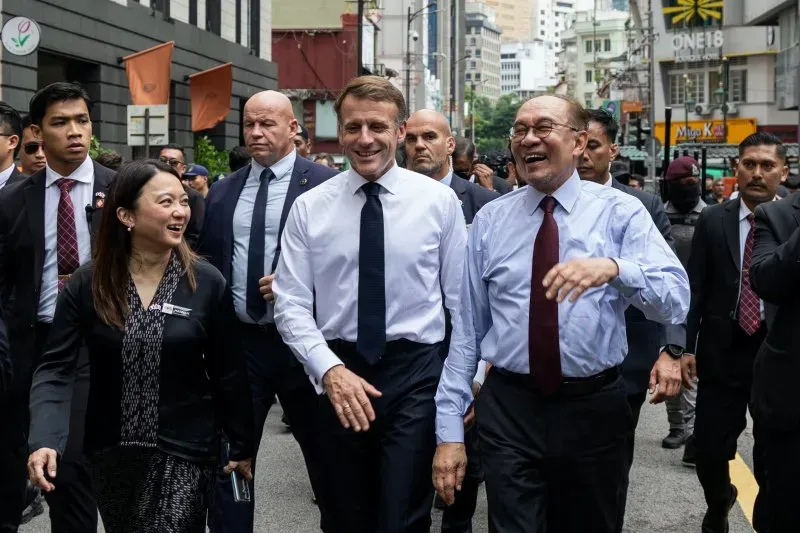
The two countries upgraded their relationship during French President Emmanuel Macron's November 16-17, 2026, visit to Malaysia. Their Strategic Partnership spans critical minerals, defense, energy and advanced technologies.
One project involves France's Carester and Malaysia's Malaco Mining Group, with operations expected to start in early 2027. The planned division of work places extraction and processing in Malaysia and further refining in France.
Imran said French cooperation could help diversify Malaysia's economy and expand its industrial capabilities, but those benefits should not come with a new dependence on an outside partner. "Malaysia must avoid becoming a mineral supplier for somebody else's industrial revolution. We should welcome French investment, but Malaysia must not exchange one form of dependency for another," he said.
He called for Malaysian companies to have a larger role in separation, refining and downstream manufacturing, alongside technology transfer and higher-value work for local employees and suppliers. "If France wants access to our rare earths, it should also help Malaysia acquire the technology, knowledge and industrial capabilities to become a producer of higher-value products," he said.
The government has described a broad scope for the cooperation. Deputy Natural Resources and Environmental Sustainability Minister Syed Ibrahim Syed Noh told the Dewan Rakyat on Thursday that it would cover technological expertise and development across the rare earth value chain, extending from mining and processing to high-value products.
Industrial plans in Malaysia and France
Carester's work with its Malaysian partner predates Macron's visit. An April 2026 paper from the ISEAS – Yusof Ishak Institute says the French refining and recycling specialist signed a memorandum of understanding with Malaco Mining Sdn Bhd in July 2025 to reduce dependency risks and facilitate technology transfer.
In France, Carester's Caremag facility at Lacq is scheduled to open in late 2026. The project secured €216 million in financing, comprising €110 million from Japanese investors and €106 million from the French government.
Caremag is designed to recycle 2,000 metric tons of magnets and refine 5,000 metric tons of mining concentrate annually. Its planned yearly production includes about 800 metric tons of neodymium-praseodymium oxides and 600 metric tons of combined dysprosium-terbium oxides. Carester says the latter volume represents around 15% of global production.
Malaysia also has domestic production goals. According to the ISEAS paper, the Ministry of Natural Resources and Environmental Sustainability has set 2030 targets for the ion-adsorption clay rare earth industry: annual upstream output of 30,000 metric tons of total rare earth oxides, midstream production of 10,000 metric tons of neodymium-praseodymium, and downstream production of 35,000 metric tons of NdFeB super-magnets.
Reserves, processing and export rules
An October 20, 2026, CSIS report estimates Malaysia's rare earth deposits at 16.1 million metric tons, placing its reserves third globally behind China's 44 million metric tons and Brazil's 21 million. The deposits consist largely of heavy rare earths in non-radioactive ionic clay.
The same report says Malaysia became the first country outside China to produce dysprosium oxide in 2025, a key heavy rare earth used in the defense industry. Investment in a new facility is set to increase the country's annual heavy rare earth processing capacity from 1,500 metric tons of feedstock to 5,000 metric tons.
Malaysia continues to maintain the moratorium on raw rare earth exports that took effect on January 1, 2024, while permitting limited exports under conditions for research, development and processing.
The ISEAS paper identifies the MCRE Resources in-situ leaching project in Perak as the only legal rare earth mine exempt from the raw export ban. It reportedly shipped 20,336.80 metric tons of rare earth carbonate to China between February 2023 and July 2025, with Perak receiving RM71.5 million in total royalties.
The paper also describes commitments Malaysia made to the United States under the Agreement on Reciprocal Trade, signed in October 2025. Malaysia agreed not to restrict rare earth magnet sales to US companies or impose bans or export quotas on critical minerals or rare earth elements destined for the United States.
Environmental safeguards
Imran also urged attention to pollution and waste management risks from rare earth extraction and processing.
The ISEAS paper recounts a suspension of MCRE Resources' Perak operations for three weeks in November 2025 after Sungai Perak's water turned blue. Radiation readings at the site reached 13 becquerels per gram, compared with the limit of 1 becquerel per gram permitted under the project's initial environmental impact assessment report. Mining resumed in January 2026 after regulators lifted the suspension.
Different goals for strategic autonomy
Imran, an international relations expert specializing in Global South affairs, linked the timing of Macron's visit to European concerns about strategic vulnerabilities. He said the war in Ukraine, energy insecurity and geopolitical tensions had exposed Europe's reliance on outside suppliers of minerals, energy and technology. Growing European interest in the Global South could give developing countries more bargaining power, he added.
Although both Malaysia and France emphasize strategic autonomy, Imran said their economic and geopolitical circumstances give the concept different purposes. For France, it is chiefly about safeguarding its international position and limiting vulnerabilities. Malaysia, he said, needs to use it to overcome structural economic dependence and build its own capacity for development.






