
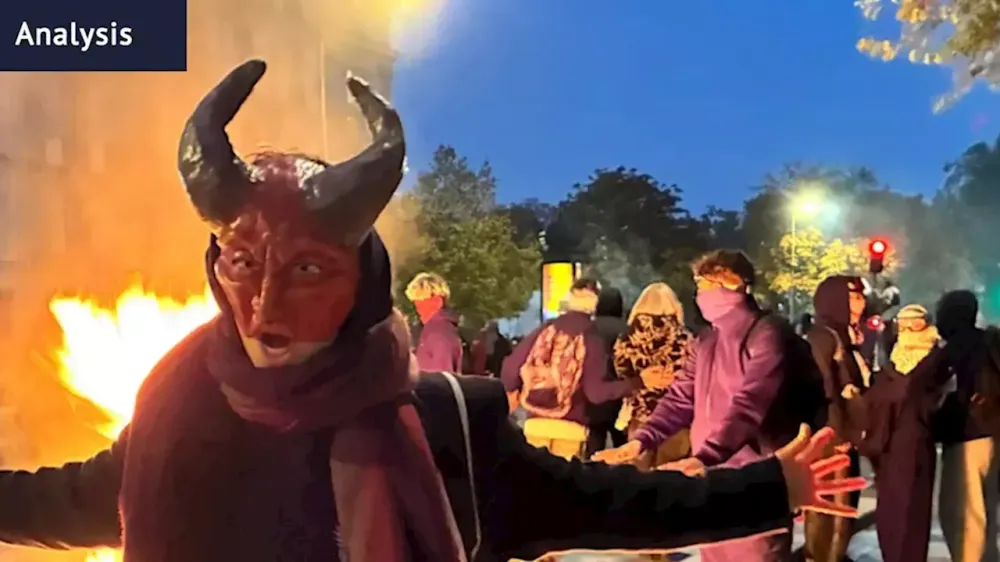
Confrontations at the march's endpoint
The march was supposed to finish peacefully at Place de la Nation, east of central Paris. Near sunset, photographers captured masked participants posing beside burning trash before confrontations broke out. Paris police said about 200 violent individuals attacked officers who were arresting a man suspected of setting a trash bin on fire in the square.
Masked groups also lit fires along Boulevard Voltaire. Police eventually charged down the boulevard, pushing protesters back and blocking streets to disperse them. The fires were extinguished, and officers regained control of the square as they came to outnumber the remaining protesters.
No new looting was observed that evening. Some stores still bore damage from earlier unrest, particularly around Place de la République, the center of the October 17 riot in Paris, where many shops remained boarded up.
The Interior Ministry recorded 46,000 marchers in Paris and 146,000 across France on Saturday; unions estimated 75,000 in the capital and 250,000 nationwide. Turnout was lower than on the previous three weekends. About 70,000 security personnel were deployed nationwide.
Masked groups and student grievances
French media describe the anarchist and far-left activists involved in the clashes as the black bloc, also using the term casseurs, or breakers. Dressed in black balaclavas, hoodies and pants, they coordinate through social messaging apps. Their face coverings offer protection from tear gas while making identification more difficult. Many French students have publicly disavowed their violence and property destruction.
Students who initiated the demonstrations have accused police of excessive force, including injuries caused by stun grenades. ACAB, an abbreviation for "all cops are bastards," was the most frequently heard chant in the crowd.
Political hostility, rather than ethnicity, united the protesters. Signs denounced fascism, demanded President Emmanuel Macron's imprisonment and ridiculed Marine Le Pen. People from different migrant backgrounds were among those confronting officers, but the unrest was not a race-based uprising.
That picture differed from the explanations offered by US President Donald Trump, who blamed migrants, jihadists and communists, and Israeli Prime Minister Benjamin Netanyahu, who attributed the unrest to an invasion of extremist Islam.
A growing movement in an election season
The movement began in mid-September 2026 with high school students protesting poor school conditions. University students, teachers, unions and the revived Yellow Vests subsequently joined. The protests are considered part of wider European unrest in 2026.
November 7 marked the fourth straight weekend of demonstrations against rising living costs. The October 17 protests had drawn about 550,000 people nationwide, including 110,000 in Paris, according to the Interior Ministry. AFP described the violence that day as France's worst riots in years. An arson attack in Limoges partially destroyed its 19th-century town hall.
The demonstrations come about five months before France's 2027 presidential election. Polls place far-right candidate Marine Le Pen in the lead, with hard-left leader Jean-Luc Mélenchon as her main rival.
Damage liability bill and Yellow Vest detentions
Lawmakers are considering the casseurs-payeurs, or "breakers pay," bill to recover damage costs. The proposal would make people participating in violent gatherings liable for up to €10,000 even if they did not personally cause the damage. It would also permit the seizure of certain social benefits.
The Senate approved the measure on October 27, 2026, by 229 votes to 105, sending it to the National Assembly. The bill was first introduced after violence following Paris Saint-Germain's Champions League victory in May 2026.
Separately, police detained Yellow Vest leaders Benjamin Ball and Azelma Sigaux outside the National Assembly on Saturday during a banned rally near parliament and the Élysée Palace. They were released on Sunday, November 8.
Wage talks and an education strike
Prime Minister Sébastien Lecornu was scheduled to meet unions and employer federations on Monday, November 9, to discuss wages and purchasing power. Student and teacher groups also called for a strike on Tuesday to demand increased education spending.






