Pensions, pay and spending
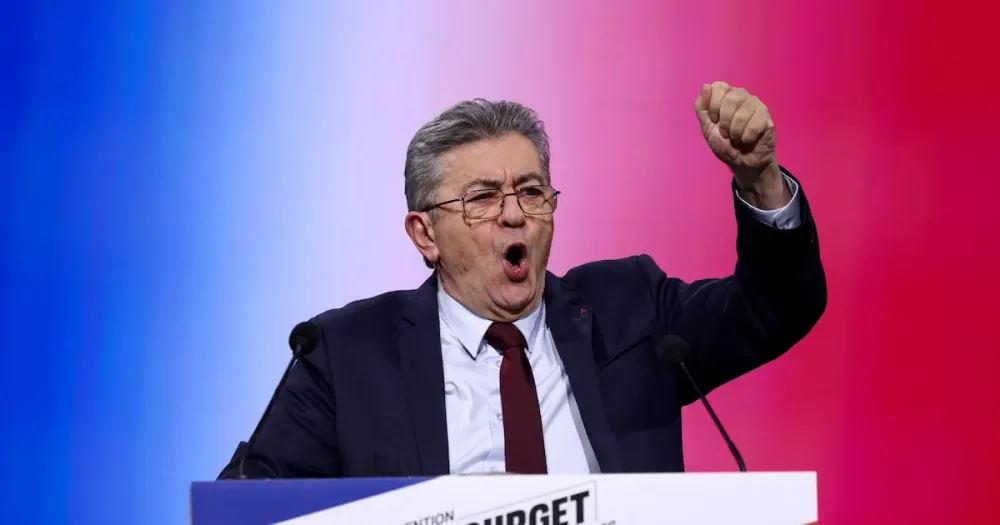
At the rally, reported by Reuters, Mélenchon declared that "everything must change" and promised an economic course opposite to President Macron's. His manifesto, "L'Avenir en commun" ("The Future in Common"), updates LFI's program ahead of the 2027 presidential election.
Mélenchon's pension proposal would let people retire at 60 after contributing to the system for 40 years. He pledged to repeal Macron's reform, under which the statutory retirement age is rising gradually from 62 to 64.
He also proposed increasing the net minimum wage from roughly 1,480 euros to 1,700 euros, a rise of about 15%. Wages would be indexed to inflation, while prices for essential foods would be capped. His tax plans include ending the flat tax on capital income and raising taxes on high-income households.
Mélenchon presented stronger household purchasing power as the basis for economic stimulus. He said "more than half of French economic activity comes from consumer spending" and argued that expanding consumption should be the starting point. He also pledged support for bringing production facilities back to France after they had moved overseas.
The platform includes canceling part of France's debt, Le Temps reports. LFI expects financial markets to react with hostility but rejects the idea that it should seek to reassure them.
A larger platform, with costs still to come
The updated manifesto contains 1,069 proposals, including 238 new ones, according to Le Temps. That is nearly twice the number in LFI's 2022 presidential platform. The party published it as a book of more than 200 pages, priced at €4.90.
Detailed cost estimates did not accompany the program's release. Party officials call it a "foundation" and say around 50 further documents will explain individual measures, Euronews reports. Le Temps says the costing is expected in early 2027.
Mélenchon and Éric Coquerel, the LFI chair of the National Assembly's finance committee, had presented a separate "revised budget" for 2027 at a mid-October press conference. According to Euronews, that proposal included roughly €100 billion in additional tax revenue and €80 billion in additional spending.
Ecological priorities and a later renewables target
Environmental transformation has moved to the forefront of the program, displacing the creation of a Sixth Republic, which led earlier editions, according to Euronews. LFI proposes replacing France's administrative regions with "eco-regions" organized around water-resource management and strengthening constitutional protections for the environment.
The party remains committed to phasing out nuclear power, but it has moved its target for reaching 100% renewable energy from 2050 to 2060. Mélenchon pledged to cancel construction of next-generation EPR2 reactors and ruled out extending existing reactors' operating lives beyond 60 years.
At the rally, he also promised a "new ecological state" based on planning, called for a "social state of emergency" and advocated giving 16-year-olds the right to vote, Euronews reports.
A staged departure from NATO
Mélenchon set out a two-stage NATO withdrawal: France would first leave the alliance's integrated military command, then gradually exit NATO itself. He argued that France had no reason to belong to the alliance or participate in America's wars and should deepen cooperation with non-aligned countries.
The manifesto also calls for suspending the association agreement between Israel and the European Union, according to Euronews. It advocates a ceasefire in Ukraine but offers little detail on military support for Kyiv. Its proposed new European security framework would include Russia.
Rivals respond as alliances take shape
The launch comes amid continuing large-scale protests in France, which Mélenchon has encouraged. The government accuses him of inciting violent demonstrations. In his rally speech, he attacked Macron's closing period in office and far-right National Rally candidate Marine Le Pen. Responding to calls for more moderate rhetoric, he said "there will be no watering down of wine."
Le Pen denounced the manifesto on X as a "plan to dismantle France," Euronews reports. Former Prime Minister Édouard Philippe criticized Mélenchon's "communitarian vision" and "administered economy." Philippe said he saw "many points in common" between Mélenchon and Le Pen, citing their "hatred of European integration" and wish to "leave NATO."
Mélenchon has also gained formal support from most Communist and overseas-territories members of the National Assembly, who endorsed him on Thursday despite French Communist Party leader Fabien Roussel's own candidacy, according to Euronews. The Greens are expected to decide in mid-December whether to ally with LFI.
Considered a strong contender on the left, Mélenchon could face Le Pen in a runoff, though he trails her in current polling. The Connexion's November polling overview puts Le Pen at 32.5% to 38% and Mélenchon at around 17.5% in polling averages. He ranks second in every mainstream poll except those conducted by Elabe.
The election's first round is scheduled for April 18, 2027. If no candidate wins more than 50% of the vote, a runoff will follow on May 2.