Confrontation at Place de la Nation
The Interior Ministry estimated that 46,000 people marched in Paris, while student unions put attendance at 75,000. Their national counts also differed: the ministry reported 146,000 demonstrators, compared with about 250,000 counted by student unions.
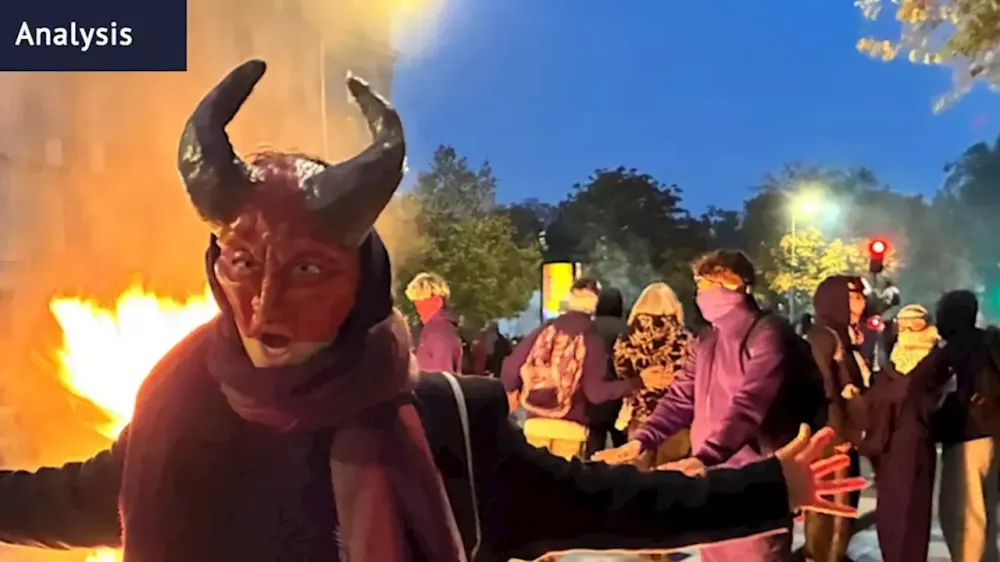
Around sunset, activists at the front of the Paris crowd readied fireworks to confront police, and fires burned along Boulevard Voltaire. Some young men wore red masks and bull horns beside trash emptied from bins and set alight.
Officers broadcast repeated orders to disperse before charging down the boulevard with stun grenades and tear gas. The use of stun grenades in the recent confrontations has injured protesters and deepened the conflict.
The remaining crowd scattered, and police extinguished the fires and regained control of the square. No further looting was observed. Elsewhere in Paris, boarded-up stores around Place de la République still showed the aftermath of the October 17 riot, whose epicenter was the square.
Student Demands and Masked Activists
French students have disavowed the property damage, using the term casseurs, or breakers, for those responsible. Student groups and union organizers have nevertheless continued their marches despite the recent violence and looting.
Among the most confrontational activists were people dressed in black balaclavas, hoodies and pants; some wore ski masks against tear gas. French media describe these groups as the ultra-left, or ultra-gauche, encompassing anarchists and socialists. Riot organizers use social messaging apps to coordinate their movements.
Masked participants urged others forward with chants of ACAB, meaning "all cops are bastards," the crowd's most frequent slogan. Signs denounced fascism and demanded prison for President Emmanuel Macron. Protesters also ridiculed Marine Le Pen, the right-wing politician leading polls for the next presidential election.
The unrest centered on political grievances, not ethnicity, and the crowd included white and Black participants from migrant backgrounds. US President Donald Trump blamed migrants, jihadists and communists, while Israeli Prime Minister Benjamin Netanyahu portrayed the unrest as an invasion of extremist Islam. That description did not reflect the diverse Paris crowd.
Nationwide Policing and a Banned Yellow Vest Rally
Interior Minister Laurent Nuñez said 232 people had been arrested by 6 p.m. on November 7 and almost 40,000 stops and searches had taken place during the day. Across France, 70,000 police officers and security personnel were deployed.
Authorities had banned protests in Paris other than the authorized march at Place de la Nation. Defying that decision, about 100 Yellow Vest demonstrators gathered at Place de la Concorde after the movement called for "mass disobedience." Riot police quickly surrounded them.
Earlier that afternoon, police arrested Yellow Vest leaders Benjamin Ball and Solene Azelma Sigaux near the National Assembly after they attempted to gather at Place de la Concorde.
What the Riot-Damage Bill Would Change
The casseurs-payeurs, or "rioters pay," bill was initially presented as a response to violence following PSG's Champions League victory in May 2026. Looting during the October 17 demonstrations gave the proposal renewed urgency, according to Public Sénat. DW described that unrest as France's worst rioting in years, with damage to public and private property exceeding one billion euros.
During the night of October 27-28, the Senate passed the bill 229-105 and sent it to the National Assembly for debate. Under the text, people who knowingly participated in a violent gathering, or remained after two police dispersal orders, would face joint civil liability. Damages would be capped at €10,000 per person. Masks worn during unrest remain an obstacle to identifying those responsible.
The Senate's version would let the state recover damages by seizing portions of social benefits, including family allowances, housing assistance known as APL, and the RSA minimum income. A minimum-subsistence safeguard, called reste à vivre, would apply.
Senators also voted 219-115 for a government amendment expanding the Pharos portal's authority to request removal of online material likely to cause serious public disorder, including calls for violence or insurrection. Platforms would have 24 hours to remove the content or face blocking or de-referencing.
Union Talks Scheduled
Prime Minister Sébastien Lecornu was scheduled to meet trade and employee unions on Monday, November 9. The government has said it plans to raise the minimum wage and increase funding for schools and teaching staff, while public debt stands at 119% of GDP.