
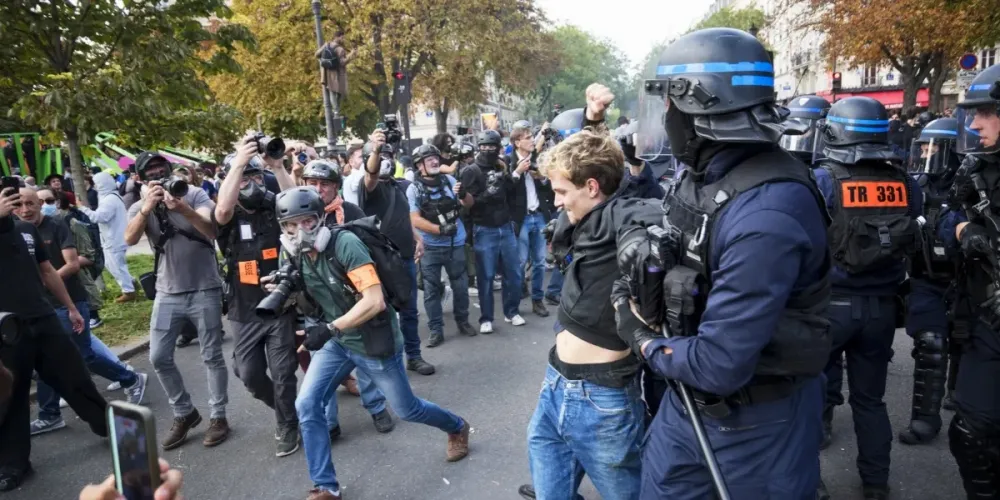
False reports targeted migration and security fears
The EU assessment examined activity from October 7 to 21 by Operation Overload, a network that circulated manipulated videos made to look like reports from established Western news outlets. Its fabrications included allegations that migrants had sexually assaulted demonstrators and warnings of imminent terrorist attacks.
The unrest followed demonstrations that began in September over conditions in public schools, then broadened to encompass living costs and cuts to public services. Some protests escalated into clashes with police, arson and looting, with severe riots across several French metropolitan areas.
Investigators said the network used fears about migration and security to present France's leadership as "both ineffective and increasingly authoritarian." Rather than organizing the street protests, the operation sought to "take advantage of unrest that was already underway."
The campaign also blamed European financial and military assistance to Kyiv for hardship at home. According to the assessment, it sought to erode support for Ukraine by claiming that governments placed foreign commitments above their own citizens' basic needs.
Speaking on October 21, President Emmanuel Macron drew a similar distinction between the demonstrations and online interference: there was no visible evidence of foreign organization of the protests, he said, but deliberate attempts to manipulate information about the crisis had occurred.
Russia's foreign ministry did not answer Reuters' request for comment on the assessments. Moscow has previously rejected French accusations of disinformation operations as politically motivated.
Other foreign accounts drew larger audiences
A separate French foreign ministry investigation examined how other foreign accounts portrayed the unrest. It found that accounts linked to Israeli officials and influencers, along with networks associated with the American Make America Great Again (MAGA) movement, promoted narratives blaming immigration and radical Islamism for the riots.
The ministry's figures showed a wide gap in reach on X between October 16 and 18. The 10 most-viewed posts from pro-Russian accounts received about 2.8 million views, compared with more than 49 million for the top 10 posts by MAGA-affiliated politicians and commentators. Posts from Israeli government-linked accounts and influencers received more than 35 million views.
Those audience figures do not establish coordination among the groups or show that every post was false, the ministry's assessment cautioned.
Elina Treyger, a senior political scientist at the RAND Corporation, characterized such foreign efforts as a long-running "narrative competition." She said they can shape perceptions of Western democracies and heighten anti-immigrant sentiment.
A network built around impersonation
Operation Overload predates the French unrest. According to the EU assessment cited by Reuters, it has operated since September 2023, targeting Western public figures, institutions and media organizations to damage trust in them and discredit their support for Ukraine. Researchers also call the network Matryoshka and Storm-1679; its activity spans X, Telegram and Bluesky.
The London-based Institute for Strategic Dialogue (ISD) has documented its use of artificial intelligence to imitate expert analysts' voices, along with forged newspaper banners and manipulated video reports. These impersonations are intended to deceive audiences and undermine confidence in established news organizations.
In a review covering January through March 2025, ISD examined at least 135 pieces of content from the network. It found impersonations of more than 80 organizations, with media outlets, universities and law enforcement accounting for three-quarters of them. The material targeted 10 countries in 10 languages. Germany was targeted most often, followed by France, while Macron appeared more frequently than any other politician.
ISD found that most of the network's material attracted little organic engagement and depended heavily on bots. One exception was a video falsely alleging that USAID paid for celebrity visits to Ukraine. It surpassed 4.2 million views after a prominent conspiracy account shared it and other high-profile accounts amplified it.
ISD also cited a finding by French government agency VIGINUM that Operation Overload appears to purchase X accounts from WebMasterMarket. ISD described this as an example of state-aligned actors drawing on commercial services, including AI chatbots, public relations agencies and hosting providers.
A separate attempt to stage a Budapest rally
In Hungary, investigations by InformNapalm and Ukrainian Militant described a different Russian influence effort: an attempt by operatives linked to Russian intelligence to arrange paid protests outside parliament in Budapest in support of a state-backed Rosatom nuclear project.
Their reporting, published October 26, 2026, relied on data obtained by the hacker group 256 Cyber Assault Division. Investigators identified Russian Colonel Timur Sirtlanov and Lieutenant Colonel Irina Parman as participants, linking both to military unit 33949. Open-source investigations have associated that unit with Russia's Foreign Intelligence Service, the SVR.
The planned rally in support of Paks II was initially set for September 20, then moved to September 26. Organizers canceled it about 30 minutes before its scheduled start.






