Recreating the M3 driving experience
The electric sedan represents a new direction for the M3, rather than an adaptation of the M5's plug-in hybrid powertrain. A combustion-powered M3 is also planned, but will arrive later.
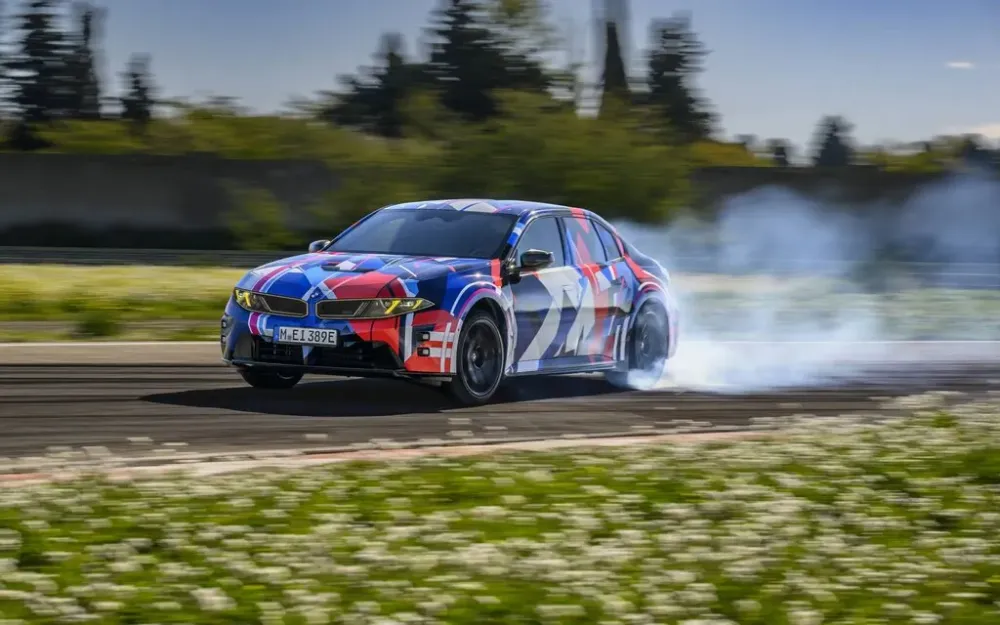
BMW's engineers studied the M3's previous generations, from the E30 through the G80, as they worked to preserve the model's driving character. At the Miramas circuit, Guide Auto's reviewer found the electric prototype easy to manage near its limits and forgiving enough to finish track sessions with a controlled slide. Steering was more precise and responsive than in the i3, although the battery's substantial weight remained noticeable.
Drivers can use the steering-wheel paddles to select six simulated gear ratios, which BMW calls "stages." Responses are nearly instantaneous, with jolts intended to mimic a conventional transmission.
An optional synthetic soundtrack changes with accelerator input and simulates an engine reaching redline when the driver does not shift up. Guide Auto's reviewer described its sound as "cyberpunk," closer to a spaceship than a familiar BMW engine. A lap with the sound disabled left the reviewer finding the audible cues more intuitive; drivers can also switch them off and hear little beyond the tires.
Four motors, structural battery and revised bodywork
The four motors are grouped at the centers of the front and rear axles. The front pair is rated at 643 horsepower and the rear pair at 751 horsepower, while total system output is 838 horsepower. The higher rear output reflects the car's rear-biased power delivery.
A 100 kWh battery forms part of the vehicle's structure and supports DC fast charging at up to 420 kW. Estimated North American range is around 480 km, compared with the 750 km promised for the i3 50 xDrive. L'argus reports that BMW claims a 10-minute charge can restore 350 km of range, but cautions that the figure lacks a specified driving cycle.
The M3 has structural reinforcements beyond those of the i3 and its own suspension setup. The test cars used carbon-ceramic disc brakes; BMW also plans to offer a less expensive braking system.
No confirmed weight is given in the reports. L'argus estimates about 2,500 kg, while BMW Blog expects more than 2,000 kg, noting that the i3 50 xDrive already weighs 2,205 kg.
Camouflage did not conceal the wider fenders and more muscular front end of the Neue Klasse-based body. BMW says the four small illuminated squares at the bumper's outer edges take inspiration from its race cars. A natural-fiber front splitter replaces the usual carbon-fiber piece, while a central hood opening aids aerodynamics. A rear diffuser and small trunk-lid spoiler complete the visible changes.
Managing energy on the track
Regenerative braking plays a substantial role in the prototype's track performance. BMW says the energy recovered over three laps of Miramas effectively provides enough for another lap. Its engineers also monitored tire temperatures after sessions, and the company says they stayed significantly below those of a vehicle without regenerative braking.
L'argus puts peak energy recovery at about 540 kW. The outlet reports that the brake discs reached only about 70°C after three fast laps behind a pace car, compared with at least 400°C expected without regenerative braking.
Track drivers have three battery strategies, according to L'argus. Hot Lap guarantees maximum power for 2 to 3 minutes, while Short Run supports sessions of about 8 minutes and requires at least a 65% charge. Long Run is designed to maintain performance for 15 minutes without a drop, but requires a battery charge of at least 80%.
An M3 name and a potential power record
BMW M CEO Frank Van Meel has confirmed that the production car will retain the M3 name, without an "iM3" or "i" designation. BMW Blog also notes that a teaser prototype carries an M3 graphic on its roof.
BMW Blog identifies the electric car's internal code as ZA0 and reports that its sources expect 800 to 900 horsepower. That would put it above the 738-hp XM Label Red as the most powerful production M car. BMW M has said it will not pursue four-figure output, choosing to preserve track endurance instead.
Production in 2027, combustion model expected later
BMW says its Munich plant will build the electric M3 alongside the i3 sedan beginning in 2027. BMW Blog reports a planned production start in March of that year.
L'argus reports a January 6, 2027, unveiling for the production model and the start of customer deliveries in June 2027. BMW has not publicly confirmed either the premiere date or delivery timing.
Pricing and demand remain open questions in Guide Auto's assessment, particularly with a combustion alternative still to come. Despite those uncertainties, its reviewer ranked the prototype as the most exciting EV he had driven in his career.
The combustion-powered next-generation M3, internally coded G84, is expected in 2028 with an inline-six engine. According to BMW Blog, it will use a mild-hybrid version of the S58 producing about 525 hp.