Grand Est bears the heaviest shortages
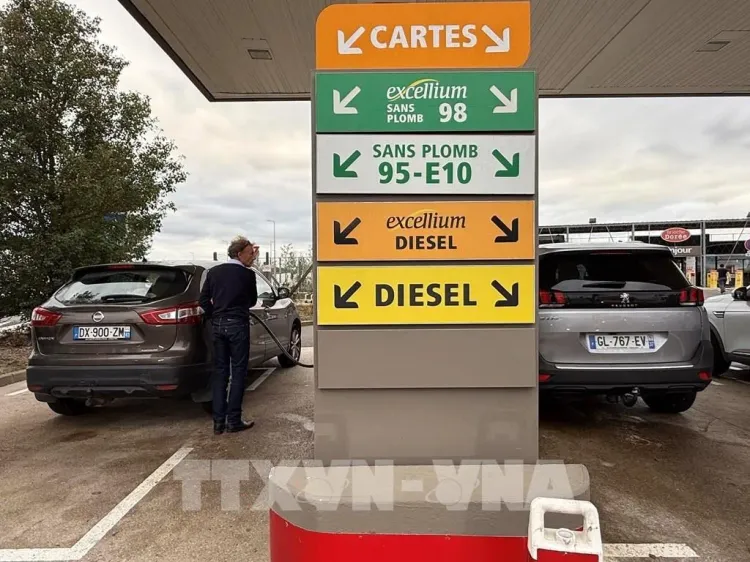
In a post on X, Schelcher warned that growing pressure on the northeast's distribution network could leave individual gas stations temporarily short of fuel. Barges could not replenish supplies regularly because the Rhine was unusually low, he said, while fuel sales had risen sharply since November 2.
Government figures accompanying the warning showed supply problems at 10% of French stations. Grand Est had the highest regional share, at 19%, while 14% of stations in Ile-de-France, which surrounds Paris, were affected. The figures were 12% in both Centre-Val de Loire and Occitanie, 10% in Bourgogne-Franche-Comte, 6% in Brittany and 5% in Provence-Cote d'Azur.
By 9 a.m. on November 16, the share in Grand Est had climbed to 22%, compared with 10% nationally. The government's definition counts a station as experiencing a shortage if it has run out of at least one gasoline or diesel product. The regional figure therefore did not mean that 22% of stations had no diesel.
The national rate subsequently fell to 5% by 8 a.m. on November 18. At that point, only two departments, Territoire de Belfort and Haut-Rhin, still had supply difficulties at more than a quarter of their stations.
Low Rhine levels constrain barge deliveries
The Rhine carries fuel from refining centers in northwestern Europe to inland depots. When the river runs low, barges must reduce their cargoes to avoid grounding. According to the IRU, the reading at Germany's Kaub gauging station was about 60 centimeters on November 13, barely above one-third of the seasonal average, forcing tanker barges to cut their loads sharply. That measurement describes the gauge level, not the depth of the navigable channel.
Schelcher's Cooperative U, formerly Systeme U, is among France's largest supermarket and hypermarket cooperatives. Grocery chains play a central role in the country's retail fuel network, operating hundreds of gas stations.
Switzerland also drew on reserves amid the low-Rhine supply strain. It began using mandatory diesel stocks on October 23, authorizing releases of up to 45,000 cubic meters through November 22. Information cited by the IRU indicated that roughly two-thirds of the authorized volume had been used by November 13.
Discounted reserves and the timetable for sales
France's price-relief program involves releasing about 10 million barrels of diesel from strategic stocks managed by SAGESS. Distributors buy the fuel at the stocks' weighted average acquisition cost. Matignon put that cost at €0.28 per liter, compared with a market price of about €1.10 in mid-October.
The program has several separate deadlines. Decree No. 2026-981, dated October 23, 2026, and published in the Journal officiel on October 24, authorized sales through January 31, 2027, with a ceiling of 1.6 million cubic meters. The October 29 sale order, however, covered only November 1 through November 30, 2026. Distributors purchasing the discounted diesel must pass the benefit on to drivers by March 31, 2027.
Diesel and domestic heating oil qualify for the scheme; gasoline does not. France's release is part of a wider European effort: on October 29, twelve EU countries committed to bringing 42.6 million barrels of emergency reserves to market by the end of January 2027, including 20.5 million barrels of diesel.
Diesel prices fall as driving patterns shift
Price readings during the period showed a substantial decline in diesel costs. Selectra's off-highway series fell from €2.393 per liter on October 30 to €2.154 on November 16. Separately, official station data recorded an average of €2.151 at 6 a.m. Paris time on November 20.
The IRU reported a French average of €2.17 per liter on November 12, a drop of 21 cents in twelve days. That decline was already greater than the government's initially announced range of 12 to 18 cents. On November 17, Mathieu Lefèvre, minister delegate for ecological transition, said more than 90% of stations had passed on price reductions, with diesel down about 20 cents and gasoline about 10 cents.
The supply disruption came alongside changes in fuel use and travel since the outbreak of the war in Iran. Highway operators recorded an overall traffic decline of 3% to 4%, though results differed by network and remained subject to confirmation. Road diesel consumption fell 7.5%, while unleaded gasoline demand increased 0.6% over the same period.
RTL economic commentator Martial You attributed the changing figures to motorists' calculations about prices. He said many appeared to be delaying refueling while waiting for strategic reserve releases that were expected to lower prices at the pump.
Global diesel pressures expected to ease slowly
The International Energy Agency anticipated only gradual relief in the global diesel market. Its outlook called for a small surplus in the fourth quarter of 2026 and a larger one in the first quarter of 2027, but it warned that those additional supplies would not fully replace inventories depleted since the conflict began. A genuine easing of market tensions might arrive no earlier than the second half of 2027, the agency estimated.