UK airports to introduce passport-free entry using facial recognition technology
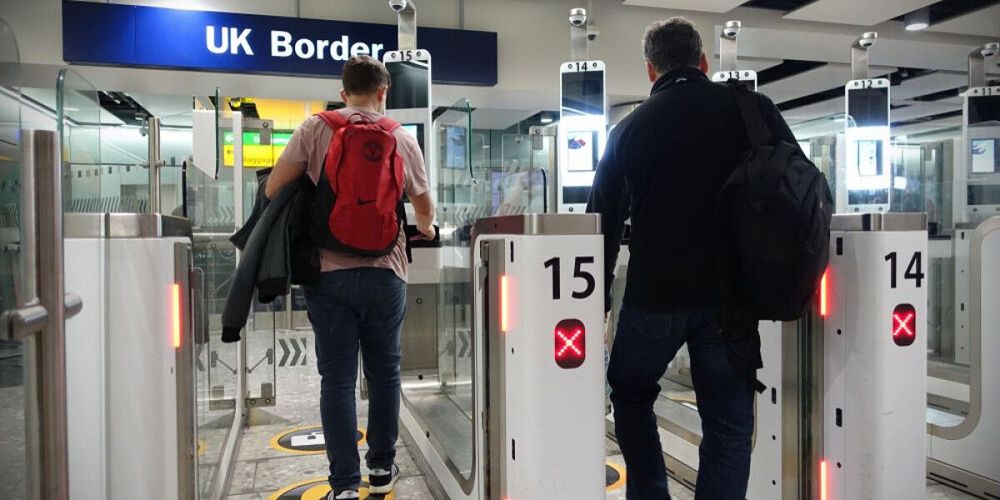
British citizens entering the UK will soon be able to pass through airport border control without scanning their passports, following an upgrade to facial recognition technology at e-gates across the country.
The advanced contactless border system is set to launch at Birmingham and East Midlands airports in the coming weeks, with a nationwide rollout to all 13 airports using e-gates planned for early 2027. The technology is expected to reduce border crossing times by up to 25%.
The system draws on facial biometric models already operating in Dubai and Australia, bringing UK border control in line with international standards. More than 270 e-gates currently operate at British airports and ports, all of which will eventually receive the upgrade.
How the new system works
Airlines will transmit galleries of passport photographs to UK Border Force agents for all eligible passengers arriving each day. Officers will upload these images to the system, allowing facial recognition scanners to verify identities against a much smaller pool of travellers rather than the entire national database.
It will mean we have a more secure border and a much faster transit through the airport. It's quicker, it's more modern, it's more secure. Because we know who's coming and can load up that gallery of who is arriving, it's not a one in 60 million check, it's a one in tens of thousands check.
said Phil Douglas, director general of UK Border Force.
The current e-gate process typically takes 20 to 25 seconds per passenger, but often runs longer when travellers struggle to position their passports correctly on scanners or when passport chips are dirty or unreadable. During a three-week trial at Manchester Airport in October 2025, officials confirmed that most passengers cleared the new facial recognition gates in under 10 seconds.
If facial recognition fails to identify a passenger, they will be directed to scan their passport. Those who cannot be verified through either method will proceed to a physical border control checkpoint, as under current procedures.
Who will benefit from the upgrade
The scheme will initially apply only to British passport holders, but authorities plan to extend it to all nationals currently eligible to use e-gates. This includes citizens of Australia, Canada, Iceland, Japan, Liechtenstein, New Zealand, Norway, Singapore, South Korea, Switzerland, and the United States, as well as EU member states.
Travellers will still need to carry their passports for international journeys, as the technology applies only to entry verification at UK airports.
We are doing this for reasons of border security. It also means our workforce will be able to pivot from doing routine immigration to crime, safeguarding, drugs - officers are going to be much more mobile.
Douglas explained.
Recent changes to e-gate eligibility
The facial recognition upgrade follows another significant policy shift implemented on July 8, 2026, when the UK lowered the minimum age for e-gate use from 10 to eight years old. The government estimates this change allows approximately 1.5 million additional children to use automated border facilities annually.
Children using e-gates must be at least 120 centimetres tall to ensure scanners can properly read their faces, and those under 18 must be accompanied by an adult. Families travelling with younger children must continue to pass through staffed border control points.
Douglas praised the success of opening e-gates to younger passengers.
When we opened the e-gates for eight-year-olds, we wondered if they were going to be able to do it. The funny thing was that the user error rate was much lower than for older passengers.
The UK's move towards streamlined biometric border control stands in contrast to recent developments in the European Union, where the Entry/Exit System began rolling out in October 2025. The EES requires non-EU nationals, including British citizens, to provide fingerprints and facial images when entering the Schengen area, with full implementation expected by April 2026.
The upgraded facial recognition system will be operational at Birmingham, Bristol, Cardiff, East Midlands, Edinburgh, Gatwick, Glasgow, Heathrow, London City, Luton, Manchester, Newcastle and Stansted airports.