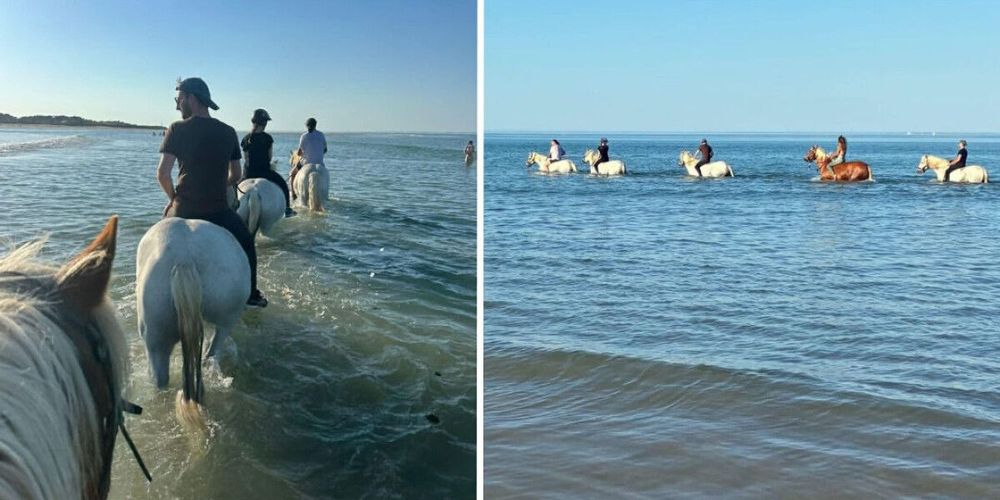
Horseback swimming treks offer refreshing summer escape on Île d'Oléron
Visitors to Île d'Oléron, France's second-largest island after Corsica spanning approximately 175 square kilometers off the Atlantic coast, can experience an unusual way to beat the summer heat: swimming on horseback in the sea.
Les Cavaliers d'Oléron, a riding association based on the island's northern coast near the historic Fort Boyard fortification, offers treks through forests, beaches and marshes aboard Camargue horses. This summer, President Pascal Maria has revived a special activity allowing experienced riders to take the horses into the water for a refreshing swim.
"It is an activity I did years ago with groups of teenagers who came on week-long riding courses. If I was comfortable with their riding level, we would go out into the water and it was like a sort of reward at the end of the week. During the May heatwave, I took some experienced riders out with the horses into the water so they wouldn't be too hot and it sparked the idea of offering this type of trek to the public."
The association first launched in 1993 and operated for eight years before reopening in 2017. Now, as France faces another prolonged period of extreme temperatures, the swimming treks provide relief for both animals and riders.
Timing treks around regulations and heat
Beach access for horses in Saint-Georges-d'Oléron is permitted only before 09:00 and after 19:30 during summer months, as each commune in France sets its own regulations for animal access to beaches through local decrees. These time restrictions align perfectly with Maria's heat management strategy for his horses.
"During hot weather my horses only go outside early in the morning and later on at night, which corresponds with the timings that are authorised by the mairie. It is safer for the riders and the horses. Also, we must not forget that ultimately, it is for the horses' benefit; it is not so much for the riders who can go for a swim whenever they want."
Swimming offers substantial health benefits for horses. The water's buoyancy reduces strain on joints and limbs compared to land-based exercise, while improving muscle tone, cardiovascular fitness and blood flow. The reduced loading and concussive forces make it particularly valuable for injury rehabilitation.
"Swimming is excellent for the horses' health. When they are injured, or when they have a joint problem, we often try to give them as many baths as possible to help them get back into shape, and it is also very good for their hydration. It is more for recovery than anything else, while also being a bit of fun for the riders, many of whom have not experienced it before."
The ancient Camargue breed
Les Cavaliers d'Oléron maintains a herd of 16 Camargue horses, one of the world's oldest breeds with archaeological evidence suggesting ancestors roamed southern France for millennia. Officially recognized in 1978, these compact horses typically stand between 135 and 150 centimeters high and weigh 300 to 425 kilograms.
The breed's distinctive light grey coat results from an unusual color transformation. Camargue foals are born dark—usually black, bay or dark brown—and gradually lighten as they mature, typically reaching their characteristic grey color between four and seven years of age due to black skin underlying a white coat.
"The Camargue is an excellent horse and, what's more, it lives in semi-freedom in its indigenous marshes and wetlands of the Bouches-du-Rhône. It is similar to our surroundings here and that is why I chose this breed for the Île d'Oléron. It is sturdy, quite hardy, energetic and versatile. It is not a particularly large horse, but does have a big heart."
The breed has evolved distinctive physical adaptations for wetland environments, including larger, flatter hooves that resist moisture and navigate marshy terrain more effectively than other breeds—ideal for Oléron's coastal landscape.
Bareback riding requires balance
While Maria welcomes both beginners and experienced riders aged 10 and over on standard treks, swimming excursions present additional challenges. Riders must mount bareback without a saddle when entering the water.
"We always go out in small groups of course and even if they are beginners, participants need to be reasonably fit and have a bit of balance otherwise it can be complicated."
Excursions last one to two hours, with reservations for groups of two to five people available daily until October 31. Bookings can be made by calling 06 40 50 15 29.