Record-breaking summer: France's heatwaves in seven stark statistics
France has faced one of its most challenging summers in recent memory, marked by droughts, wildfires and a succession of record-breaking heatwaves that have wreaked havoc across the country.
These crises have caused extensive damage running into millions of euros, claimed lives and decimated natural resources. By late July, more than 98,000 hectares had already burned in what became the worst wildfire season on record for France. In the Gironde department, fires became so intense they generated pyrocumulonimbus effects—fire thunderstorms that created lightning and sparked additional blazes, an extremely rare phenomenon never before documented in the country.
Between May and August, France recorded five distinct heatwaves, the most ever documented in a single year. The possibility of a sixth remains, with state forecaster Météo France predicting warmer than average temperatures through the coming two months.
These heatwaves have fueled the wildfires and droughts while devastating crops and raising concerns about potential food shortages. Here are seven statistics that capture the scale of this extraordinary summer.
1. 136 weather stations recorded all-time highs
The most striking records came from the temperatures themselves. Hundreds of communes saw monthly highs broken between May and August during successive heatwave rounds, with records falling across all regions of France.
Across this summer, 136 weather stations operated by Météo France in mainland France and Corsica recorded new all-time highs, surpassing every previous measurement—some dating back to the 19th century. Many of these records fell during the intense second heatwave between June 22 and 28.
2. High of more than 40C in Normandy
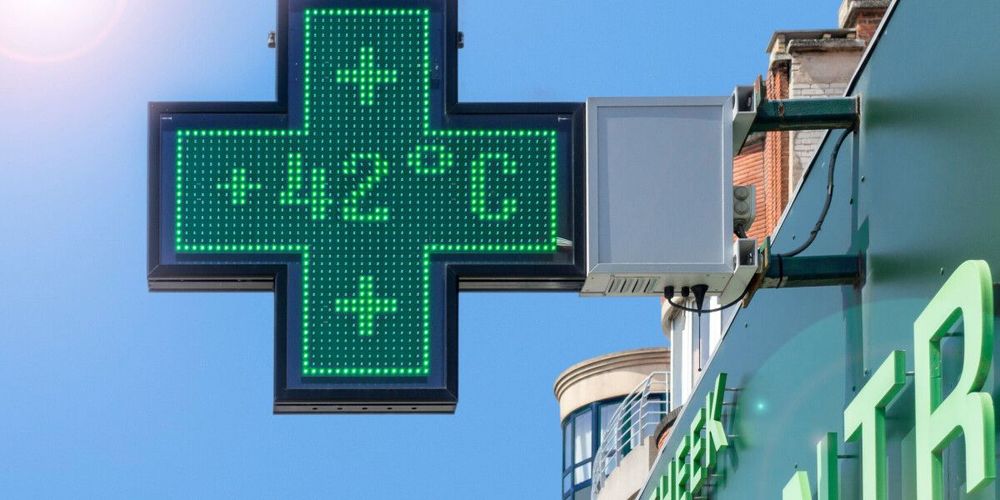
Cities across western France saw extraordinary temperatures: 42.5C at Bordeaux-Mérignac airport in Gironde, 42.7C in both Niort (Deux-Sèvres) and La Roche-sur-Yon (Vendée), and 42C in Vannes (Morbihan).
Even as far north as Caen in Calvados, the Norman city reached 40.8C. In eastern France, new records across Alsace were approximately 1.5C warmer than any previously recorded. All these measurements were taken in shade, meaning direct sunlight conditions felt considerably hotter.
Several new overnight lows were also set, including in Vivès (Pyrénées-Orientales), where temperatures remained above 30.6C on July 9. These tropical nights are particularly dangerous as they prevent bodies and buildings from cooling down after daytime heat exposure.
3. National temperature high broken on three consecutive days
During the June heatwave, France broke its all-time national average high temperature on three consecutive days. The national average, which covers conditions across mainland France and Corsica and accounts for both day and night temperatures, reached 29.8C on June 23, beating the previous 2003 record of 29.4C. It then climbed to 29.9C and 30C on June 24 and 25 respectively.
Apart from a brief period in June, the national average temperature remained above seasonal norms for essentially the entire summer. The devastating 2003 heatwave, which killed approximately 15,000 people in France and more than 70,000 across Europe during a three-week August period, had previously set the benchmark for extreme heat in the country.
4. 52 days of heatwave conditions
For those who felt the heatwave was never-ending this summer, the data confirms their perception. Between June 17 and August 19, France spent a record 52 days under heatwave conditions, according to Météo France data.
This included 14 days in June, 16 days in early July and another 22-day stretch between late July and August 19. For these statistics, a heatwave exists when national average temperatures reach 25.3C for one day and remain at or above 23.4C for at least three consecutive days.
The 2026 total far exceeds any previous year since records began in 1947. By comparison, three separate heatwave periods in 2022 combined for only 33 days. The deadly 2003 heatwave lasted 22 days, while the single-longest heatwave in France, recorded in July 1983, persisted for 23 days.
July 2026 itself was the hottest and third driest July on record in France, with a nationwide rainfall deficit of nearly 70% according to Météo France.
5. 2,000 heat-related emergency room visits in one day
During the most intense heatwave periods, French authorities activated emergency temperature-based Orsec plans, increasing resources for local authorities and opening cooling centers for vulnerable people. Hospitals nationwide implemented their plan blanc emergency protocols in anticipation of patient surges.
The complete death toll from the summer heatwaves will not be known for several weeks, but early indicators paint a grim picture. Between June 17 and July 2 alone, 5,764 excess deaths were recorded—36.2% above average for the period, according to state health body Santé publique France.
People aged 75 and above accounted for 3,719 of these deaths. For the first time during a heatwave period, excess mortality rates were recorded across all age groups from 15 and older. An additional 1,243 excess deaths occurred during the July 3-22 heatwave period, with individuals aged 75 and older accounting for approximately three-quarters of the toll.
On June 26 alone, 2,089 heat-related emergency room visits were recorded, a level unprecedented since health monitoring began in 2004.
6. Nearly 70% of France under crisis drought alert
By mid-August 2026, nearly 70% of France's territory—67 out of 101 departments—was under maximum crisis drought alert, with water allocated only for essential needs such as healthcare and drinking water. Two-thirds of the aquifers that supply most of France's drinking water had dropped below normal levels, and more than 30,000 people were already experiencing tap water cuts, receiving water by tanker instead.
The article references 57 departments on crisis alert at publication, though the number peaked higher during August as conditions worsened.
7. 274 drowning deaths so far this summer
A consequence of the heatwaves and people's desperate attempts to cool down has been a spike in drowning deaths across France. Between May 1 and July 15, 274 drowning deaths were recorded, mostly in rivers and waterways.
Figures for the latter half of summer are not yet available, but the death toll is expected to surpass 2025, when a record 409 people died from drowning during the summer months.
France's warming trajectory is accelerating. During the 20th century, the country's average annual temperature rose by 0.95C, approximately 30% higher than the global average of 0.74C. Official climate projections forecast average temperature increases of 2.7C by 2050 and 4C by 2100 for metropolitan France compared to the pre-industrial era, suggesting that the extreme conditions of 2026 may represent the new normal rather than an anomaly.