Phantom braking incidents under investigation
Eleven motorists have filed complaints claiming their vehicles activated automatic emergency braking systems without any obstacle present, creating potentially dangerous situations on French roads.
The complaints describe vehicles suddenly braking at high speed. One motorist reported her Ford Focus stopped abruptly on a motorway at around 100km/h, while another said her Dacia Sandero repeatedly braked before stopping.
The cases concern vehicles fitted with radar and camera-based collision avoidance systems, which have been mandatory on all new vehicles sold in the European Union since July 2024. This regulatory requirement explains the widespread adoption of the technology across newer vehicle models.
France's vehicle market surveillance authority and the Ministry of Transport are investigating whether software faults, sensor issues or system integration problems could be responsible. Manufacturers have disputed the existence of a widespread defect.
The issue has attracted significant public attention. A Facebook group bringing together affected motorists now has around 3,000 members.
The investigation carries particular urgency following a separate phantom braking incident in France earlier in 2026 in which a passenger was killed. The driver in that case was later convicted of involuntary manslaughter, highlighting the serious legal and safety implications of such malfunctions.
Questions over private radar car effectiveness
Nearly four out of five speeding detections by radar cars do not result in fines, according to the Ligue de Défense des Conducteurs.
The driving organisation says radar vehicles recorded around 3.5 million speeding incidents in 2024, but only 740,000 penalty notices were issued. In other words, 79% of flashes did not produce a fine.
The programme has expanded significantly since private speed camera cars were first introduced in Normandy in 2018. Around 450 private radar cars were operating across France by 2026, up from 223 vehicles in service at the end of 2022. By the end of this year, only Île-de-France and Corsica will not be using them.
In 2024 the majority of radar cars were privately operated. The Ligue compared this with 2020, when radar cars were only police-operated and only 26% of flashes did not result in fines.
The organisation said the figures show privately operated radar cars are not effective and should be discontinued.
Not every radar flash leads to a fine. Detections must pass through checks by officials, including speed tolerance rules, vehicle identification and licence plate recognition.
For mobile radar cars, a 10km/h or 10% margin is applied, depending on the speed recorded. This is higher than for fixed cameras, partially explaining the difference in fine conversion rates between the two systems.
Peugeot and DS recall over faulty door handles
Several Peugeot and DS models are being recalled after a defect was identified with interior door handles.
The fault affects vehicles manufactured between 2022 and 2026 and could prevent occupants opening doors from inside while the engine is running.
The recall covers Peugeot 308, 408, 3008 and 5008 models, as well as DS 4, DS N°4 and DS N°8 vehicles. The recall affects over 142,000 vehicles globally across the Stellantis group, including approximately 110,000 Peugeot vehicles. The defect is caused by a software bug in the Vehicle Supervision Module.
Owners should check their vehicle identification number on the government's RappelConso website and contact their dealer if affected. Repairs carried out under safety recalls are generally free.
The defect could be particularly dangerous if occupants need to leave the vehicle following an accident or emergency.
Stricter mobile phone penalties expand
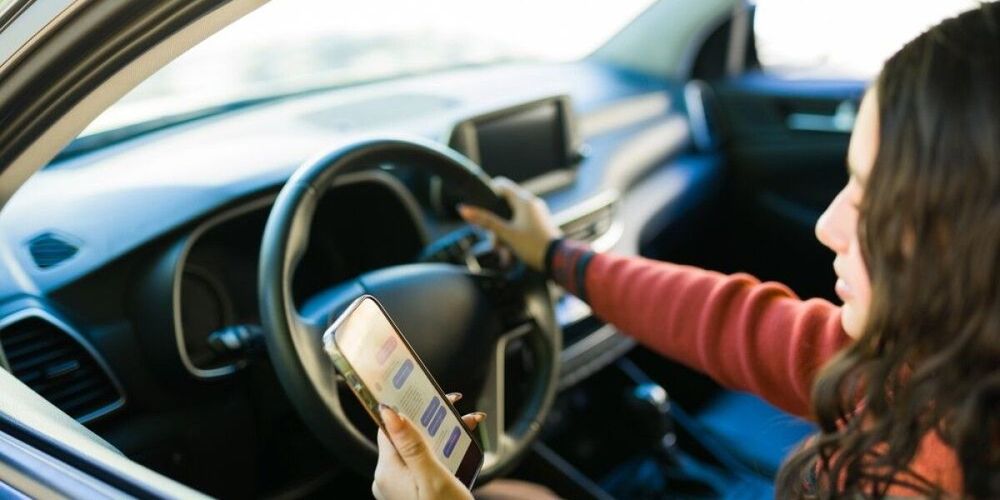
Deux-Sèvres has become the eighth French department to introduce immediate licence suspensions for drivers caught using their phone at the wheel.
The measure, introduced on June 15, adds to existing penalties of a €135 fine and a three-point licence deduction for holding a phone, wearing headphones or touching a phone while driving.
Landes was the first French department to implement the stricter enforcement in November 2025, which explains why it accounts for the majority of the more than 500 licences reportedly suspended since the measure was introduced in participating departments.
The crackdown addresses a serious safety issue. According to France's road safety authority Sécurité Routière, using a mobile phone while driving triples the risk of an accident, while reading or writing a text message increases the risk by a factor of 23. Authorities say mobile phone use at the wheel contributes to around 400 deaths per year in France.
France's junior interior minister Marie-Pierre Vedrenne indicated in May 2026 that the immediate licence suspension for mobile phone use could be extended nationwide, citing rising road fatality figures.
Road safety officials stress that phones may still be used as sat-navs for route planning if they are securely mounted and not handled while driving. Routes should be set before departure, with any adjustments made only when the vehicle is safely stopped.