France's extraordinary relationship with water: from fountains to thermal spas
As a former waterways journalist, I once wrote a book exploring the many ways to enjoy water in the UK. Called Just Add Water, it promised over 100 ways to relax and recharge with the wet stuff. I would never dare attempt such a project in France, where the imagination for watery possibility appears unbounded.
Here, simply ordering a Perrier opens endless choices: très pétillante ou un peu pétillante? Delicately fruit-flavoured or full mineral intensity? De Gaulle famously barked: "How can you govern a country that has 246 types of cheese?" The same could be demanded of France's dizzying spectrum of drinking waters. The country now has 152 mineral or natural spring water sources exploited for commercial use, with French people consuming around 135 litres of bottled water per year. Compare this to England, where just 20 sources appear on the gov.uk website.
This abundance is no accident. French mineral water is strictly controlled by the Ministry of Health, the Academy of Medicine, and the Ministry of Mines. Sources must be surrounded by a secured perimeter of 4 to 6 kilometres called an impluvium to protect against contamination, ensuring the purity that has made French waters renowned worldwide.
Paris pioneers public water access
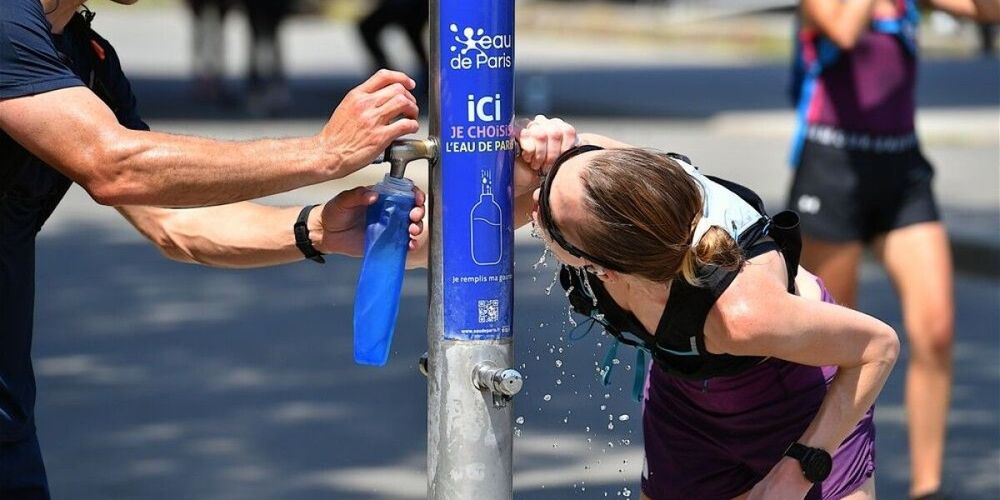
Even tap water receives special attention. Visitors to Paris during recent heatwaves may have encountered the Eau de Paris website, which maps 1,311 free public water points for refilling drinking bottles. Among these are 17 fountains dispensing sparkling water, a Parisian innovation that began in 2010 with the first such fountain installed in the Reuilly garden, making Paris the first French city to offer free carbonated water publicly.
The fountains themselves range in sculptural grandeur from the iconic cast-iron Wallace models to contemporary silhouettes, balled fists, and sleekly minimalist Arceau designs for children and people with reduced mobility. The 109 grand Wallace fountains now gracing Paris streets trace their origins to 1872, when Sir Richard Wallace donated 50 fountains following the Franco-Prussian War and Paris Commune to provide free drinking water to residents recovering from conflict.
The Seine as climate solution
Creative thinking extends to harnessing the city's most famous waterway. Not content with cleaning the Seine for public swimming, Paris has developed an ingenious cooling system that circulates cold river water through a network of pipes. Operating since the 1990s, the system run by Fraîcheur de Paris currently extends 120 kilometres underground, feeding major landmarks including the Louvre and Grand Palais, along with hospitals, schools and office districts. The network aims to triple to approximately 250 kilometres by 2042, reaching over 3,000 buildings and eliminating the need for individual air conditioning units. Future expansion will particularly target hospitals, day care centres and retirement homes.
Therapeutic waters and medical tradition
France embraces water's therapeutic qualities through an extensive spa infrastructure. The Route des Villes d'Eaux links 17 spa towns across eight departments, though France counts more than 100 approved stations thermales nationwide. Around 500,000 people annually attend medically-supervised cures partly reimbursed by the state health system, a practice dating to 1947. Southwest France hosts the largest concentration, with 32 officially recognised thermal establishments in the Pyrénées, Landes and Gers regions attracting more than 200,000 spa guests each year.
I visited my nearest spa town, Saint-Honoré-les-Bains in Nièvre, this July. Here, water naturally rich in sulphur, sodium chloride and trace minerals spawned a sprawling 19th-century neoclassical complex treating respiratory conditions and rheumatic disorders. It remains open to patients today, many reimbursed under state healthcare.
This medical approach distinguishes French water culture. Thermal treatments require doctor prescription and follow rigorous protocols: 18-day programmes with six therapy days weekly, with the state reimbursing 65 percent of the fixed treatment cost for approved chronic conditions including rheumatological disorders, respiratory ailments and digestive problems.
My own doctor recently added "boire 1/2 litre d'eau gazeuse dans la journée" as an enigmatic addition to a repeat prescription. A brumisateur facial mist spray appeared on my hospital's list of essential labour items when I had a baby here in 2017. A recent pharmacy visit suggests such practices continue unabated, with counters heaving with rainbow-coloured refillable cans, traditional eau thermale sprays, and even eau de raisin versions for sensitive skin.
"Water, water everywhere," wrote Coleridge in The Rime of the Ancient Mariner, though his protagonist lamented having not a drop to drink. Conversely, the real challenge in France lies in navigating the sheer scope to quaff, spritz, prescribe, commercialise, splash in or use water to cool entire cities. For the unversed foreigner, understanding French waters can feel like genuinely thirsty work.