Brassioux: The American suburb frozen in time in central France
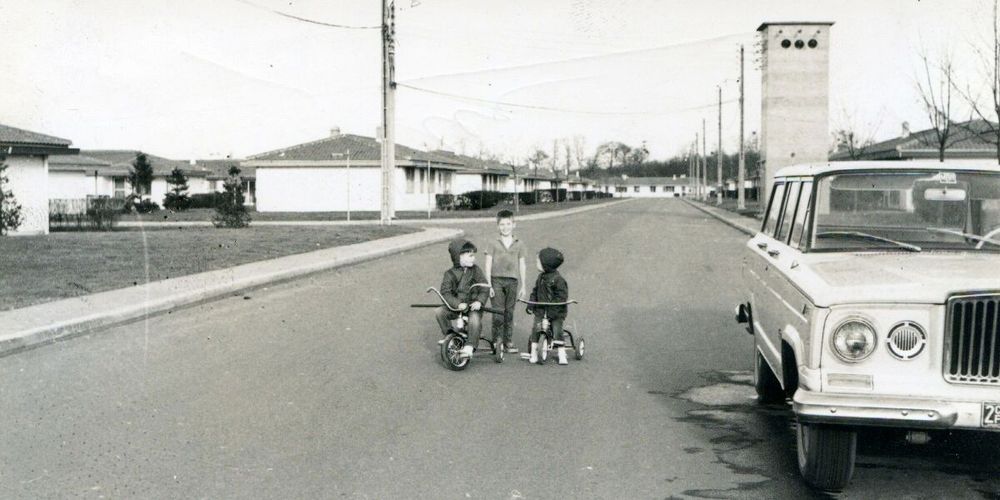
Six kilometres north of Châteauroux in central France lies Brassioux, a 350-home neighbourhood in Déols (Indre) that looks unlike any other French suburb. While one side features standard 1970s-80s French cottages, the other presents a distinctly American scene: single-storey ranch houses with screen doors, wide front yards, low-pitched roofs, attached garages and streets curving into culs-de-sac.
"Consider it France's first American-built suburbia," says Bruno Mascle, author of 1951-1967 – Les Américains à Châteauroux and a retired journalist who worked 40 years for La Nouvelle République in Châteauroux. He bought a house in Brassioux in 2009.
A NATO suburb modelled on California
The neighbourhood's American character is no accident. Before Brassioux existed, only a single farm occupied the swampy land. In 1957, NATO and the U.S. government financed construction of the suburb to house U.S. Air Force officers stationed at the nearby Base Aérienne 103 de Châteauroux-Déols. The final agreement for the Châteauroux-Déols Air Depot (CHAD), which became the largest depot in Europe to support the United States Air Forces in Europe and other NATO air forces, was signed on 27 February 1951.
Brassioux drew its blueprint from Lakewood and Panorama City, quintessential post-war planned suburbs in California. Lakewood, developed between 1950 and 1953, built more than 17,000 homes with assembly-line efficiency, becoming one of the first Levittown-style communities on the west coast. The California model proved so popular that on the first day of sales on 24 March 1950, an estimated 25,000 to 30,000 people lined up to view Lakewood's model homes, with over 200,000 visiting during the first month.
This suburban template arrived in France during the Marshall Plan era, when American investment was reshaping postwar Europe. Between 1948 and 1952, the Marshall Plan transferred approximately $130 billion (in 2010 USD) to European countries—around 5 percent of U.S. GDP in 1948—providing dollar assistance to purchase commodities including food, fuel and machinery, and funding infrastructure reconstruction projects.
American amenities in a French countryside
The contrast with 1950s Châteauroux proved stark. While the town lacked public healthcare, electricity and running water, Brassioux featured cookie-cutter ranch-style homes with subfloor heating and unlimited access to fuel oil and electricity. Interiors emphasized practicality with built-in storage, modern kitchens and two to three bathrooms per home. "Americans came in here like kings of the hill," Mascle observes.
At its peak in 1956, the base employed 3,750 French workers alongside 6,000 American military personnel, creating significant economic impact on the local community. Overall, more than 14,000 GIs were stationed in Châteauroux and surrounding areas at the operation's height.
At La Martinerie Air Base, troops enjoyed state-of-the-art amenities: a 600-bed hospital, two cinemas, football and baseball fields, a bowling alley, a nine-hole golf course and a firefighters' barracks. They shopped at the PX, a supermarket selling fridges, radios and televisions—luxuries at the time. "Similarly, consider that they brought the first supermarket to France," Mascle adds.
De Gaulle's decision and the American departure
The American presence ended following President Charles de Gaulle's decision to withdraw France from NATO's integrated military command. On 7 March 1966, de Gaulle announced the withdrawal, giving foreign NATO forces one year to depart France, with an April 1967 deadline. His decision stemmed from his belief that France was losing its independence in foreign policy due to U.S. dominance within NATO, and he refused to store U.S. nuclear weapons on French soil.
A farewell ceremony on 23 March 1967 marked the American exit, with the last personnel departing in December 1967. French families then purchased the homes and gradually adapted them. Original street names—Texas Drive, Ohio Drive, Nevada Avenue—became allée des Anémones, avenue des Capucines and allée des Primevères. Characteristically American open front yards were enclosed with privet hedges.
A suburban model for France
Brassioux's blueprint—car-centric layouts, standardised homes and self-contained amenities—prefigured France's banlieue pavillonnaire explosion. By the early 1970s, more than 40 Levitt-style developments dotted suburban Paris, marking a shift from grands ensembles to single-family homes, as urban historian Marie Cartier documented in La France des "petits-moyens" (2008). This transition gained momentum as state funding for large-scale housing projects diminished following the economic crisis of the 1970s, and as grands ensembles underwent demographic shifts that brought increased social challenges.
Yet Brassioux never fully shed its American identity. "The Cité de Brassioux remains a strange enclave, an exiled archipelago in the Champagne berrichonne countryside, just five kilometres from the urban area," writes PSS-archi, a collaborative platform dedicated to architecture and urban planning. Mascle insists there is "a little supplément d'âme"—a touch of added soul. "It remains an American area."
Preserving the transatlantic legacy
The US Museum in Châteauroux, run by the association Châteauroux c'était l'Amérique, preserves relics from the era: Cadillacs, jazz records and the first hamburgers cooked on French soil. The Saint-Cyran building, a 13-storey tower built for NATO generals, still looms over the city, while the Flamme de l'Amitié (Flame of Friendship), lit in 2010, honours the transatlantic bond. The Collège La Fayette, originally Collège Touvent and constructed by Americans between 1951 and 1967, was renamed in 2017 for the 50th anniversary of the base's closure.
Since 2025, the annual Brassioux American Days festival has kept the spirit alive with cowboy hats, mechanical bulls and 1950s nostalgia.
In March 2026, Mascle ran for the départementales elections on a platform of revitalising local commerce. For Brassioux, this meant reviving the neighbourhood's commercial heart. "There's only a small grocery store and a pharmacy left. What we would have wanted was a tobacco shop and a newsagent. We would have needed a hairdresser and a baker." He lost with 48.47 percent of the vote.
His connection to Brassioux transcends politics. As a child, he grew up in Chennevières, a small village in Eure-et-Loir along the D939, where the U.S. Air Force was stationed from 1953 to 1967. "My basket was full of American toys," he remembers. "I grew up with a baseball bat lying around wherever I went in the house."
In 2009, when he bought his Brassioux house, he donated part of the kitchen to the US Museum. While gardening, he found Lincoln pennies—coins from his childhood resurfacing in the soil, literally binding him to the place.
"You do not move into Brassioux by accident. You never get over your childhood. It's a family inheritance."