Hotels see demand soften
Didier Arino, who heads the research and consulting firm Protourisme, said hotels in Paris, Lyon and Marseille were seeing reservations decline. He and other industry observers interviewed by AFP said the scale of the damage to tourism would depend on whether violence resumed in the following weeks.
MKG Consulting reported that, since the second week of October, Paris hotels had missed out on potential reservations for the next six weeks. Its figures also showed a sharp slowdown between October 19 and 20: for stays scheduled for October 20-29, the share of rooms booked went from 1.0 percentage point above the comparable 2025 level to just 0.2 points above it.
For the shorter October 20-25 period, the year-over-year lead narrowed from 3.5 percentage points to 1.9 points. "This slowdown is especially notable for near-term and high-end stays," MKG said, comparing the pattern with December 2018, when Yellow Vest protests swept through Paris.
Separate industry figures reported by Travel Extra showed that 27% of reservations were canceled for October 19-25, 2026, stays compared with the same period a year earlier. New hotel reservations dropped 47% on October 18, while cancellation rates in the Paris Île-de-France region were around 10%.
Arino estimated that one day of rioting and urban violence in central Paris produced a cancellation rate of about 1% of the monthly total in the days afterward, with the same effect for the following weeks. "For the 42 million hotel nights forecast for 2026, that's not major. But watch that you don't underestimate the effects from repeated incidents," he said.
Visitors weigh safety concerns
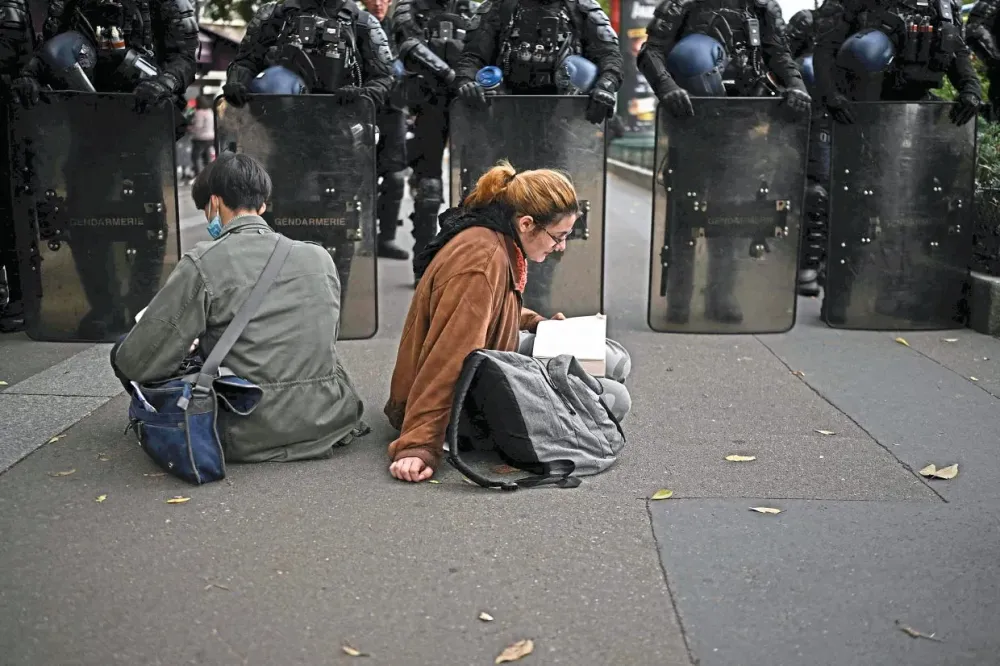
The unrest began with cost-of-living and anti-government protests on October 17, 2026. DW described that weekend's rioting as among the worst France had experienced in recent years.
International coverage showed confrontations with police, fires at public buildings, looting and masked young men moving through the streets. On social media, the usual carefully presented cafe scenes gave way to influencers asking "Is Paris safe?" Many used artificial intelligence in thumbnails or videos to attract clicks.
"The surge of violence in the centres of Nice, Paris, Lyon – it's catastrophic," said Christelle Cassagne, head of ADN Tourisme, which represents France's tourism institutions. "When you book a hotel for a week, it's not so you (can) stay stuck in the hotel," she said.
Some visitors also encountered disruption at the Louvre, which recently closed because a small group of student protesters blocked its entrance. The closure disappointed travelers who had made the museum a priority. An Indian businessman staying at an expensive Paris hotel, who declined to be named, described his own hesitation: "Honestly, we were not certain that we'd keep our stay."
Arino said travelers coming from farther away were more sensitive to safety risks, making the effect on those markets greater. Visitors from the United States and some Asian countries also tend to spend more during their trips than Europeans. France's annual visitor spending exceeds €70 billion, equivalent to RM320 billion.
Governments issue travel warnings
The United States, China and Germany were among the countries issuing travel advisories for citizens in France as reservations weakened. DW also reported warnings from the Czech Republic, the Netherlands, Poland, Denmark, Sweden, Finland and Norway.
Malaysia advised its citizens to consider delaying nonessential trips until conditions improved.
French authorities introduced curfews in specific areas after the weekend violence, according to DW. Overnight restrictions covered the areas around Place de la République and Les Halles in central Paris, while localized restrictions continued in Lyon, Bordeaux, Nice and Marseille.
Public buildings and bike fleets damaged
The destruction extended to prominent public sites. Fire engulfed Limoges' town hall, which dates to 1883, on Saturday, bringing down its roof and belfry. Lyon's tourist office at Place Bellecour was also set on fire, DW reported.
Authorities arrested a 40-year-old man in connection with the Limoges fire, and the Counter-Terrorism Sub-Directorate joined the investigation. Prime Minister Sébastien Lecornu told parliament that 1,000 police officers and gendarmes had been injured nationwide during the weekend, a toll he called unacceptable.
Shared-mobility companies reported damage to their Paris fleets as well. Dott said roughly 300 e-bikes had been destroyed and another 120 severely damaged, putting its losses at about €400,000. Lime reported that 6% of its fleet in the capital was damaged or destroyed. Smovengo said about 300 bikes from its 20,000-strong Vélib fleet had been damaged or stolen.
Industry watches for further unrest
Laurent Abitbol, head of the executive board at travel agency group Selectour, said the duration of the unrest would be decisive. "If this lasts two weeks, that's not so serious. However, if this continues for several months it will be catastrophic."
He also criticized the impression created by international broadcasts. "When you watch CNN, or Fox News, BBC, all that, you'd believe that France is at war. That's not good," he said.
DW reported that further demonstrations were planned for the weekend following the unrest. French unions also called rallies for November 5, 2026.