Buses assigned to rapid transit service
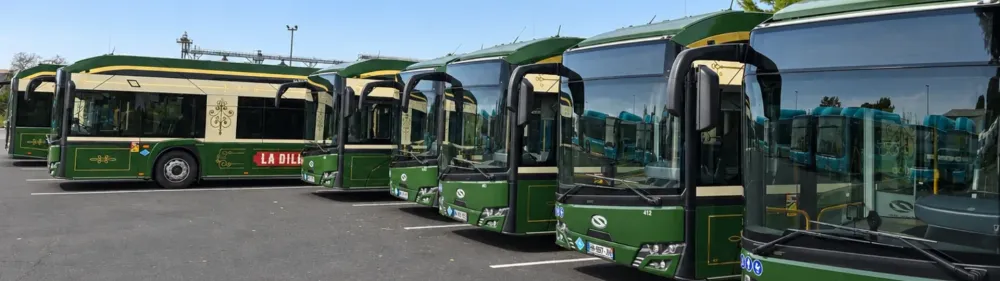
Purchased through UGAP, France's central purchasing body, the buses are Solaris' first vehicles for the wider Béziers agglomeration. RATP Dev Béziers Méditerranée is the fleet's operator, and the vehicles are assigned to beeMob's bus rapid transit line, according to Ballard Blog and Entreprises Occitanie.
Ballard Blog identifies the fuel cell engine fitted to the buses as Ballard's 70 kW FCmove-HD. Each vehicle accommodates more than 90 passengers and has passenger information displays, CCTV cameras, USB charging ports and safety equipment that includes blind spot detection.
The fleet also includes eSConnect remote diagnostics, intended to let the operator monitor vehicle parameters in real time and help manage the buses efficiently.
The delivery adds to nearly 700 buses Solaris has supplied to France as it expands its presence across the country. Across Europe, more than 900 of its Urbino hydrogen buses are in operation in over 50 cities.
Local refueling and renewable hydrogen production
Qair operates the station supplying the Béziers buses in the Méridienne business zone, near the A9 and A75 highways. Inaugurated on April 22, 2026, the facility is designed to dispense as much as 600 kg of hydrogen daily.
The buses' hydrogen comes from Hyd'Occ in Port-La Nouvelle, which was inaugurated on November 12, 2026. Its promoters describe it as France's largest renewable hydrogen production plant. The initial phase provides 20 MW of electrolysis capacity, with a designed annual output of 2,700 metric tons. A planned second phase would increase those figures to 40 MW and 5,400 metric tons a year.
Together, the buses and refueling infrastructure form part of a regional hydrogen mobility initiative intended to support a local ecosystem for producing and using green hydrogen from renewable sources.
According to Qair Group and Entreprises Occitanie, investment in the Hyd'Occ plant-and-stations project totals €130 million, including €55 million in bank financing from Crédit Agricole and Bpifrance. France's ADEME awarded €8 million toward plant construction and €1.7 million for the Béziers station. Total state support for the regional project amounted to €13 million.
Connections to a wider European corridor
The Béziers facility and a second station in Narbonne were selected through the "Corridor H2 Occitanie" call for proposals, Qair Group says. The initiative brings together the Occitanie Region, the European Investment Bank and the European Union through its Connecting Europe Facility (CEF), with the goal of establishing a zero-emission transport corridor linking the Iberian Peninsula and Northern Europe.
In October 2026, the Narbonne station refueled a hydrogen-powered heavy truck traveling from the Netherlands in the HyWayOne Challenge. The truck covered about 3,800 km through six European countries. Qair points to that journey as evidence that the north-south hydrogen corridor is taking shape.