August 12 eclipse in France approaches: five questions answered
A rare near-total solar eclipse will sweep across France and the UK on the evening of August 12, 2026, as the moon passes between the earth and the sun. While total darkness will occur only in parts of northern Spain and Portugal, millions across Europe will witness a dramatic partial eclipse — the first major solar event visible from mainland Europe since 1999.
The August 12 event marks the beginning of an exceptional astronomical period for the Iberian Peninsula. Another total solar eclipse will cross Spain on August 2, 2027, with totality lasting up to 6.5 minutes, followed by an annular eclipse visible from Portugal and Spain on January 26, 2028. This clustering of three eclipses within less than two years represents a historically rare opportunity for European observers.
Adding to the cosmic spectacle, August 12 will offer stargazers multiple celestial events in a single day. Before dawn, six planets will form a visible arc across the sky, creating a rare planetary alignment. After the eclipse concludes, the Perseid meteor shower will reach its peak under ideal viewing conditions, as the new moon ensures exceptionally dark skies.
Timing and visibility across France
The eclipse will begin in France at approximately 19:30, reaching maximum coverage between 20:15 and 20:30. However, exact timing varies by location. Online simulators such as Photo Ephemeris and EclipSEOP can provide precise local times and eclipse parameters for specific areas. When using EclipSEOP, add two hours to the displayed Coordinated Universal Time to convert to French time.
The extent of solar coverage will differ dramatically across regions. South-western France will experience the most dramatic views, with up to 99.5% of the sun obscured in some areas. Toulouse will see 97.8% coverage, while Bordeaux, Montpellier and Marseille will witness more than 96% obscuration. Paris will experience 92.2% coverage, and Strasbourg around 89.9%.
In northern Spain, observers will witness complete totality, with the sun fully obscured for nearly two minutes in some locations. The UK will see a partial eclipse, with up to 96% coverage in the far south-west.
The 1999 total solar eclipse followed a different path across Europe, with totality visible from southern England, northern France, Belgium, Luxembourg, Germany, Austria, Hungary, and Romania, where maximum totality lasted 2 minutes and 23 seconds.
Choosing an observation location
As the eclipse begins, the sun will sit low above the western horizon, appearing as a crescent shape. Coastal areas, hilltops and locations with unobstructed western views will provide the clearest sight lines, weather permitting. Minimising light pollution will also enhance the viewing experience.
Local community groups and astronomy societies often organise observation events at optimal locations. France's Nuits des Étoiles festival, scheduled for August 7-9, will feature additional stargazing activities in the days before the eclipse.
Critical eye protection requirements
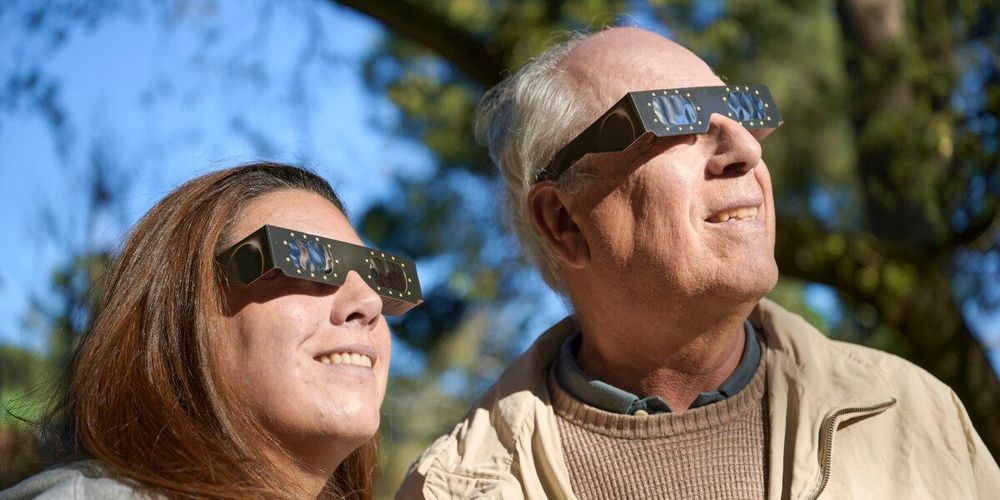
Despite most of the sun being covered during the eclipse, looking directly at it without proper protection can cause permanent eye damage. Even when 99% of the sun's surface is obscured, the remaining crescent remains intense enough to cause retinal burns, despite illumination levels appearing similar to twilight.
During a partial eclipse, the darkened sky causes pupils to dilate, which paradoxically allows more harmful light to reach the retina when viewing the partially eclipsed sun. This can potentially cause more damage than looking at the uneclipsed sun.
Solar retinopathy occurs when intense light causes photochemical damage to the retina, particularly affecting the central vision area. The damage is painless and may go unnoticed until hours or days after exposure, potentially resulting in permanent vision loss or distorted vision.
Observers must purchase special eclipse glasses from reputable suppliers. These glasses should clearly identify the manufacturer, include usage instructions, and state compliance with the ISO 12312-2 standard for solar viewing filters. This international safety standard, developed by the International Organization for Standardization in 2015, forms the basis for CE certification required for legal sale of eclipse glasses in Europe.
Regular sunglasses and damaged eclipse glasses offer no protection. Children under three must not view the eclipse. Older children and adults should limit viewing to three consecutive minutes with proper protection, allowing eyes to rest between observations.
French health authorities advise immediately consulting an ophthalmologist or calling 15 if you experience vision loss, spots in your vision, blurred vision or distorted images in the hours following the eclipse.
Photography considerations
Photographers must keep eclipse glasses on at all times and should not view the sun through camera viewfinders without protection. Cameras and mobile phones require special neutral density solar filters to prevent equipment damage from concentrated sunlight.
Camera settings should be adjusted to minimise light entering the lens, protecting the camera sensor from potential damage during the eclipse.
The August 12 eclipse continues Spain's remarkable eclipse history. Between 1900 and 1912, Spain experienced three total solar eclipses known internationally as 'The Spanish Eclipses,' with the 1905 event attracting scientific expeditions from France, the United Kingdom, Italy, Switzerland, Portugal, the Netherlands, Russia, Hungary, Mexico and the United States. The upcoming series of eclipses visible from the Iberian Peninsula echoes this historically significant period of astronomical observation.