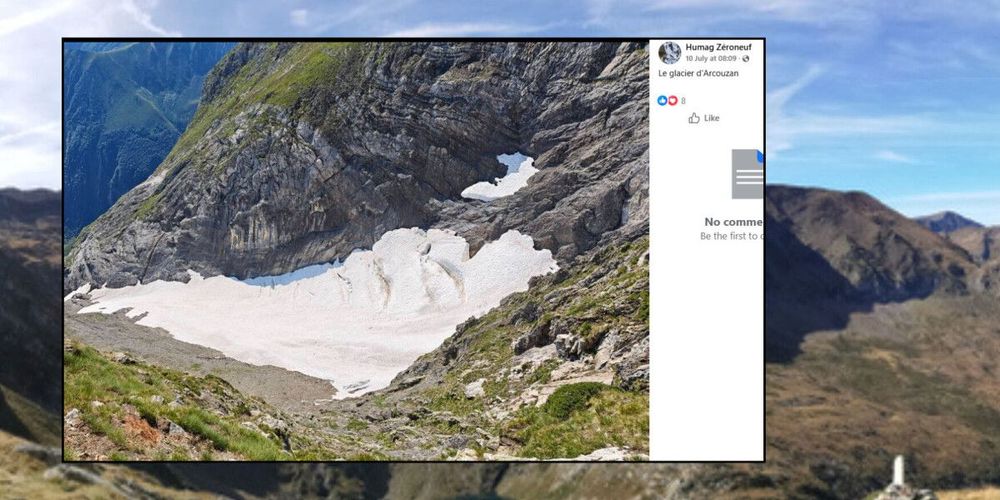
Arcouzan glacier: France's last Ariège ice body offers fragile hope amid Pyrenean collapse
Recent photographs of the Arcouzan glacier, nestled beneath Mont Valier's north-east face at 2,838 meters, show it blanketed in snow despite France's prolonged summer heatwaves. The images have sparked cautious optimism for the last remaining glacier in the Ariège department, but glaciologists monitoring the Pyrenees warn against premature conclusions.
Pierre René, a glaciologist at Association Moraine, which has monitored French Pyrenean glaciers since 2001, emphasized that topography provides the glacier's lifeline. The glacier occupies a sheltered cirque on the mountain's north-east side, where it benefits from shade and regular winter avalanche deposits from above. North-facing cirques receive significantly less solar radiation than south-facing slopes in the Northern Hemisphere, resulting in lower temperatures and reduced ice-melt throughout the year.
Arcouzan holds a unique position in the Pyrenean system as the only glacier situated below 3,000 meters and the most eastern and isolated ice body in the entire mountain chain. These favorable conditions help it shrink more slowly than its neighbors, but René stressed that the glacier is still retreating.
We cannot say it is resisting climate change. It is shrinking less than other glaciers in the Pyrenees, but it is still shrinking.
Waiting for October's verdict
The melt season extends until October, making July assessments unreliable.
Today the glacier is still covered with snow, but by September it will probably be completely exposed. Only then can we assess whether the year has been favorable or not.Glaciologists measure ice bodies at the season's end to determine annual changes in mass and extent.
Association Moraine, created in 2001 to address a knowledge gap after systematic observations ceased in the late 1980s, now monitors nine glaciers on the French side of the Pyrenees. Their 2024 monitoring showed a balanced year for glacier mass following extreme losses in 2022 and 2023, though the long-term trajectory remains unfavorable.
Dramatic regional decline
The broader picture across the Pyrenees reveals an accelerating crisis. When René began monitoring in 2000, 44 glaciers existed across the range. Today only 17 remain. By the end of 2023, the Pyrenees contained just 15 ice bodies with a total area of 143.2 hectares, down from 27 ice bodies covering 302 hectares in 2011.
Historical data shows the scale of loss. In 1850, the mountain range supported 52 glaciers. By 1984, this had fallen to 39, and by 2016 only 19 survived. The total glacierized area dropped by 23.2 percent between 2011 and 2020 alone, with three glaciers shrinking so much they stopped moving and no longer qualify as glaciers. Since 1850, Pyrenean glaciers have lost 88 percent of their volume, and since 2011 they have been thinning at approximately 0.7 meters per year.
Temperature increases drive this collapse. Since 1950, temperatures in the Pyrenees have risen by more than 1.5 degrees Celsius, causing progressive glacier shrinkage that has accelerated in the 21st century. Over the past quarter-century, glacier surface area has shrunk by more than 60 percent, with one or two ice bodies disappearing annually on average.
A fragile future
In all likelihood, within 10 to 15 years, Arcouzan will also have disappeared. It is the smallest glacier in the Pyrenees, making it especially fragile.
The crisis extends beyond the Pyrenees. In the French Alps, retreating glaciers threaten summer skiing on the Grande Motte glacier in Tignes, where warmer temperatures and reduced snow cover have shortened the season. Alpine reference glaciers lost more than 24 meters in thickness between 1997 and 2017, corresponding to a mean annual mass loss of 1.2 kilograms per square meter.
For now, Arcouzan's sheltered position provides temporary reprieve from the warming that has claimed dozens of its neighbors. But as René cautioned, the glacier's apparent health in July offers no guarantee of survival beyond the coming decades.