Turning a blank canvas into a garden for all seasons
In Fromental, a rural commune of around 540 inhabitants located 38 kilometers north-east of Limoges in the Haute-Vienne department of Nouvelle-Aquitaine, an exceptional garden has been cultivated to provide visual interest throughout the entire year. Le Grand Bagnol, begun in 1994 on land left fallow for over a decade, now stands as a mature and richly planted landscape surrounding a restored old farmhouse.
Annie Specht Carpentier, a Haute-Vienne native who spent years working at the European Union's Council of Ministers in Belgium, purchased and renovated the property with her husband Guy, an engineer. While Guy restored the buildings, Annie embarked on designing the garden from scratch.
"Everything had to be cleared. I had a blank canvas," Annie recalls. "I designed the garden on paper. It was only long weekends and holidays at first. We would often drive from Belgium with a car full of plants because there were very few specialist nurseries nearby at that time."
The property encompasses one hectare in total, including the buildings. The naturally acidic soil has proven ideal for cultivating acid-loving plants. With a pH between 4.5 and 6, the conditions suit ericaceous species such as rhododendrons, camellias, and heathers perfectly. This soil chemistry also allows Annie's hydrangeas to maintain their blue coloration, as acidic soil with pH 5.5 or lower provides the aluminum availability necessary for blue flowers, whereas neutral to alkaline conditions would turn them pink or red.
"My parents always had a kitchen garden, it was normal to grow things," Annie explains. "I like to cultivate and to propagate. I do lots of cuttings and divisions. I have a greenhouse to help with that."
Structured Diversity
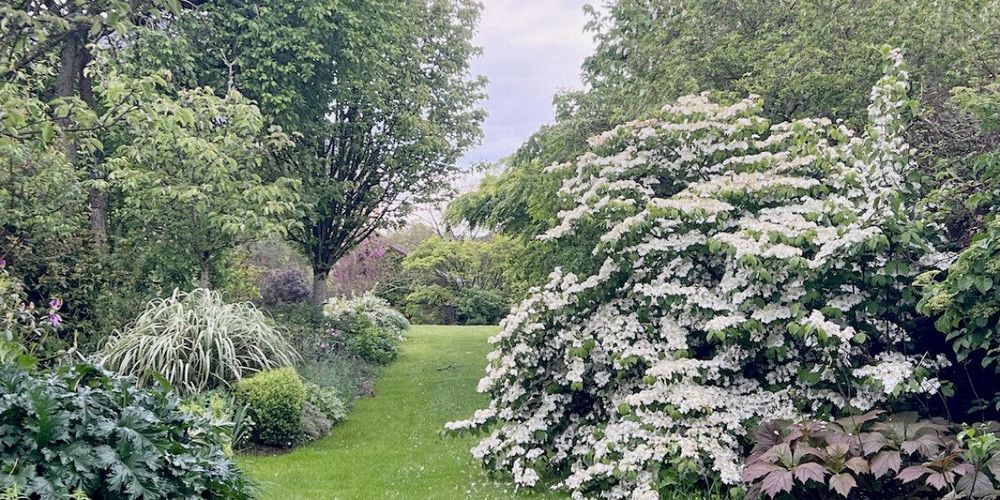
The garden divides into two distinct sections: an upper level with lawns and mixed borders, and below, a sloping English-style garden. A productive kitchen garden supplies vegetables, salads, and fruit. Annie draws inspiration from gardens she visited throughout Belgium, the Netherlands, and southern England, from Kent to Cornwall.
Rather than conventional hedging, Annie has created living boundaries filled with specimen-quality trees and shrubs: pearlbush, Sunburst honey locust, rowans, flowering plums and cherries, and crabapples. These provide year-round colour, structure, wind and sun protection, and wildlife habitat.
"We have planted lots of trees," Annie says. "In Belgium I attended the Société Belge de Dendrologie. I learned a lot there. We have planted a huge botanical variety to give us a wide spectrum of colours and forms: acers, Raywood ash, sassafras, and so many dogwoods. We have a Cornus kousa that is 10 metres high now. We have Cornus florida with pink flowers. We paid attention not just to leaf colour but to the texture and colour of the bark too."
Autumn brings violets, purples, oranges, and bright yellows, followed by trunks displaying silver, grey, black, and maroon bark in varying textures.
Winter Interest and Seasonal Succession
Annie has ensured abundant winter-flowering specimens throughout the garden. "We need some interest then, don't we? I want to see things blooming, alive, at that time of year," she asserts.
Magnificent rhododendrons include Rhododendron 'Christmas Cheer'. A collection of witch hazels provides firework-like flowers and powerful scent, echoed by wintersweet. Hellebores and snowdrops bridge the gap to spring's explosion of blooms.
Bulbs of every variety—narcissi, hyacinths, tulips, ixias, and camassias—provide profuse flowers alongside the large blooms of camellias and magnolias. Camellia × williamsii 'Donation' produces abundant semi-double deep-pink flowers, while numerous Magnolia stellata varieties display different hues.
As spring transitions to summer, over a hundred varieties of clematis and roses burst into bloom, joined by hydrangeas, viburnums, and many phloxes.
Managing Water and Heat
Water comes from a 25-metre-deep borehole. "I am very conscious of the need not to waste any water," Annie notes. "We have lost some trees to drought. I think July and August can be the most difficult months. The plants can suffer during heatwaves or prolonged periods without rain. But things like our Persicaria look awful and then, after a shower, can just perk up and flower again. They are amazingly resistant. We have made shaded areas where we grow ferns and hostas."
Sharing the Creation
Annie and Guy have opened their garden to visitors for several years. "I think anyone who creates something wants to share it with others," Annie reflects. "They want their creation to be out there."
The couple participated in this year's Rendez-vous aux Jardins, the annual Ministry of Culture event held June 5-7, 2026, with the theme 'The Five Senses in the Garden: Sight'. This nationwide celebration sees over 2,000 gardens across France open to the public with activities, workshops, and guided tours. Le Grand Bagnol also welcomes visitors through Association Open Gardens and by appointment, allowing guests to experience the garden's transformations across all seasons—from autumn's colourful asters and Persicaria to spring's magnificent displays.
Those wishing to visit might consider waiting for early autumn, when cooler weather returns and the garden enters what the French call Petit Printemps, or "Little Spring."