Blockades affect about 1% of high schools
The ministry's count represented roughly 1% of France's approximately 3,700 lycées, or high schools. Most of the blockades were around Paris, Marseille, Rennes, Toulouse and northern France. Hundreds of schools had experienced blockades or other protest actions before the break.
French media reported that small groups of protesters tried to prevent entry to schools in Paris, Marseille and Rennes. Police appeared at some sites in television footage, but were not wearing full riot gear.
Education Minister Édouard Geoffroy played down the scale of the disruption in an interview with France Inter radio. "As far as the blockades, or rather attempted blockades, are concerned, the phenomenon is extremely marginal. We are talking about only a handful of schools," he said. Geoffroy distinguished between permitted demonstrations and illegal attempts to prevent access to schools.
President Emmanuel Macron urged a calm resumption of classes, saying that "young people have been heard". On Sunday, November 1, his office said it was time for students to return to class, while acknowledging that such movements do not end neatly.
Funding and admissions remain disputed
The students' demands cover school buildings, teacher numbers, university capacity and an admissions system they consider unfair. Their representatives have promised further demonstrations despite the package Geoffroy announced in the week of October 26.
The government's offer combines €4 billion for school renovations with 15,000 additional university places and a new university admissions system from 2028. It also cancels planned staff cuts in national education and adds 500 teaching positions.
A proposed limit of 28 students per class applies only to seconde, the first year of upper secondary school, roughly equivalent to 10th grade. Student representatives pointed to that restriction when arguing that the measures were inadequate.
The inter-union student bloc comprising USL, Unef, FAGE and Union étudiante wants €10 billion invested in education and higher education, rather than the government's €4 billion renovation allocation. It also demands the immediate repeal of the Parcoursup university admissions platform, instead of waiting for the government's planned replacement by 2028.
A movement extending beyond schools
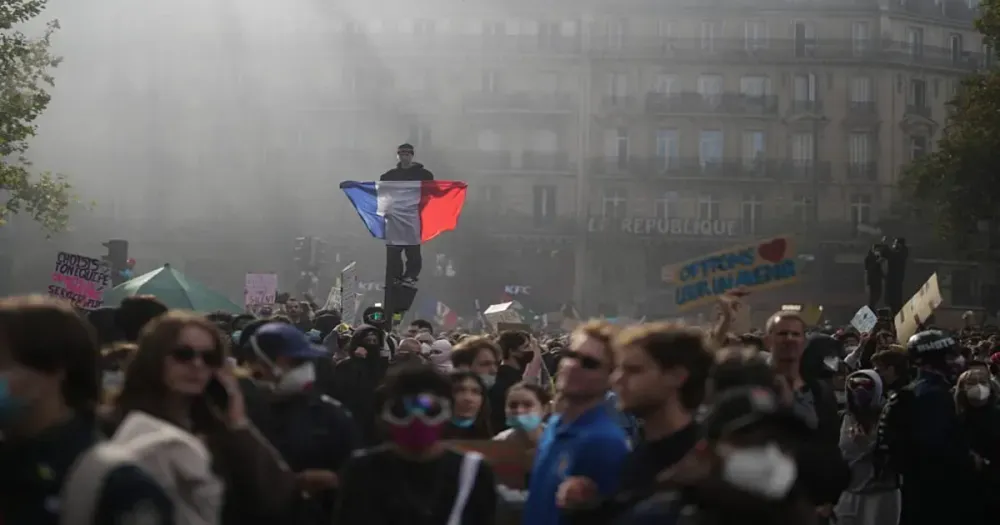
The school protests started in the Paris suburbs in September and subsequently spread across France. Education was their initial focus, but living-cost concerns widened the movement, which attracted trade unions and activists and sometimes involved violent confrontations.
Monday's school protests came after hundreds of thousands of people, students among them, demonstrated across France on Saturday, October 31, over living costs and education. It was the third consecutive weekend of demonstrations.
During October, several cities reported clashes with police, damage to property and looting at some protests. The unrest put Macron's minority government under political pressure.
France's demonstrations also belong to a broader wave of youth-led protests in Europe. In Germany, Italy, Belgium and Albania, concerns driving those movements include rising living costs, deteriorating school infrastructure and corruption.