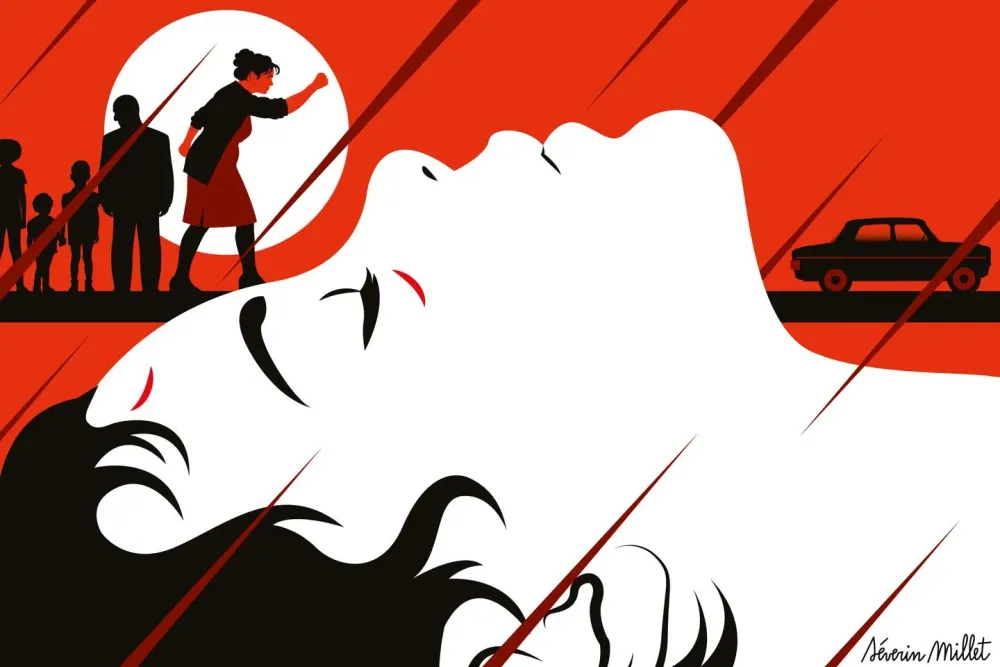
The charges before the court
Halima El Bakhti, 72, and Ahmed Touloub, 74, face a maximum sentence of life imprisonment, according to RTL. Their case is being heard by the Loir-et-Cher criminal court in Blois, in France's Loire Valley.
The charge against El Bakhti concerns injuries across her daughter's body, including bites that tore away her nipples, fractures, burns, bruises, wounds and scars. Forensic findings reported by RTL, citing medical examiners' findings consulted by AFP, included burns from an iron and scars from human bites attributed to a woman.
During the investigation, El Bakhti acknowledged slapping Inass and said she became a different person when she hit her, according to ICI. She did not admit inflicting the bites or burns. Touloub was described as having witnessed the violence without intervening. He said he feared his wife and feared that the other children would be placed in care.
The couple, now divorced, will attend the trial out of custody. After several months in pretrial detention, they were released in 2019 and 2020, ICI reported. Their defense lawyers are Camille Radot and Franck Berton.
The child behind the unidentified grave
For 31 years, Inass was known only as "the little unknown girl of the A10." Born in Casablanca, Morocco, on July 3, 1983, she was the third of seven children, according to ICI. Her maternal grandmother cared for her in Morocco for her first 18 months before she joined her parents, who operated a grocery store in the Paris region.
On August 11, 1987, her parents left the 4-year-old's tortured body alongside the A10 and continued their journey to Morocco. Traveling with them were five other children: two girls, ages 9 and 6, and three younger boys, including a newborn only a few days old.
Inass was buried on September 9, 1987, in Suèvres, near Blois. A rural police officer, the mayor and a priest attended the burial. Her grave, covered in white gravel, remains in the town's cemetery.
All six of her siblings, the youngest born in 1991, have joined the proceedings as civil plaintiffs. Child protection groups and the town of Suèvres are also participating in the case.
A DNA breakthrough after decades without an answer
Efforts to identify the child reached well beyond France. According to RTL, the gendarmerie mounted what was described as the country's largest-ever witness appeal, circulating her description in more than 30 countries. Her photograph appeared in 65,000 schools and 30,000 town halls.
The searches produced no identification. Orders dismissing the case, known as non-lieu, were issued in 1991 and 1997.
An unrelated dispute provided the breakthrough in 2017. France Info reported that gendarmes took a snack bar manager's DNA after a fight over the quality of a tiramisu in Villers-Cotterêts, in the Aisne department. It matched traces recovered from the girl's body. The manager was one of her brothers.
That discovery led investigators to El Bakhti and Touloub, who were arrested in June 2018.
Appeals and the trial schedule
The case took several more years to reach trial. Both the parents and the Blois prosecutor's office appealed the indictment order. In September 2024, the Cour de cassation upheld the original charges and cleared the way for the proceedings, RTL reported.
The trial is scheduled to continue through November 18, 2026, with about 12 hearing days and roughly 15 experts expected to testify, according to ICI. RTL reported that around 80 journalists had been accredited.
Confrontation outside the courthouse
After the first morning of hearings on November 2, a handful of members of the child protection collective Mouv'Enfants confronted El Bakhti outside the Blois courthouse, Le Figaro reported.
The group called for justice for Inass, shouted expressions of shame and pasted photographs of the girl's bruised face on the courthouse walls. At least three police officers had to restrain the collective's president, Arnaud Gallais.