Bringing designers into development
CEO Philippe Berlan told visitors that Everdye's task is to turn a scientific innovation into an industrial process that can operate at scale. He also wants independent designers involved in development, saying their requirements can help shape the product.
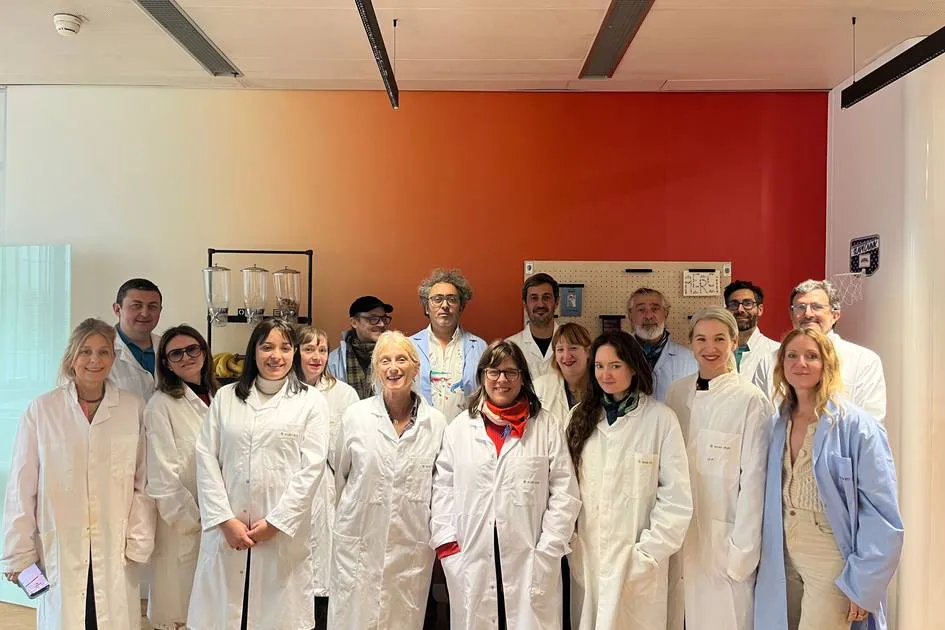
Jill artistic director Jean-Pierre Blanc introduced a group that included representatives of Who's Next (WSN), the French Ministry of Culture, independent labels and design studios. On Everdye's side, Berlan was joined by co-founder and materials chemist Amira Erokh, operations head Victor Durand and textile engineer and dyeing specialist Nicolas Bodart.
The company already serves mainly dye houses and brands with their own factories, including Lacoste and Petit Bateau, according to Formes de Luxe. The publication reported that Everdye employed about 30 people in Romainville as of August 2026, compared with fewer than 20 a year earlier.
A color carrier that works without heated baths
Rather than concentrating on dye manufacture, Everdye's patented approach changes how color attaches to fabric. Erokh explained that it substitutes bio-sourced formulations for petrochemical-based dyes. The company gives cellulose, a naturally occurring plant biopolymer, a positive electrical charge through chemical modification. That charge attracts it to negatively charged fibers, including cotton, linen, hemp and lyocell.
This modified color carrier allows fixation at ambient temperature instead of requiring a heated dye bath. Everdye supplies the product as a liquid, and the process currently works for pad dyeing and garment dyeing. Jet-dyeing applications remain under development.
During small-scale demonstrations in the laboratories and testing rooms, visitors asked about the palette. The first range uses mineral-based dyes to produce earthy shades; a second range under development is intended to add brighter colors. Everdye said it would not pursue some colors, including fluorescents, if producing them conflicted with its environmental objectives.
An August 2026 report by Formes de Luxe described the existing technology as using insoluble, iron-oxide-based mineral pigments for cellulosic fibers, including cotton, linen, hemp and viscose. A soluble-dye range needed for yarn dyeing and industrial jet dyeing was being developed for late 2027. At that time, the company planned to enter synthetic fibers, beginning with polyester, in late 2026. Wool, silk and cashmere remained lower priorities.
Environmental claims and pilot-scale findings
Everdye says its process uses 75% to 95% less energy and 30% less water, runs up to three times faster and works with existing dyeing machinery.
A separate process-level life cycle assessment published by Carbonfact in May 2026 for lingerie brand Adore Me put emissions from Everdye's process at 0.45 kg CO2e per kilogram of dyed fabric in France, 1.45 kg in Turkey and 1.68 kg in Tunisia. It reported a processing time of about two hours, compared with about 12 hours for conventional methods. Carbonfact characterized the assessment as preliminary: it relied on pilot-scale data and had not undergone external review.
Adore Me, which belongs to the Victoria's Secret & Co. portfolio, also released a Halloween capsule developed with Everdye. It used bio-based pigments and a low-heat, low-energy dyeing process. Carbonfact described the collection as one of the technology's first brand-scale applications.
The dyes meet the requirements of the Zero Discharge of Hazardous Chemicals (ZDHC) program, which seeks to eliminate hazardous chemicals from textile manufacturing. According to Textile World, Everdye announced on October 5, 2026, that its chemical products had received ZDHC certification confirming compliance with the Manufacturing Restricted Substances List.
Visitors also asked what happens to the used dye baths. Berlan said the dyes' affinity for textile fibers leaves less product in the remaining liquid, which goes through standard effluent treatment. The team said machinery can be washed between cycles using ambient-temperature water.
Colorfastness, cost and creative constraints
Berlan described test results for resistance to washing, light, perspiration and dry rubbing as satisfactory. Wet rubbing fastness was the only area he identified as still needing improvement, and he said the team was working on it.
Purchase prices remain another consideration. Everdye acknowledged that its pigments currently cost more than conventional alternatives, but said reductions in energy, water, effluent treatment and processing time can offset the difference. Matching the total cost of conventional dyeing remains a goal, rather than an outcome the company claimed to have achieved.
At the closing discussion, Berlan asked designers whether they would accommodate the constraints of lower-impact dyeing in their creative work, even when that required changing their original plans. The exchange brought the visit back to his interest in involving designers in product development.
From doctoral research to industrial expansion
According to Formes de Luxe, the method grew out of Erokh's doctoral research for NATO on textiles intended to protect soldiers against biological attacks. An unexpected color change during that work provided the starting point for the dyeing technology.
Erokh and engineer Ilan Palachi founded Everdye in 2021, initially working from her laundry room. Palachi has since left the business. The company raised its first funding round in 2022, and Berlan became CEO in September 2024.
In 2025, Everdye raised €15.5 million in a Series A round to expand production and adapt the process to existing dyeing machinery, Formes de Luxe reported. Crédit Mutuel Innovation, Daphni, Reine Capital, Turkish fund 212 Next and the EIC Fund participated alongside earlier investors.
The October 5 announcement also named Everdye as one of 20 European startups chosen for the CEMATEX Start-Up Grant. The grant will finance the company's participation in ITMA 2027 in Hanover.
On November 24, 2026, Everdye joined the Denim Deal, according to Textile World. Founded in the Netherlands in 2020 to accelerate circular denim production, the initiative aims to support production of one billion pairs of jeans containing at least 20% post-consumer recycled cotton by 2030. Its membership exceeds 60 organizations and includes Primark, Tommy Hilfiger, Kiabi and Urban Outfitters.