Managing heat, frost and water
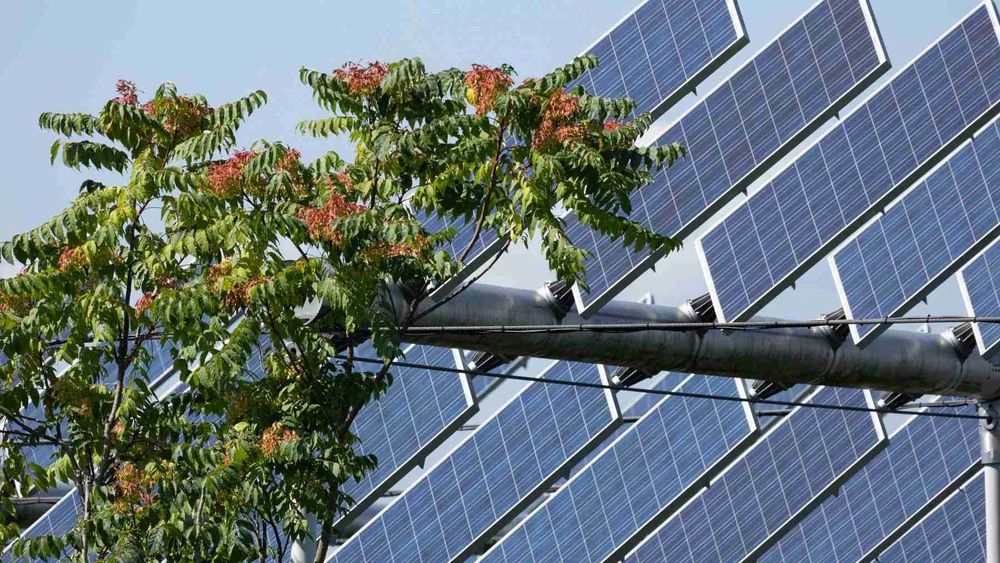
At the orchard in Loriol-sur-Drôme, adjustable panels regulate how much sunlight reaches the trees. Summer temperatures beneath them have been as much as 4°C lower than in exposed areas. During late spring frosts, closing the panels at night retained heat from the ground and raised temperatures by up to 2°C.
Alongside the 20% reduction in summer irrigation needs, owners Christian and Adrien Clair reported improvements in fruit size, color, firmness and ripening. The installation has a generating capacity of 2.2 MW, with annual electricity production described as equivalent to the needs of 626 households.
The technology, developed about 15 years ago, uses algorithms to adjust panel angles in real time according to the crops' need for sunlight and shade. At Clair Fruits, the structure stands 4.95 meters high, with 5 meters between rows, leaving room for tractors and other farm machinery. The panels have also helped protect cherries from fruit flies.
A response to repeated crop losses
Founded in 1977, EARL Clair Fruits is a 35-hectare family farm with four generations of experience growing pome and stone fruits. Increasing weather-related losses prompted its fourth-generation owners to seek protection for their cherry crop.
A severe hailstorm struck in 2018. Spring frosts subsequently destroyed 80% of the cherry blossoms in 2020 and 90% in 2021. The Clairs partnered with Sun'Agri, a French agrotechnology company specializing in dynamic agrivoltaics, and tested its system on a small area before expanding after favorable results.
Sun'Agri's project overview describes an initial experimental demonstrator covering 1,500 square meters, or 0.15 hectare, as commissioned in late 2021, followed by expansion to 2.7 hectares a year later. It identifies the demonstrator as the first system of its kind over cherry trees in the Drôme department.
The company's detailed timeline gives different commissioning dates. It records the pilot's selection in the French Energy Regulatory Commission's Innovation tender in December 2020, construction of the demonstrator in November 2021 and commissioning in April 2022. The larger pilot orchard was planted in March 2023 and commissioned that June.
The 2.7-hectare plot contains 27 cherry varieties planted at a density of 909 trees per hectare. A separate 0.4-hectare control area provides a comparison with trees grown without the panels.
Yield gains were not uniform
The owners' reported 15% average yield increase masks differences among varieties. In its 2024 coverage, the trade publication Cherry Times reported that 2023 yields exceeded those in the control area by 13% for Primulat and 32% for Burlat. Bigalise, by contrast, yielded 19% less.
A peer-reviewed study by Sun'Agri researchers also found variety-specific responses. Presented at the AgriVoltaics World Conference 2025 and published in July 2026, the study examined the Loriol-sur-Drôme orchard during the heavy rains of 2024.
For Primulat, fruit cracking fell from 28.82% in the control area to 17.86% beneath the panels. For Burlat, the corresponding figures were 38.23% and 11.84%. Both reductions were statistically significant; the researchers found no significant difference for Bigalise.
The study measured air temperatures up to 2°C lower under the panels. It also recorded less leaf defoliation in the control trees in both 2023 and 2024.
Protection during specific weather events
Cherry Times described three weather hazards the farm had encountered after installing the panels in an October 2024 report. During a light frost in March 2024, a 1.2°C temperature increase beneath the structure prevented frost damage. A major hailstorm left the covered orchards unaffected.
In a separate rain event, the control orchard was almost entirely destroyed, while more than 60% of the crop beneath the panels was saved, the publication reported.
Certification and the wider rollout
The installation became the first in France to receive AFNOR Class A agrivoltaic certification for both development and commissioning. Sun'Agri's timeline dates the development-phase label to June 2022 and the commissioning-phase label to December 2023.
AFNOR's "Agrivoltaic Project" Class A rules limit the area shaded by fixed photovoltaic panels to 50% and the area occupied by foundations to 10%. Agricultural performance receives an interim evaluation three years after planting and a final assessment after five years.
Beyond Clair Fruits, a 2026 overview by Econ Market Research cited Sun'Agri's reported portfolio of 31 commercial sites protecting 63 hectares, plus 63 projects under development covering another 320 hectares. Across its monitored installations, the company reported average irrigation reductions of 27%, cooling of up to 4°C during heat events and nighttime warming of 1.7°C during late frosts.
Lessons for the next installation
In October 2024, Cherry Times reported that a third agrivoltaic project was underway at Clair Fruits. The farm urged other growers to allow time for a lengthy administrative process.
Its practical advice was to avoid planting trees in the same year as panel installation: machinery compacts the soil during construction.