Grounding and helicopter evacuations
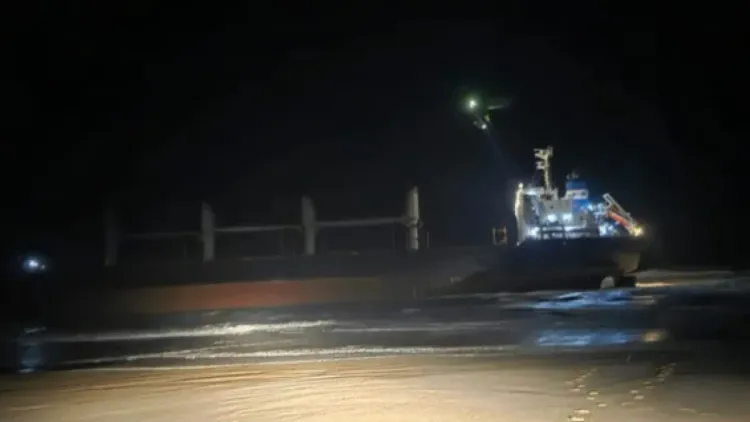
Winds gusting to about 90 km/h left the MIRO G struggling off the Landes coast before it ran aground shortly before 1 a.m. on Friday, November 20, 2026. The crew had deployed an anchor, but the ship continued drifting toward shore and became stuck on a sandbank near Cap de l'Homy, close to Lit-et-Mixe.
A French Air and Space Force helicopter dispatched from Cazaux air base winched 19 crew members to safety on Friday. They were brought to Saint-Julien-en-Born, where the Landes Red Cross operated an emergency accommodation center.
With conditions expected to worsen, a helicopter evacuated another 11 people on Saturday, including the captain, two other crew members, salvage specialists and company representatives. No injuries were reported.
Fuel risk prompts emergency measures
Although its cargo holds were empty, the vessel had just over 100 metric tons of diesel in its propulsion tanks. Officials identified that fuel as the main potential pollution threat to the Landes coast. French Navy aerial surveillance found no pollution in the surrounding water, and authorities closed the beach at Cap de l'Homy during the response.
France activated level 3 of its ORSEC maritime emergency plan, along with the Biscay Plan for maritime cooperation with Spain. As part of that response, the Spanish rescue tug SAR Gavia departed Bilbao on the evening of Thursday, November 19, to assist.
Authorities formally instructed the shipowner to address all immediate and future dangers and limit environmental harm if pollution occurred. They also planned an expert mission to evaluate towing requirements and monitor the pollution risk.
An empty ship bound for Rouen
The MIRO G was heading to Rouen in ballast, according to reporting citing ship-tracking data from Kpler and LSEG. After leaving Egypt on October 13, 2026, it unloaded urea in early November at Errenteria, near San Sebastián in Spain, and at the French port of Bayonne. Its next scheduled cargo was about 30,000 metric tons of wheat to be loaded in Rouen for Libya.
Built in 2011, the Handysize bulk carrier measures 169 meters long and about 27 meters wide, with a deadweight capacity of roughly 28,200 metric tons. It is registered under the Maltese flag with IMO number 9589712. Vessel databases identify SIR JAM SHIPPING SA as its registered owner, PRELUDE MARINE SA as its ISM manager and HANDY GUY MARINE SA as its commercial manager.
Regional tug coverage draws criticism
The association Mor Glaz criticized the withdrawal of a deep-sea emergency tug from La Rochelle 15 years ago, saying it had left much of the Bay of Biscay without protection. The association noted that the French salvage tug Abeille Bretagne had to travel from Brest to reach the MIRO G.
The incident has also prompted comparisons with the TK Bremen, which storm Joachim drove onto a beach at Erdeven in Brittany's Morbihan department in December 2011. Damage made that vessel unsalvageable, and it was dismantled on the beach. A single storm in 1976 also stranded three ships along the Landes coast.
Power, tides and shallow water complicate salvage
Salvage crews have added seawater to the MIRO G's ballast tanks to help keep it stable and reduce the danger of capsizing or shifting closer to the beach. Before the vessel can be towed free, that water must be removed to lighten it.
Both main generators supplying the pumps have failed, hindering the operation. Engineers are working to restore an alternative power supply while specialists assess how to refloat the ship.
The Abeille Bretagne has arrived carrying a 1,000-meter towline, but shallow water prevents it from approaching closer than about 900 meters. That separation adds to the difficulty of towing the grounded vessel.
French maritime authorities said waves of five to six meters and poor beach access for pumping equipment were further obstacles. Falling tidal coefficients over the coming days would also leave less water beneath the hull at high tide, when a refloating attempt must take place.
With strong winds and rough seas expected to continue, officials warned that freeing the MIRO G could take several days or longer. Maritime authorities intend to use the first favorable weather window, but said a successful refloating was not assured.