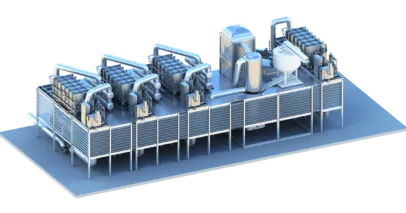
Grid-connected power and recovered-heat cooling
The system combines Haffner's CORE100 platform with C-iB, a new variant developed for multi-module installations. It supplements rather than replaces a data center's grid connection, reducing the electricity drawn from the grid. Haffner describes the offering as a source of local, decarbonized power with guaranteed availability, cooling services and lower on-site water use.
Haffner specifies a ten-module configuration with two modules reserved for redundancy and limited, on-demand natural gas backup. In its August 28, 2026 announcement, the company said this arrangement is designed to deliver energy availability above 99.995%, the level required for Tier IV infrastructure. Natural gas is expected to contribute less than 0.1% of primary energy.
The cooling system uses heat recovered during electricity generation. According to Haffner, the combined cycle achieves electrical efficiency of about 55%, measured against the energy contained in the syngas. Lithium bromide absorption chillers use recovered heat at around 90°C to produce chilled water at approximately 4°C. The company says recovered heat can meet the data center's entire cooling requirement rather than relying on electricity and water.
Fuel supplies can be held at the facility or nearby for several weeks, Haffner says. The technology accepts several types of residual biomass, including agricultural and forestry residues, giving projects the option to diversify their feedstock sources.
C-iB output and biochar options
A November 16, 2026 update set out Haffner's expected nominal performance for C-iB. The company puts a standalone module's renewable syngas output at about 2.4 MW, roughly 40% above the 1.7 MW designed output of C-iC.
In a shared installation, nominal syngas output can reach 4.2 MW per module if all co-produced biochar is used for energy recovery in shared equipment, according to Haffner. That is up to 2.5 times C-iC output. If the biochar is instead recovered for other uses, the figure is 3.4 MW per module. The company describes a four-module C-iB facility as having approximately 20 MW of primary energy input and 17 MW of nominal syngas output.
Haffner also presents biochar as a route to biogenic carbon removal. It says each metric ton of biochar made from lignocellulosic biomass using its process can sequester about 3 metric tons of CO2-equivalent, or approximately 2 metric tons net after production emissions are accounted for. Such sequestration can generate Carbon Removal Certificates, or CORCs, tradable on the voluntary carbon market.
Module economics and deployment schedule
Chairman and CEO Philippe Haffner said an individual data center project could require more than ten modules. He put revenue from each module in a full-service data center installation at about €6 million ($6.98 million), nearly three times the revenue from a module dedicated to syngas production. Because specialized partners supply some of the additional equipment, he said, the higher revenue would not require a proportional expansion of Haffner's industrial capacity.
The company revised its CORE100 financial estimates on September 17, 2026, increasing potential revenue from more than €300 million at launch to more than €500 million. Forecast gross margin rose from €90 million to more than €175 million, with the program still capped at 100 modules.
That September update reported reservations for 38 C-iC units and extended the reservation period to January 31, 2027. Industrial deployment is scheduled to run from March 2027 through March 2030. In its November 16 update, Haffner separately reported that Canadian partner Mundi Énergies had reserved 40 C-iB modules.
Luxembourg experience and Strasbourg plans
Based in Vitry-le-François, France, Haffner says it previously led engineering and construction of a Luxembourg trigeneration plant supplying electricity, heat and cooling to Kiowatt. The plant powers LuxConnect, which Haffner describes as Europe's first green data center.
Haffner is also a founding member of ÆTHER, a European consortium whose members include 2CRSi, ÉS Group, Socomec and Projex. The consortium is bidding for the European Commission's "AI Gigafactory" tender and plans an AI gigafactory in France's Strasbourg region.
In July 2026, project company ÆTHER Infrastructures said it was in advanced negotiations to buy two industrial sites in the region, according to a 2CRSi announcement. Its first data center, FR-SXB1, is expected to start operations during 2027. The two sites are planned to provide a combined 42 MW of electrical capacity initially, with a longer-term goal of more than 400 MW, subject to grid availability.