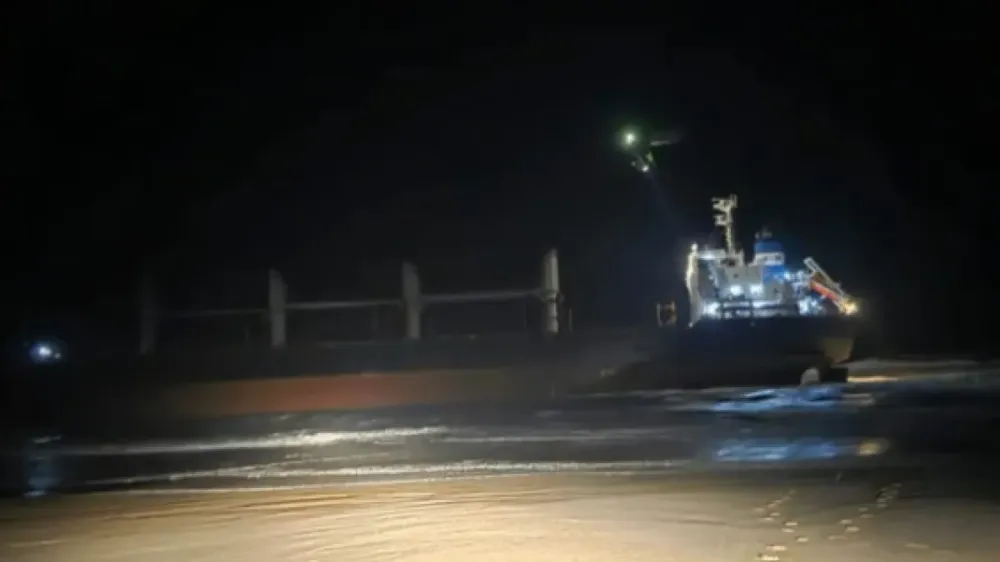
Anchors dragged in heavy seas
The ship began struggling to maneuver Thursday evening amid rough seas and winds of up to 48 knots, according to regional reports. An emergency anchoring attempt 1.8 nautical miles off Lit-et-Mixe failed to halt its drift: the anchors dragged, and the vessel grounded south of Cap de l'Homy beach shortly before 1 a.m. Friday.
Sudouest reported that an Air and Space Force helicopter from Cazaux carried the evacuated sailors to Saint-Julien-en-Born. They were received at an emergency accommodation center operated by the Landes Red Cross.
Catherine Chabaud, minister delegate for the sea and fisheries, reported two minor injuries, according to Le Monde. Atlantic maritime prefecture spokesperson Frigate Capt. Laurent Falhun clarified that one sailor had a preexisting health condition and another experienced minor pain after the helicopter evacuation.
An empty ship headed for Rouen
Built in 2011, the Miro G is a Handysize bulk carrier with approximately 28,200 tonnes of deadweight capacity. It had no cargo aboard when it grounded, according to gCaptain's Nov. 20 reporting.
Kpler tracking data showed that the ship departed Egypt on Oct. 13 and unloaded urea in Errenteria and Bayonne before continuing toward Rouen. There, it was scheduled to take on about 30,000 tonnes of wheat for Libya, gCaptain reported.
In a Nov. 20 regional analysis, AquitaineOnLine described the grounding as the second involving a Maltese-flagged vessel on French coasts in 15 years and the eighth involving a cargo ship in 40 years. It drew a comparison with the TK Bremen, which grounded at Erdeven in Brittany during storm Joachim in 2011.
Fuel risk prompts monitoring and emergency measures
Authorities put the maritime ORSEC emergency plan at level 3 and activated the Biscaye framework for cooperation between France and Spain. The Atlantic maritime prefecture coordinated with an emergency Spanish tugboat from Bilbao, while a municipal order barred public access to every beach in Lit-et-Mixe.
The main potential pollution hazard was the more than 100 tonnes of diesel in the ship's propulsion tanks, according to officials cited by AFP in reporting carried by gCaptain. A French Navy Falcon 50 surveillance aircraft monitored the vessel; its first aerial assessment detected no evidence of pollution.
French authorities also formally ordered the shipowner to address immediate and future dangers and to limit environmental damage if pollution occurred, according to a statement reported Nov. 20. An expert mission was planned to assess the technical requirements for towing and monitor pollution risks.
Weather limits the refloating options
"The hull is touching the bottom. The goal of the operations now is to think about a refloating of this boat, that is to say to pull it toward the open sea in order to prevent it from tipping over," Falhun said.
He explained that crews would need to lighten the ship by pumping diesel from its tanks, reducing its weight on the seabed at high tide. But French maritime officials said Nov. 20 that waves reaching five to six meters and difficult beach access for pumping equipment were complicating the operation.
Falhun told France 3 Nouvelle-Aquitaine that a towing opportunity remained before Saturday night into Sunday, with the weather forecast to deteriorate again that weekend. He cautioned against rushing an operation involving a 169-meter vessel.