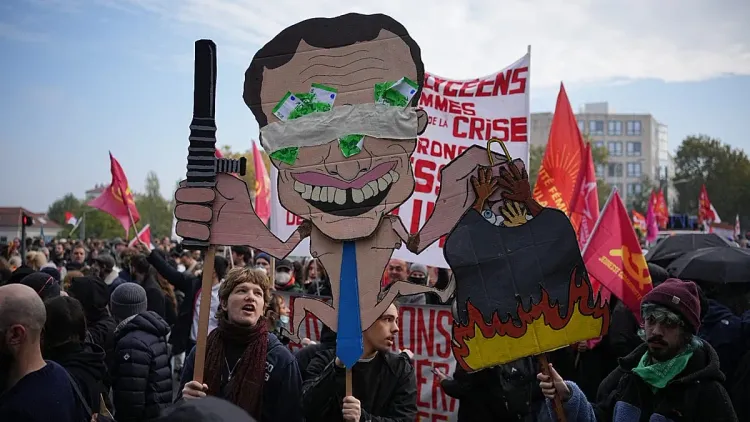
School shortages fuel demands for resources
Aellen describes a country where the state collects almost half of national wealth, yet students complain about missing teachers and deteriorating schools, public services seek additional funding, and citizens want greater purchasing power.
The school demonstrations began in late September 2026. Students blocked access to hundreds of lycées, or high schools, across France. The government promised to send 3,000 substitute teachers to the 114 schools most affected by shortages out of the country's 3,700 lycées. By mid-October, the education ministry said, 2,000 had been assigned.
Education ministry data reported by RFI put average secondary-school class size at a record 30.2 students in 2025, excluding vocational programs. In public secondary schools, a lack of replacements for absent teachers left about 7.5% of teaching hours uncovered during 2024-2025, amounting to 15.4 million hours.
France's spending per upper-secondary student is 24% above the OECD average. Separately, a government report on the draft 2027 budget says pensions are set to account for nearly one-third of the education ministry's budget.
The demands have a precedent. According to the BBC, roughly 500,000 students marched in October 1998 seeking school funding and staff. Those protests led to almost €1 billion for school renovations and 14,000 additional staff.
High taxes, persistent deficits and rising debt
For Aellen, the problem extends beyond the level of school funding. He describes France as having one of the highest public-debt burdens and an annual deficit exceeding €150 billion, or more than 5% of GDP.
The OECD's June 2026 Economic Survey of France records a general government deficit of 5.1% of GDP in 2025, compared with 5.8% in 2024. Its forecasts put the deficit at 5.0% in 2026 and 4.6% in 2027. Public expenditure amounted to 57.2% of GDP in 2025, which the OECD characterizes as comparatively very high.
Even with that projected narrowing of the deficit, the OECD expects gross government debt to rise. It stood at 115.5% of GDP in 2025; the survey projects 118.8% for 2026 and 120.9% for 2027.
Aellen argues that financing further spending through higher taxes could squeeze middle-class purchasing power, deter investment, weaken economic activity and encourage companies to relocate abroad. In his assessment, slower growth could then leave tax receipts below expectations and deficits unresolved.
The Cour des comptes raised related concerns in February 2026. With France already carrying the eurozone's highest tax burden, it warned that raising tens of billions of euros more could hurt competitiveness or employment, depending on which tax bases were targeted. It also identified risks to public acceptance of taxation and tax compliance.
Debt servicing is another growing expense. The Cour des comptes put interest costs at nearly €65 billion in 2025, exceeding either the education or defense budget. It projected that refinancing debt at higher market rates could take annual interest spending above €100 billion by 2029.
A gridlocked political backdrop
The debate is unfolding amid parliamentary deadlock. The BBC reported in October 2026 that the National Assembly remained gridlocked following President Emmanuel Macron's June 2024 snap election. At that point, the next presidential election was about six months away, and Macron was barred from standing.
Prime Minister Sébastien Lecornu has described himself as the "weakest prime minister" in living memory, according to the BBC.