Lyon clashes amid restrictions on march route
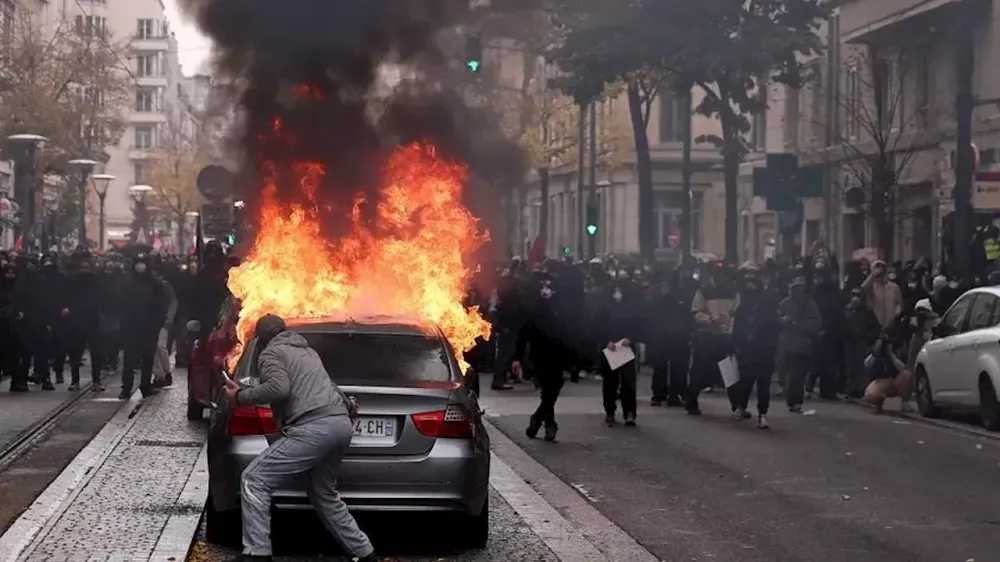
The Interior Ministry said officers in Lyon faced several hundred hardcore protesters. It described the violence as contained but said tensions remained high. Some demonstrators shouted anti-police slogans; others wore black clothing and covered their faces.
Thursday afternoon's turnout figures for Lyon ranged from 30,500, according to the Rhône prefecture, to about 55,000, according to the CGT union. The authorities and union use different counting methods.
The march took place under restrictions imposed by the prefecture, which prohibited demonstrations within a central area of the city. Marchers were barred from crossing the Pont de la Guillotière bridge or finishing at Place Bellecour. Unions sought to overturn the restrictions, but the Lyon administrative court rejected their appeal on November 4.
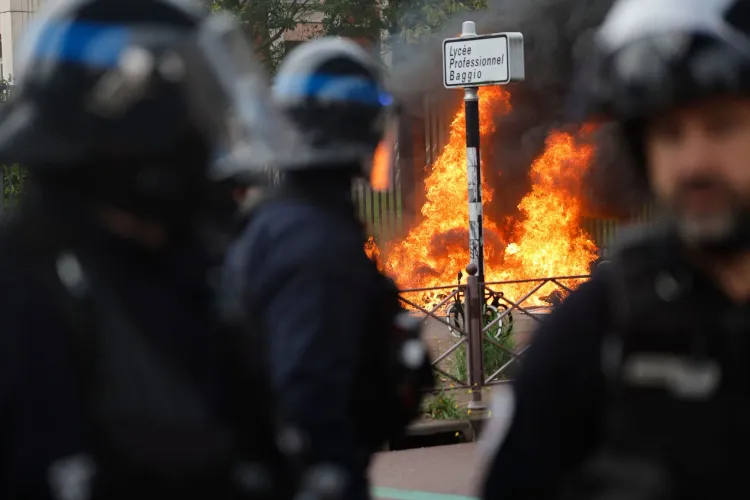
There were confrontations elsewhere on Thursday morning. In Paris, high school students and other protesters blocked a street with trash bins and faced riot police. Near Toulouse, people throwing fireworks started a fire at a high school, according to the Interior Ministry. Students and staff evacuated as firefighters extinguished the blaze.
Unions press pay demands
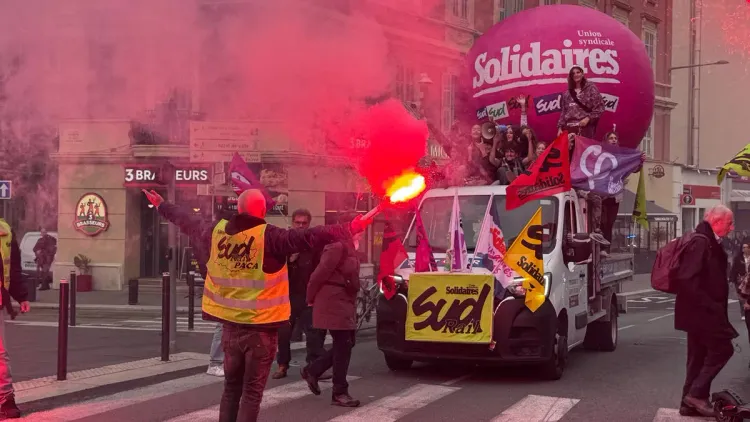
The CFDT, CGT, FO, Unsa and FSU union federations organized the strike around demands concerning wages, public services, jobs and industry. Higher pay, starting with the minimum wage, was central to their demands. High school and university students joined the action to call for better education conditions.
Demonstrations began in Lyon, Marseille and Nantes during the morning. Paris's main march was scheduled to leave Place de la Republique at 2 p.m., with as many as 80,000 participants expected, according to AFP.
By early afternoon, the Interior Ministry reported 270,000 marchers at 180 demonstrations outside Paris. The CGT put its count at more than 250,000 across 73 cities. Separately, CGT leader Sophie Binet estimated that about 250,000 people were demonstrating nationwide.
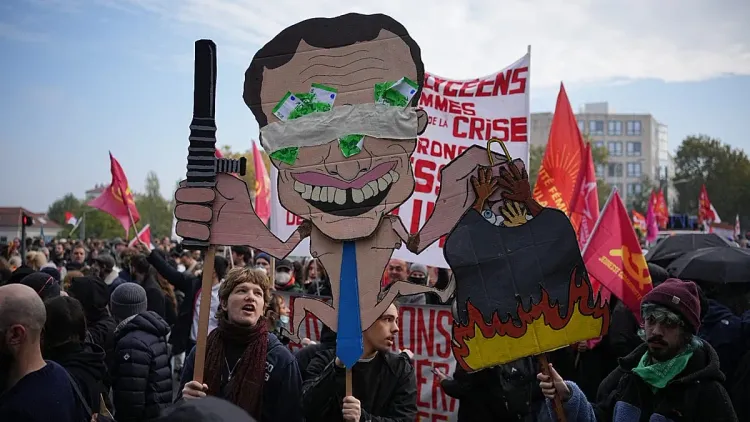
"The government tried to block the demonstrations. The demonstrations are bigger than ever," Binet told reporters.
Among those joining the Paris protest was Mehdi Dumontroty, a 45-year-old firefighter. "Our pay has not kept up with inflation," he said. Referring to wildfires caused by intense heat waves earlier in the year, he said the summer had demonstrated that firefighters were right to seek more resources to handle the crisis.
School closures and public-sector walkouts
About 16% of teachers nationwide joined the strike, the Education Ministry said. Official figures recorded blockades at 81 of France's 3,700 high schools. A high school student association gave a broader measure of disruption, saying classes were suspended at 1,000 secondary schools, including both blockaded schools and those closed for the strike day.
The Ministry of Public Action's midday figures showed strike participation of 9.89% in the state civil service, 4.60% in local government and 3.93% in hospitals.
The walkout helped reduce French nuclear power output early Thursday, but no major transport network problems were reported. The Eiffel Tower's operators said the monument closed for the day because of the planned strike and protests.
October unrest and the approaching election
Authorities had tried to ease tensions following the October 17 riots and looting, which caught security forces off guard and damaged shops and public buildings nationwide. The unrest, the country's worst in years, intensified criticism of Macron's response to the crisis.
Authorities put turnout on October 17 at roughly 550,000 nationwide, including 110,000 in Paris. Interior Minister Laurent Nunez reported more than 2,000 detentions and injuries to more than 600 police officers. In Limoges, the 143-year-old town hall was set on fire. Carrefour CEO Alexandre Bompard said violence affected about 1,500 stores across France.
Thursday's deployment of about 70,000 police was comparable to those of recent weekends. The government has backed police tactics while promising investigations into any abuses.
The demonstrations come about five months before a presidential election in which Macron, an unpopular president serving his second term, cannot run again. Voting begins April 18, 2027. If no candidate receives more than 50%, the two leading candidates will face a runoff on May 2.
Early-November polls continued to suggest a runoff between far-right candidate Marine Le Pen and hard-left rival Jean-Luc Mélenchon. Le Pen's support ranged from 32.5% to 38% in surveys by Ipsos, Harris, Ifop, Cluster17, Odoxa and OpinionWay. Mélenchon placed second in every polling scenario except those from Elabe.