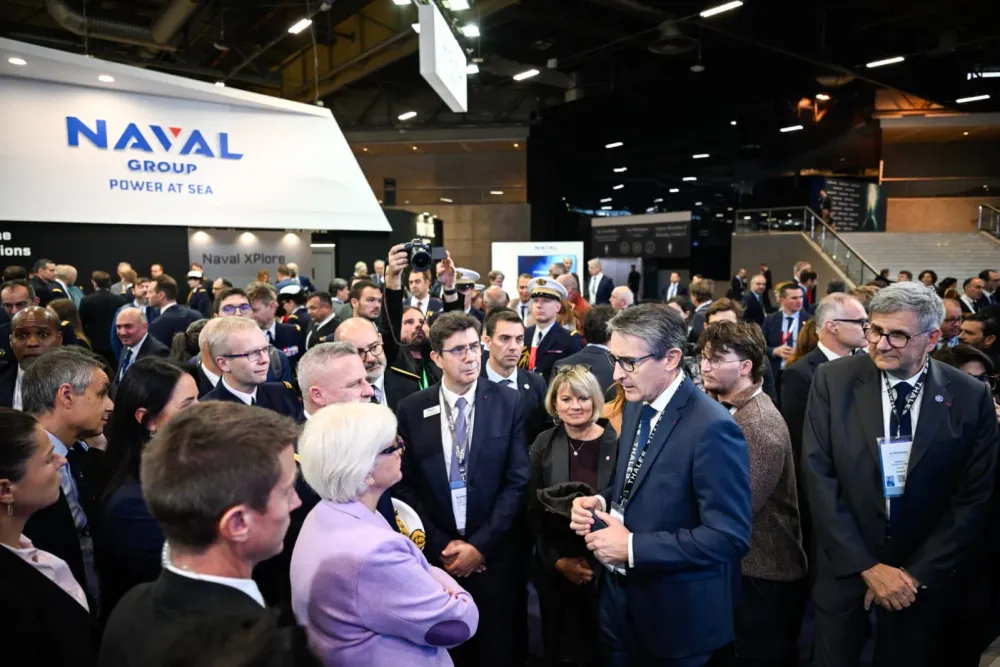
A national framework for naval drones
The pact follows a similar French effort to accelerate the fielding of aerial drones. Vautrin presented it as a new way to bring together the armed forces' requirements, according to Defense News.
The defense ministry identified mine removal, hydrographic and oceanographic data collection, and deep-sea exploration as areas where unmanned systems could benefit from the arrangement.
The announcement came amid rising naval production worldwide. At Euronaval's opening conference, Pierre-Eric Pommellet, president of both the exhibition and French naval industry group GICAN, said the value of global military naval production had increased by around 50% over two years to more than $122 billion. Delivered tonnage grew from about 1 million to 1.5 million metric tons over the same period, according to Shephard Media.
Expanding the deep-sea fleet
French officials announced plans at the show to purchase a second ROV-DeepSea from LD Travocean. The remotely operated vehicle weighs 3,600 kilograms and is capable of reaching a depth of 6,000 meters.
Deep-sea operations have been a priority in French naval technology strategy for several years. Governments still have limited knowledge of much of the seabed, while underwater cables and pipelines have become targets of sabotage and warfare.
France ordered its first ROV-DeepSea, also known as ROV-D, in 2024. The DGA procurement agency announced on Oct. 29 that it had completed qualification trials. Testing off Toulon in July 2026 cleared the vehicle to 2,500 meters, followed by a September campaign off Greece that took it below 5,000 meters. The DGA said development and construction took 21 months and that it was preparing an order for a second system under the MFM seabed-warfare program.
The first vehicle is scheduled to enter French Navy service in 2027 with the GISMER underwater intervention group, according to Mer et Marine. Under the military planning law, France aims to have three pairs of deep-sea systems by the early 2030s, each combining a remotely operated vehicle and an autonomous underwater vehicle capable of reaching 6,000 meters.
Exail is developing the autonomous vehicle, designated A6KM, from Ifremer's Ulyx drone. Its delivery was expected the year after the ROV.
Mine-hunting robots and a second combat vehicle
The navy also plans to acquire eight Exail A18 countermine robots. Using multiple sensors, these underwater drones locate and characterize sea mines ahead of their removal.
A separate purchase will give the navy a second unmanned combat underwater vehicle from Naval Group. A ministry spokesman told Defense News that it would be a "bit longer" than the first test vehicle, exceeding 10 meters in length and 10,000 kilograms in weight. It is intended to remain underwater for weeks at a time.
The ministry's description of the Unmanned Combat Underwater Vehicle program puts the extra-large drone's width and height at about 2 meters each. It describes the vehicle as armed, transportable by air and deployable from land or at sea. Naval Group runs the program with industrial partners Photospace, Exail, Thales and Sirehna.
FDI frigates to carry twice as many Aster missiles
Alongside the drone announcements, defense officials signed an agreement with Naval Group and MBDA to increase Aster interceptor capacity aboard France's FDI frigates. Existing ships will be upgraded from 16 to 32 launch cells, while new vessels will receive the larger magazine during construction.
Naval News reported that the decision had been confirmed during National Assembly budget discussions on the 2026 Finance Bill. The first three French FDI frigates—Amiral Ronarc'h, Amiral Louzeau and Amiral Castex—are slated for retrofits. The fourth and fifth will have 32 cells from the outset, matching the configuration of the Hellenic Navy's Kimon-class FDI variant.