A larger exhibition, a demanding industrial agenda
The 30th Euronaval naval defense exhibition will run November 3-6, 2026, in Hall 6 at Paris Nord Villepinte. According to the organizer, exhibitor numbers will be 40% higher than at the 2024 edition. Its agenda includes resilient ships and communications, open architectures and the work needed to move new technologies into operational use.
For France, those priorities concern an industry that spans shipyards, nuclear propulsion, weapons, sensors and robotics. FW Magazine's assessment identifies the breadth of that industrial base as a strategic strength, while questioning whether it can deliver usable combat capability at the pace required.
Fleet capability exceeds what tonnage alone shows
France has the European Union's largest combat fleet by displacement, according to the Euronaval 2026 ranking compiled by Flottes de Combat and GICAN. Worldwide, it places seventh, following the United States, China, Russia, Japan, India and the United Kingdom. The January 1, 2026, count covers 66 French combat vessels above 200 metric tons, with a combined displacement of 259,801 metric tons. Auxiliary ships are excluded, and the figures do not reflect vessels unavailable because of maintenance.
The fleet includes an aircraft carrier, four nuclear-powered ballistic-missile submarines, five to six nuclear-powered attack submarines and three amphibious helicopter carriers. That combination puts France alongside Britain among Europe's leading powers in maritime power projection and strategic deterrence. It also gives French manufacturers domestic programs requiring expertise in submarine quieting, carrier operations and the integration of complex naval task groups.
The constraint is depth rather than the range of missions France can undertake. Ammunition stocks and weapons capacity fall short of those on comparable US and Chinese vessels. Maintaining France's position therefore involves timely ship replacement as well as improvements in survivability, adaptability and availability.
A broad supplier base, but not the largest output
GICAN puts French naval defense revenue in 2025 at €11.97 billion, across more than 750 companies supporting 46,098 direct jobs. Domestic business accounted for 64% of revenue and exports for 36%. These figures cover naval defense, not the whole French civilian and military maritime economy: national procurement underpins the industry, while overseas sales help sustain it.
Delivery tonnage gives a different view of France's position. In 2024-2025, it delivered 38,460 metric tons of military and coast guard vessels above 200 metric tons, ranking seventh worldwide. Italy's total was 53,700 metric tons and Turkey's was 44,216. China delivered 636,208 metric tons, compared with 270,509 for the United States.
France's competitive offering combines the integration of complex ships with technologies that can also be sold internationally. Naval Group leads its high-end warship and submarine business, but the shipbuilding base extends to Piriou, Kership, CMN, Socarenam and Ocea for patrol vessels and medium-sized ships. Chantiers de l'Atlantique contributes expertise in constructing large platforms.
Nuclear programs sustain long-term expertise
Submarine construction provides work extending from today's production lines into the next decade. Four of the six Suffren-class nuclear-powered attack submarines have been delivered, with the delivery program due to finish in 2029. The class sustains skills in nuclear propulsion, acoustic discretion and integrated underwater combat systems. Four third-generation ballistic-missile submarines, designated SNLE3, are to begin arriving in 2036.
The next-generation nuclear-powered aircraft carrier, PA-NG, is scheduled for delivery in 2038, when it will replace Charles de Gaulle. President Emmanuel Macron announced the production launch at the end of December 2025. Managed by the French defense procurement agency, DGA, with the CEA, the program involves a wide manufacturing network over nearly 20 years.
Naval Group, Chantiers de l'Atlantique and TechnicAtome are working on the approximately 78,000-metric-ton carrier. Beyond building the hull, the project maintains nuclear engineering and large-ship integration expertise, including the connections between propulsion, aviation and combat systems.
Frigates bring orders, upgrades and availability targets
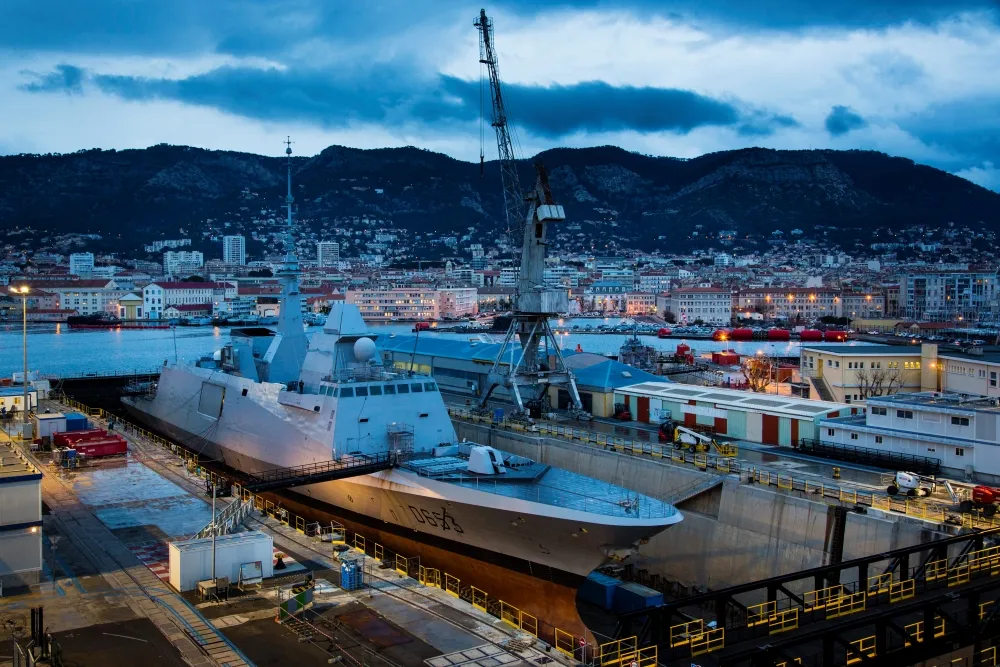
The defense and intervention frigate program, known as FDI, supplies recurring construction and systems-integration work. On March 31, 2026, the DGA placed the order with Naval Group for France's fifth FDI, following the fourth in December 2025. Naval Group says the five French ships and four for the Hellenic Navy bring production of that series to nine. Greek and Swedish orders also extend the program's international reach.
France received its first FDI, Amiral Ronarc'h, on October 17, 2025; the ship is now conducting its long-duration deployment. Delivery of the remaining French frigates is scheduled for 2027-2032.
Their weapons include Exocet MM40 B3c anti-ship missiles, Aster 15 and Aster 30 air-defense missiles, MU90 torpedoes, and 20 mm and 76 mm guns. Each frigate can embark a helicopter and a drone simultaneously, together with a special-forces detachment and two commando boats.
Under France's 2024-2030 Military Programming Law, all five French FDIs will have their SYLVER A50 vertical-launch capacity increased from 16 to 32 cells, Admiral Nicolas Vaujour has confirmed. Ships four and five will arrive with 32 cells. The third will be upgraded immediately after entering service, with the first and second to follow.
Maintenance is another part of the design requirement. Naval Group says the French Navy's FREMM multi-mission frigates have maintained 80% availability for more than a decade. The company says shorter maintenance periods are intended to help the FDI match that performance.
Exports and equipment extend the industry's reach
French submarine business is not confined to vessels built for France or in French yards. The Netherlands' four-submarine ORKA program uses Naval Group's conventionally powered BLACKSWORD BARRACUDA design. Indonesia's two SCORPÈNE EVOLVED submarines, equipped with lithium-ion batteries, are intended to be built at PT PAL. Design work, technology transfer, equipment supply and integration allow French companies to participate even when construction takes place abroad, an activity domestic delivery tonnage does not fully capture.
Equipment suppliers reach a wider market than French-built platforms alone. Thales provides radar, sonar, electronic warfare, communications and command systems; worldwide orders for its CAPTAS sonar systems total 100 units. MBDA supplies missiles for air defense, anti-ship operations and deep strike. Navigation, optronics and protection technologies come from Safran and Lacroix, while KNDS France supplies naval weapons and artillery.
Mine warfare connects this equipment base with unmanned operations. Thales and Exail develop surface and underwater vehicles, navigation systems and robotics. The Franco-British SLAM-F program is shifting mine detection and neutralization toward remotely operated and autonomous systems so crews can remain farther from danger. Kership is also building 12 mine-countermeasures vessels for the Belgian-Dutch program, linking French shipbuilding to that transition.