Nationwide marches and wage demands
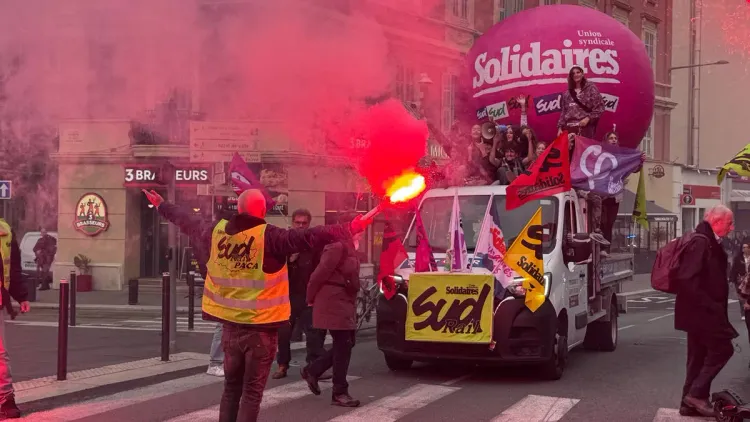
The gap between union and government turnout estimates was also pronounced in Paris: the CGT claimed 350,000 marchers, compared with the Interior Ministry's roughly 65,000. Socialist Worker reported demonstrations in at least 70 towns and cities, with about 50,000 people marching in Lyon and large numbers of dockworkers taking part in Le Havre. Other protests took place in Marseille, Toulouse, Bordeaux and Grenoble.
Public-sector participation varied. According to figures reported by RFI, nearly 10 percent of central government employees struck, as did 4.6 percent of local government workers and 3.93 percent of public hospital staff. The Education Ministry had said around 17 percent of primary school teachers would strike.
The unions' demands included higher minimum pay. The CGT sought an immediate 10 percent minimum-wage increase, while the CFDT called for an additional 100 euros a month, or about 7 percent.
Guillaume, a striking rail worker interviewed by Socialist Worker, described strong participation among train drivers. He said pay had failed to keep pace with inflation and energy prices had doubled over 15 years. "There is a lot of money for shareholders and nothing for salaries," he said.
Fuel costs were also the subject of government action. On November 1, authorities began releasing 10 million barrels of diesel from strategic reserves to ease prices during a global supply shock. Economy Minister Roland Lescure said on November 4 that diesel prices had fallen by an average of 15 cents per liter, with reductions of 20 cents per liter at more than 3,000 of France's roughly 10,000 stations.
School blockades and the police response
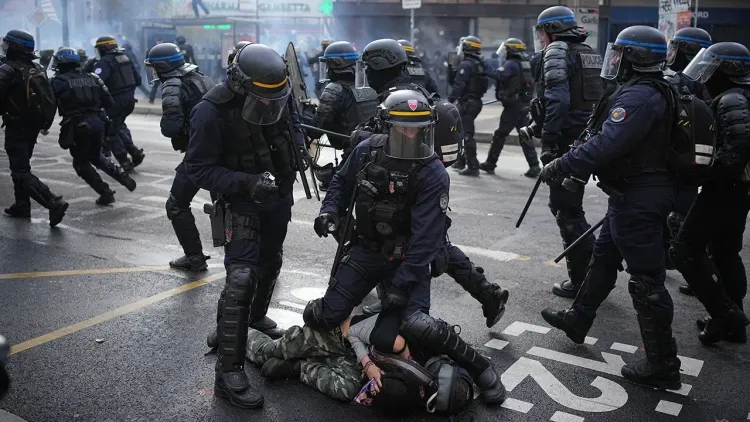
Teenage students started the movement, according to Socialist Worker, and school blockades were among the first actions on Thursday. At the Hélène Boucher secondary school in central Paris, the newspaper reported that police cleared barricades, surrounded students and checked their bags, knocking some students to the ground while forcing them to move.
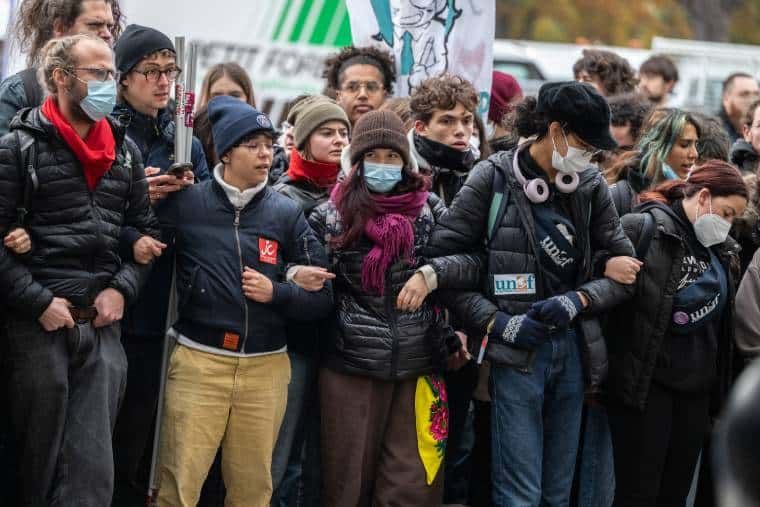
Students regrouped later that morning on the Rue de Rivoli, where they blocked the road with plastic wheeled trash bins and confronted riot police. Nationwide, Interior Minister Laurent Nuñez said more than 70,000 police officers and gendarmes were deployed. Police used drones, helicopters, armored vehicles and water cannons.
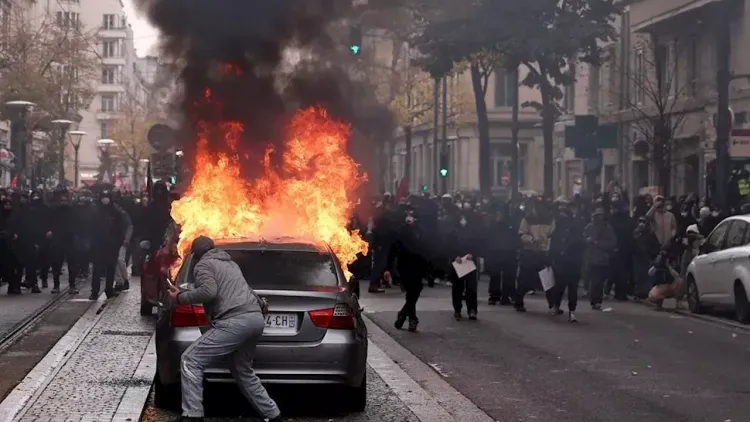
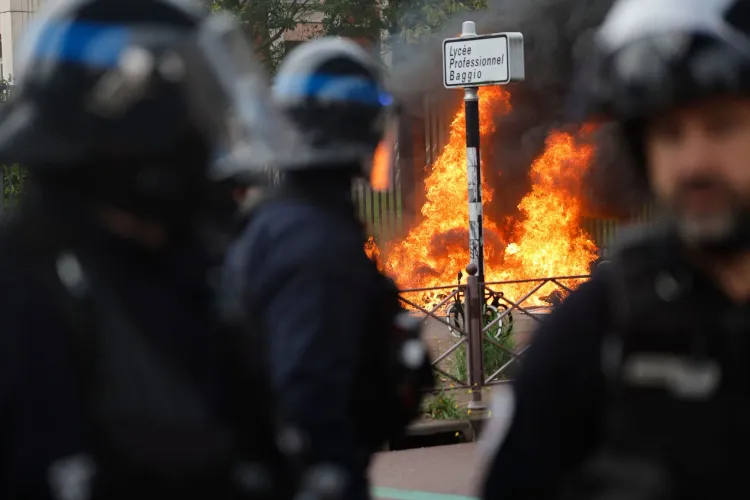
The Interior Ministry reported 448 detentions across France and said firefighters responded to 86 fires.
Student groups were seeking more than $10 billion in additional education funding, $1.5 billion for school infrastructure and 250,000 more university places. They dismissed as insufficient the government's October 26 package, which included €4 billion in preferential-rate loans for school renovations and 15,000 additional university places for 2027–2028.
At Paul Éluard school, one of the first to be blockaded, staff have been striking since September 24 to demand more resources and oppose police violence. They vote each day on whether to continue. Monica, a student there, told Socialist Worker that students had participated "since day one" and pointed to what she described as 10 years of Macron.
Students and workers converge in Paris
A group from Saint-Denis marched through Gare du Nord station before heading toward the main Paris demonstration. Rail and hospital workers, together with students and staff from Paul Éluard, led the group. Socialist Worker reported that police briefly blocked their arrival before allowing them through.
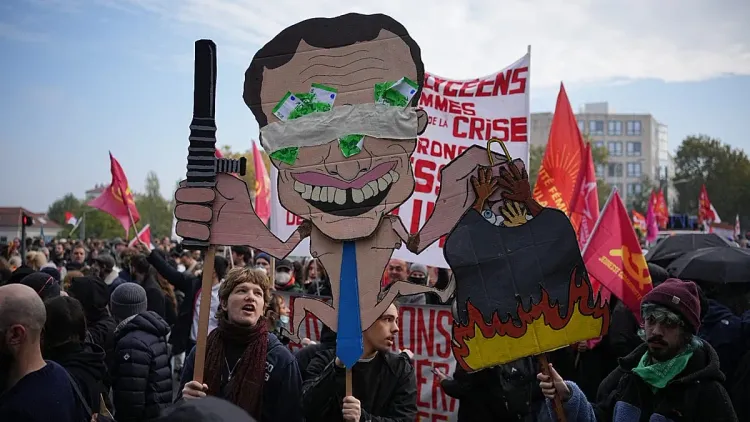
The Paris procession combined large union contingents and sound systems with art students' floats. One float depicted an enormous papier-mâché Macron above a burning school. Lawyers wearing black robes marched behind a banner reading "Colère noire", expressing anger at the repression of young people. Palestinian flags were prominent, and marchers repeatedly took up anti-fascist chants.
Arnaud, a striking firefighter, told Socialist Worker that inadequate recognition of workers and deteriorating conditions in the fire service would ultimately hurt the public. He also linked his participation to concern for his children's future and solidarity with retirees.
The alliance prompted debate over whose demands should lead. Some participants argued that students' concerns needed greater prominence and warned against workers taking over the movement with workplace issues. Many workers, however, saw their grievances as shared with those of the schools. Sam, an NGO worker, argued that protecting students meant joining them through workers' own strikes rather than treating them only as people in need of help.
How workplaces organized
At the natural history museum, workers set up a morning picket after a general assembly of 150 people voted for it. Kaïna, a striking museum employee, told Socialist Worker that the picket allowed colleagues to meet and made their work visible to visitors who often did not realize how many people the museum employed.
Marie, a CGT representative at the museum, said the dispute had lasted six months, with strikes closing the library every Saturday. Conversations during the action had broadened an initial pay dispute to include work arrangements and management practices. Thursday brought the museum staff together with students, university employees and workers from other museums.
Marie also said marching with colleagues could help people who were nervous about attending alone. At Voltaire school, staff who struck that week began with an early picket, met at a nearby cafe and then joined students at the main demonstration.
Other workers described the difficulties of building participation. A consulting-firm employee said attempts to persuade colleagues to strike had not yet succeeded. Sam described low pay and heavy workloads at her NGO, where the organization's good cause was used to justify the pressure. Union members there held weekly general assemblies and went door to door to discuss the strike.
Budget battle and further action
The strike followed the National Assembly's cross-party rejection of the revenue portion of the 2027 budget bill on November 4. The government's original proposal then went to the Senate, where a vote is scheduled for December 9.
CGT leader Sophie Binet promised to take the movement "to the next level". Socialist Worker argued that defeating Macron's budget would require workplace-level organizing beyond the limits set by union leaders and a wider spread of strike action.
The Yellow Vest movement, which joined Thursday's mobilization, called for strikes and blockades to continue on Friday, November 6, followed by demonstrations on Saturday during its fourth weekend of action.
Separately, unions and rights groups from France, the United Kingdom, Belgium, Spain, Italy, Portugal and Greece met in Paris and called for coordinated cost-of-living demonstrations beginning Friday, November 20.