Romania deployment and Army expansion
Gen. Jacques de Montgros, the French Army chief of staff, confirmed the deployment during an October 14 parliamentary hearing. He said another drone-combat unit would travel to Poland for an exercise in November. The Army aims to have around 15 such units by summer 2027, with further formations planned by the end of that year.
The expansion moves drones beyond their traditional reconnaissance role. An initial program calls for dedicated drone-combat squadrons in five additional regiments. Gen. Bruno Baratz, who heads France's Future Combat Command, said the resulting six units are expected to be operational in 2027.
The 6th Armored Brigade is also creating a unit outside that allocation. Its commander, Gen. Maxime do Tran, said the brigade chose to fund a third drone-combat unit with its own resources rather than wait for the Army's five additional squadrons. One of the brigade's infantry regiments already has a drone-combat unit deployed in Romania.
Assignments will depend on the regiment receiving the drones: reconnaissance and intelligence for light cavalry, greater emphasis on lethal firepower for infantry, and protection of armored columns for units attached to Leclerc tank regiments.
The NATO mission in Romania
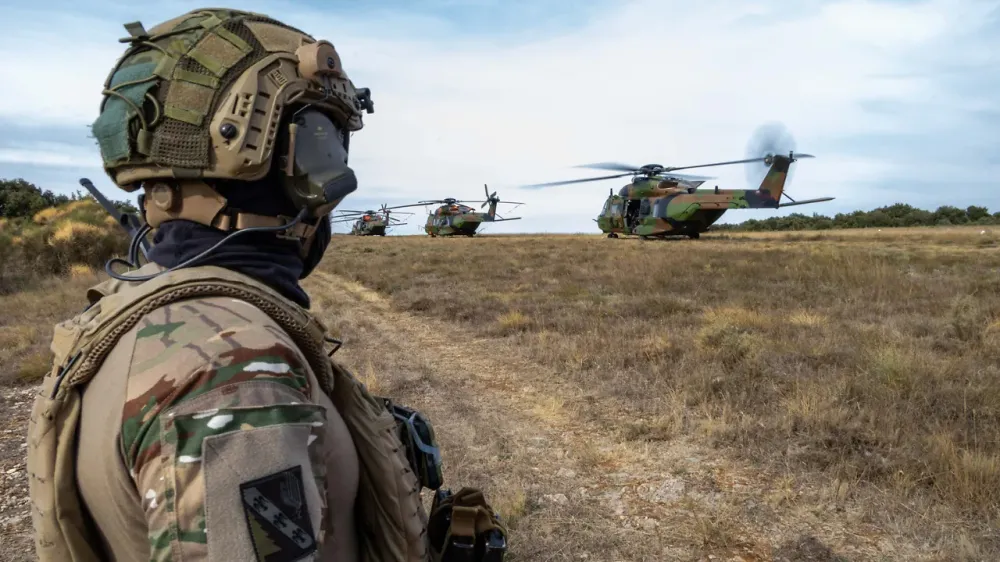
Mission Aigle began on February 28, 2022, with the deployment of a French spearhead battalion from the NATO Response Force. France took the lead-nation role in the multinational battlegroup, which was based at a newly built facility in Cincu. The force expanded to brigade level in 2025; plans call for division-level strength and more than 15,000 troops at Cincu by 2027/2028.
According to the French Ministry of the Armed Forces, the multinational force in Romania had more than 1,500 soldiers as of November 2025, drawn from France, Belgium, the Netherlands, Luxembourg and Spain. It included about 100 personnel serving with a French MAMBA medium-range surface-to-air defense detachment at Capu Midia.
An experimental squadron's development
The 1er RIMa's experimental all-drone squadron began as an idea in the regiment's training and operations office in late 2023. An early test came during NATO's Exercise Hedgehog in Estonia in May 2025.
At that exercise, the regiment's drone pilots represented about 5% of a French combined-arms tactical group's active strength but were credited with roughly 20% of the attrition it inflicted in one day of combat. That assessment came from 1er RIMa operations chief Maj. Sylvain, according to Defense News. The opposing unit was the U.S. 5th Squadron, 7th Cavalry Regiment, equipped with M2A4 Bradley Fighting Vehicles.
The squadron received official status within two months of Hedgehog, and French Army staff declared it "fully operational" in early April 2026. During Exercise Orion 2026, it reportedly carried out simulated strikes on four regimental command posts as well as logistics convoys, air-defense systems and counter-drone units.
Its June 2026 combat-preparation exercise at Mailly-le-Camp produced the highest score among roughly 30 French Army units assessed at the training center over a 12-month period. Lt. Col. Guillaume, head of training at the 1st Light Infantry Battalion that staffs the center, provided that assessment.
How the squadron fights and resupplies
Although the 1er RIMa squadron retains parts of an armored reconnaissance unit's organization, drones provide its main combat capability. Its mix includes surveillance aircraft, first-person-view (FPV) one-way attack drones and loitering munitions.
About 100 of its approximately 120 personnel are drone pilots. They serve across two FPV platoons, an intelligence, surveillance and reconnaissance (ISR) element, and a platoon for longer-range loitering munitions, supported by a command and logistics platoon.
The squadron is intended to locate enemy positions and strike them while remaining mobile and difficult to detect. Commanders have highlighted how quickly FPV aircraft can cover battlefield gaps and attack along an enemy's main routes of movement. Surveillance drones can locate tactical headquarters several kilometers behind the front, providing targets for artillery or FPV operators. Attacking those headquarters and delaying troops and supplies is intended to disrupt an opponent's decisions as well as its equipment.
An FPV pilot works with a driver and vehicle commander, sometimes joined by a fourth crew member using a Parrot drone or another ISR system to designate targets. The crews also carry conventional weapons: Heckler & Koch rifles, a heavy machine gun and an AT4 shoulder-fired antitank weapon.
The drone-heavy force has different supply needs from conventional units. Its supply vehicles carry drones rather than ammunition, and it requires battlefield power generation to recharge batteries. Cpl. Igor, an FPV pilot, said a day of exercises and simulated strikes could see him use 10 or 20 drones.
Exercises expose limits as well as strengths
The strong training results have not led the Army to treat drones as substitutes for conventional weapons or ground troops. Bad weather, electronic jamming and counter-drone systems can all hinder their use.
At Mailly-le-Camp in June, electronic warfare interrupted drone operations several times, giving the opposing force opportunities to bring in armored vehicles and briefly recover the initiative. The French unit adapted by concealing movement, using camouflage and taking other steps to make troops less visible. Its opponents spread out their personnel and moved vehicles farther from exposed positions to reduce their vulnerability.
French officers said drone formations must be prepared to face enemies with their own unmanned systems and electronic warfare equipment. Commanders also insist that operators retain conventional combat skills. Infantry units, for example, must remain able to use mortars and antitank weapons when drones cannot operate effectively.
Army exercises have also shown that an early advantage from drones does not guarantee a position can be held. A larger opposing force can still break through if defenders lack sufficient troops and conventional weapons.
Work on accuracy, range and autonomy
Hit rates remain a concern. According to 1er RIMa Staff Sgt. Tristan, a novice FPV pilot may hit a target 5% to 10% of the time, compared with about 30% for an experienced pilot. He put the probability of landing a shot with the AMX 10 RC's cannon at more than 90%. The regiment hopes autonomous terminal guidance can bring drone hit rates to around 80% to 90%.
Communications are the main practical constraint on the squadron's doctrinal goal of FPV strikes at distances of up to 10 kilometers, according to Maj. Sylvain. He said its ISR platoon, which operates several models from French supplier Parrot, is beginning to reach the doctrine's surveillance ranges of up to 20 kilometers.
The regiment is working with Alta Ares, Icarus Swarms and Naval Group on AI-enabled detection, autonomous navigation, computer-assisted piloting and drone-launch systems. One concept still in development would use a larger "mother" drone to direct smaller drones released from a canister. The intended arrangement would let an operator assign a mission, then leave the system to identify and engage designated targets with limited additional intervention.