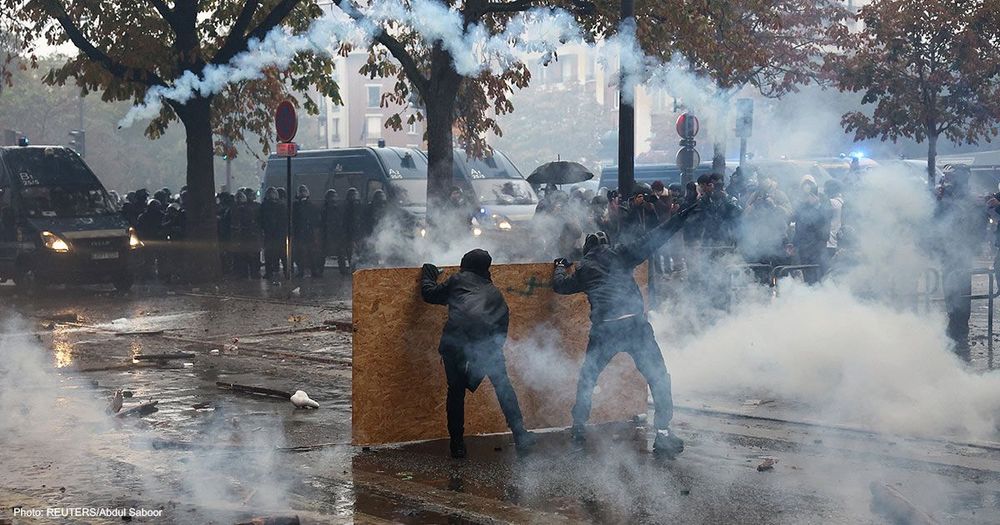
Mass rallies and damage in France
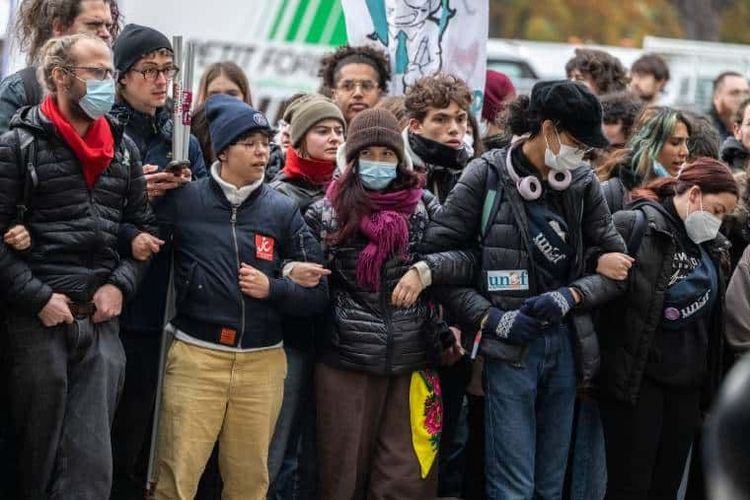
More than 400,000 people demonstrated across France on Saturday, October 24, 2026. The Interior Ministry counted 410,000 participants nationwide, including 110,000 in Paris. The CGT union's estimates were substantially higher: nearly 800,000 across the country and 250,000 in the capital.
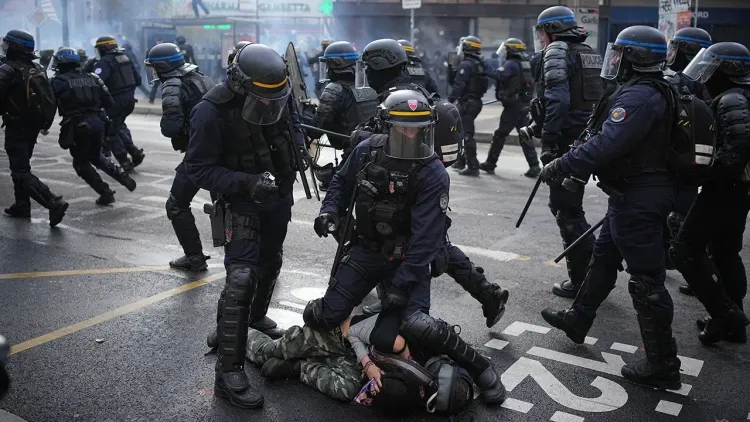
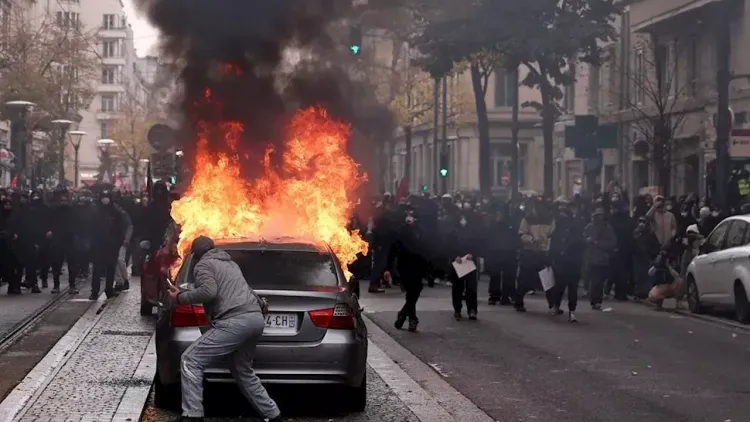
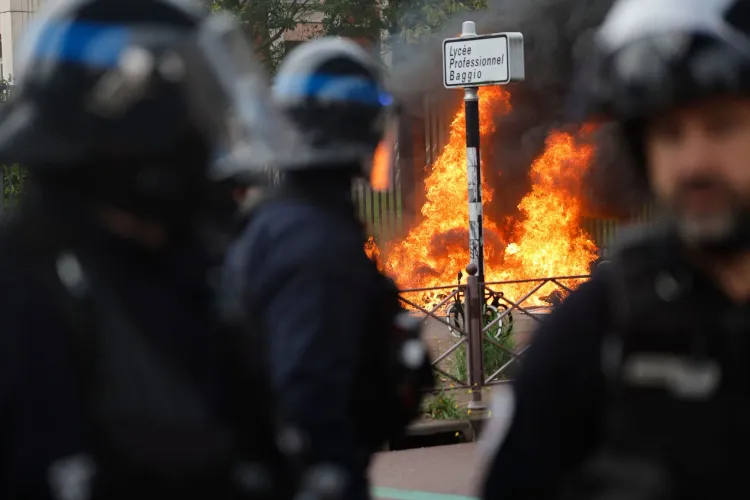
In an October 26 analysis for The Washington Stand, Suzanne Bowdey cited reports of more than 1,300 arrests in France. On Saturday alone, authorities responded to more than 75 fires and at least two dozen store break-ins and robberies.
Paris had begun preparing for renewed violence by Friday. Soldiers guarded the Arc de Triomphe as businesses covered their windows and doors with boards. A contractor interviewed by The Associated Press described urgent requests from merchants seeking to protect their premises.
Bowdey also reported that unrest briefly surrounded the Colosseum in Rome on Saturday, while Greece, Albania, Italy, Belgium and Spain were trying to contain pro-Palestinian agitators.
Student demands and the government's response
Access to higher education is a central demand of the student groups organizing the French protests. They want 250,000 additional places and an end to selection through Parcoursup, the national online university admissions platform.
Their joint 10-point proposal also seeks more teachers, repairs to schools and universities, a monthly increase of 200 euros ($224) in student grants, and a freeze on rents in public student housing.
On Monday, October 26, the government pledged to replace Parcoursup in 2028. The announcement was intended to calm student anger after weeks of protests over education and everyday expenses, The Associated Press reported.
Inflation figures illustrate the pressure on household budgets. France's national statistics agency, INSEE, reported that energy prices in September 2026 were 21.3% above their level a year earlier, helping push overall inflation to 3.1%.
Arguments over the movement's direction
Nora Bussigny of The Free Press argues that genuine grievances about French education have been taken over by factions opposed to the republic. Having spent more than a year undercover in France's anti-Israel movement, she describes an alliance between radical leftists and political Islamists based on hostility to Western institutions and values. She views the French unrest as part of a broader phenomenon.
Other commentators cited by Bowdey make related arguments. National Review's John Sullivan describes an "ultra-progressive ideology of extreme egalitarianism, anti-capitalism, and cultural hostility to France." He rejects any justification for the violence. Rich Lowry compares the Palestinian flag's role as a symbol of resistance to the West with that of the North Vietnamese flag in the 1970s.
Political leaders have also framed the unrest around immigration and integration. President Trump said he had warned President Emmanuel Macron that France's open-borders policy was destroying the country. Vice President J.D. Vance argued on X that Western liberals had neglected questions of assimilation and compatibility. Nice Mayor Éric Ciotti said that Islamo-leftism threatened the republic.
Debt, spending and borrowing costs
David Bahnsen, founder and chief investment officer of The Bahnsen Group, sees a deeper economic problem behind the unrest. Speaking with Family Research Council President Tony Perkins on "This Week on Capitol Hill," he said many French citizens feel they receive less despite extensive social spending, yet oppose cuts. He also argued that spending on government programs crowds out private investment and future growth.
Government spending in France amounts to about 57% of GDP, a share exceeded only by Finland among OECD countries, according to Al Jazeera. Public pensions account for about 14% of GDP, and that proportion is expected to increase as the working-age population shrinks.
Fortune reported that public debt had reached a record $4 trillion by late October, equivalent to 119% of GDP. The debt ratio was the highest since the immediate aftermath of World War II, while bond yields had reached a 24-year high.
Al Jazeera reported that, by mid-October, France's 10-year bond yield had climbed more than 130 basis points since June to above 4.9%. Borrowing costs were at their highest since 2002.
Moody's retained France's Aa3 credit rating with a negative outlook in late October, warning that political divisions and social unrest could obstruct efforts to reduce the deficit. Its forecast put the 2027 deficit at about 5.2% of GDP despite planned reductions, with debt rising to roughly 122% of GDP next year.
Bahnsen cautioned against equating France's situation with that of the United States. He said the United States remained far from embracing socialism as a national model, while warning that movement in that direction could happen incrementally.
Macron faces an approaching election
The protests are challenging Macron's authority as his presidency enters its final months. Voters are due to elect his successor in May 2027.
The leading contenders, Marine Le Pen of the far-right National Rally and far-left candidate Jean-Luc Mélenchon, have both sought to turn the protests into political support.